Whisky
The "Water of Life" is defined by a linguistic divide between two regional spellings.
The "Water of Life" is defined by a linguistic divide between two regional spellings.
The term "whisky" is an anglicization of the Gaelic uisce beatha, literally meaning "water of life." This mirrors the Latin aqua vitae, reflecting the spirit's origins as a medicinal tonic. Over centuries, a geographic spelling split emerged: Ireland and the United States favor "whiskey" (with an 'e'), while Scotland, Canada, Japan, and the rest of the world use "whisky."
While some argue the spelling should reflect the spirit’s origin, it is largely a matter of regional convention. In the U.S., the "whiskey" spelling became the standard in the mid-20th century, yet federal regulations and several iconic brands like Maker’s Mark and George Dickel continue to use "whisky" on their labels to honor tradition or specific heritage.
Distillation evolved from a medieval medical miracle into a global commodity shaped by tax evasion.
Distillation evolved from a medieval medical miracle into a global commodity shaped by tax evasion.
Distillation technology traveled from the ancient Greeks and medieval Arabs to European monasteries by the 12th century. Initially, alcohol was a pharmaceutical tool used by monks and "barber-surgeons" to treat ailments like colic and smallpox. It wasn't until the 15th century in Scotland and Ireland that the practice moved into the secular world for recreational consumption.
The modern character of Scotch was forged by conflict with the taxman. Following the 1707 Acts of Union, heavy taxes forced Scottish distillers underground. They operated "moonlight" stills at night to hide smoke from government agents, hiding spirits in altars and coffins. This era of illicit production fostered a culture of ingenuity and resilience that eventually led to the legalization and global expansion of the industry in the 1820s.
Turning grain into spirit requires a precise sequence of biological and chemical transformations.
Turning grain into spirit requires a precise sequence of biological and chemical transformations.
Whisky begins as a simple grain mash—barley, corn, rye, or wheat—that must be "tricked" into releasing its sugars. During malting, grains are soaked to begin germination, then suddenly dried (kilned) to stop the process. In Scotland, burning peat during kilning imparts the distinct smoky flavor associated with many Islay malts.
The chemistry continues in the still. Copper is the essential element here; it reacts with the spirit to strip away harsh sulfur-based compounds that would otherwise make the liquid unpleasant to drink. While pot stills produce a heavy, flavorful spirit in batches, the 19th-century invention of the Coffey (column) still allowed for continuous, high-efficiency production, enabling the creation of lighter, blended whiskies.
The cask acts as a chemical laboratory where flavor is extracted, not just stored.
The cask acts as a chemical laboratory where flavor is extracted, not just stored.
Unlike wine, whisky does not mature in the bottle. Its "age" refers strictly to the time spent interacting with wooden casks—typically charred white oak. This interaction is a complex dialogue of extraction and oxidation: the spirit pulls vanillin and wood sugars from the oak while the porous wood allows the spirit to breathe, concentrating flavors as a small portion (the "angel's share") evaporates.
The history of the cask itself often dictates the flavor. While American bourbon requires brand-new charred oak, many other styles use "seasoned" casks that previously held sherry, port, or rum to impart fruitier, more complex notes. However, aging has a limit; after two or three decades, excessive interaction with wood can overwhelm the spirit, proving that older is not always better.

Image from Wikipedia

Old Bushmills Distillery, County Antrim

A man pours some whisky into a flask in this 1869 oil painting by Scottish artist Erskine Nicol.
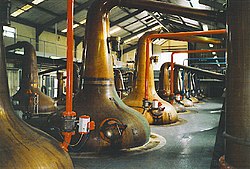
The production of whisky from barley to bottle (top), swan necked copper stills in the Glenfiddich distillery (bottom)

Copper pot stills at Auchentoshan Distillery in Scotland
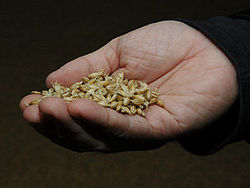
Malted barley is an ingredient of some whiskies.
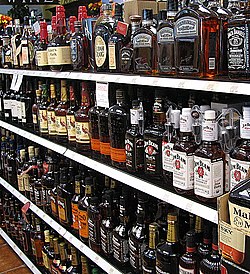
Various American whiskeys on store shelves

Various Canadian whiskies
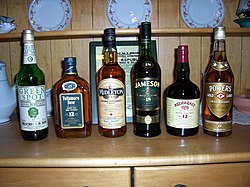
Various Irish whiskeys
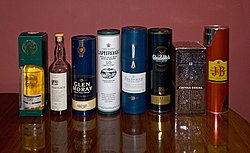
Various Scotch whiskies

The regions of Scotch whisky

A charred oak barrel used to age whiskey