Vienna Secession
The Secession was a moral rebellion against the commercial "peddlers" of traditional art.
The Secession was a moral rebellion against the commercial "peddlers" of traditional art.
In 1897, a group of forty artists—including Gustav Klimt, Josef Hoffmann, and Otto Wagner—staged a dramatic exit from the Association of Austrian Artists. Their protest wasn't merely about aesthetics; it was a spiritual confrontation. Led by Klimt, the group sought to dismantle the "historicism" of the official Vienna Academy, which they viewed as a stagnant, commercialized system that stifled genuine creativity.
The movement took its name from the Munich Secession and adopted the motto Ver Sacrum (Sacred Spring). Their goal was to create a new, internationalist artistic language that rejected nationalism and established a direct dialogue with the French Impressionists and other avant-garde movements across Europe. They prioritized the "spiritual state" of the artist over the market demands of the salon.
They pioneered the "Total Art" concept, dissolving the boundaries between architecture, furniture, and painting.
They pioneered the "Total Art" concept, dissolving the boundaries between architecture, furniture, and painting.
Central to the Secessionist mission was the Gesamtkunstwerk, or "total work of art." They believed that no object was too small for artistic consideration. This philosophy led architects like Otto Wagner and Josef Hoffmann to design every element of a space—from the structural steel and reinforced concrete down to the lamps, wallpaper, and even bathroom towels—to ensure a unified aesthetic experience.
This obsession with unity is best seen in the transition from the floral, curving lines of early Art Nouveau toward the geometric rigor of modernism. Wagner’s Austrian Postal Savings Bank and Hoffmann’s Stoclet Palace utilized industrial materials like aluminum and glass, proving that functional, mass-produced items could possess the same soul and dignity as a fine-art painting.
The Secession Building functioned as a three-dimensional manifesto for the modern era.
The Secession Building functioned as a three-dimensional manifesto for the modern era.
To showcase their radical ideas, the group commissioned Joseph Maria Olbrich to design a dedicated exhibition hall. Completed in 1898, the building became a "temple" for contemporary art, topped with a distinctive golden dome of laurel leaves. It was the first gallery in Vienna dedicated exclusively to modern works, serving as a neutral, flexible "white cube" long before that concept became a global standard for museums.
One of its most famous installations was the 14th exhibition in 1902, dedicated to Ludwig van Beethoven. It featured Max Klinger’s statue of the composer surrounded by Gustav Klimt’s Beethoven Frieze. The exhibition was a landmark event that synchronized music, sculpture, and painting into a singular, immersive environment, cementing the building's status as the epicenter of the Viennese avant-garde.
Internal disputes over the "utility" of art eventually fractured the group at its peak.
Internal disputes over the "utility" of art eventually fractured the group at its peak.
Despite its success, the Secession was not a monolith. By 1905, a deep rift emerged between the "Stylists" (including Klimt, Hoffmann, and Wagner) and the "Realists." The Stylists argued that decorative and applied arts—like those produced by the Wiener Werkstätte—were equal in status to "fine" arts like painting. The Realists disagreed, favoring a more traditional hierarchy.
The tension came to a head over a proposal to purchase a commercial gallery (Galerie Miethke) to sell their work. The motion was defeated by a single vote. Following this loss, the most prominent members, including Klimt and Hoffmann, resigned from the group they had founded. While the Secession continued to exist and hold exhibitions, it lost the explosive originality and cultural dominance that characterized its first decade.
Its legacy redefined the visual language of Central Europe and survived Nazi suppression.
Its legacy redefined the visual language of Central Europe and survived Nazi suppression.
The influence of the movement was so profound that in many Central European languages—such as Hungarian, Czech, and Polish—the word for "Art Nouveau" is simply Secession (e.g., szecesszió or secesja). It paved the way for the Deutscher Werkbund and later the Bauhaus, shifting the world's eye toward the clean lines and geometric functionalism that define modern design.
The movement’s physical heritage faced a dark period under the Nazi regime, which branded Secessionist work as "degenerate art" and destroyed the original Secession building. However, the hall was faithfully reconstructed after World War II. Today, the Vienna Secession remains a rare example of a 19th-century avant-garde institution that still functions in its original spirit, managed independently by working artists.
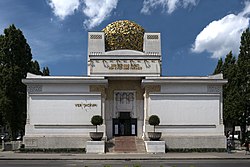
Image from Wikipedia

Vampire in Ver Sacrum #12 (1899) p. 8 by Ernst Stöhr

Section of the Beethoven Frieze by Gustav Klimt in the Secession Building (1902)

Poster for the 14th Secession Exhibit (1902), by Alfred Roller

Dance by Koloman Moser (1902), inspired by dancer Loïe Fuller

Illustration to The Goose Girl by Maximilian Liebenwein, published in Ver Sacrum in 1902

Advertising poster of Grado by Josef Maria Auchentaller (1906)

Woman in a Yellow Dress by Max Kurzweil (1899)

The Kiss by Gustav Klimt (1907–08)

Secession Building by Joseph Maria Olbrich (1897–98)

Floral design by Alois Ludwig on the facade of one of the Linke Wienzeile Buildings by Otto Wagner (1898)

A medallion by Koloman Moser and sculptures by Othmar Schimkowitz at Linke Wienzeile 38 (1898)

Church of St. Leopold by Otto Wagner (1902–1907)

Austrian Postal Savings Bank by Otto Wagner (1904-1912)

Stoclet Palace by Josef Hoffmann in Brussels (1905–1911)