Vanilla
Vanilla is an evolutionary outlier that requires human intervention to fruit at scale.
Vanilla is an evolutionary outlier that requires human intervention to fruit at scale.
As an orchid vine, vanilla is not autogamous—it cannot pollinate itself. In the wild, it relies on specific orchid bees native to Mesoamerica. Because its male and female organs are separated by a physical membrane, the plant remained a regional curiosity for centuries; when transplanted to Europe or Asia, the vines grew but never produced pods.
Today, nearly every commercial vanilla bean on Earth is the product of manual labor. Farmers must visit each flower during its narrow 24-hour blooming window to perform "hand-pollination." Using a small sliver of wood or bamboo, they lift the membrane and press the pollen onto the stigma. This labor-intensive requirement is why vanilla remains the world’s second-most expensive spice, trailing only saffron.
A 12-year-old’s discovery on a remote island broke the Mexican monopoly.
A 12-year-old’s discovery on a remote island broke the Mexican monopoly.
For centuries, Mexico was the sole producer of vanilla because it was the only place where the plant's natural pollinators lived. While European botanists struggled to find a mechanical solution, the breakthrough came in 1841 from Edmond Albius, a 12-year-old enslaved child on the French island of Réunion.
Albius developed a simple, efficient thumb-press technique that allowed for rapid pollination. His method was so effective it was immediately adopted across the Indian Ocean, enabling Madagascar and Réunion to become global production leaders. Despite his contribution saving the industry, Albius’s discovery was initially contested by French botanists who falsely claimed credit for the technique.
The global supply is bottlenecked by geography and weather.
The global supply is bottlenecked by geography and weather.
The vast majority of the world's vanilla is the V. planifolia species, primarily "Bourbon vanilla" grown in Madagascar and Indonesia. This geographic concentration makes the global market extremely volatile. Because vanilla takes years to reach maturity and requires a specific tropical "terroir," supply cannot be quickly adjusted to meet demand.
A single tropical cyclone in the Indian Ocean can—and often does—decimate the global supply, causing prices to skyrocket. For example, prices spiked to $500/kg in 2004 and again in 2017 following major storms. This instability creates a "boom and bust" cycle that frequently drives commercial food producers toward cheaper, synthetic alternatives.
Most "vanilla" consumed today is a chemical mimic derived from wood or oil.
Most "vanilla" consumed today is a chemical mimic derived from wood or oil.
Because real vanilla is so expensive and difficult to produce, an estimated 95% of vanilla-flavored products are flavored with synthetic vanillin. While natural vanilla extract is a complex cocktail of several hundred different organic compounds, the "signature" note is vanillin, which can be chemically synthesized at a fraction of the cost.
Historically, this synthetic vanillin was derived from the glycosides of pine tree sap or lignin (a byproduct of the paper industry). Today, most food-grade synthetic vanillin is produced from guaiacol, a petrochemical. While this serves the mass market, it lacks the "diamond-dusted" complexity of cured pods, which develop crystallized phenolic compounds known as givre (hoarfrost) as they dry.
Ancient Mesoamericans used vanilla to "tame" the bitterness of chocolate.
Ancient Mesoamericans used vanilla to "tame" the bitterness of chocolate.
Long before it was a staple of French ice cream, vanilla was domesticated by the Totonac people of eastern Mexico. By the 15th century, the Aztecs had conquered the Totonacs and developed a taste for the pods, which they called tlilxochitl (black pods).
The Aztecs used vanilla primarily as a modifier for xocolatl, a bitter cacao drink. Because sugarcane was not yet available in the region, vanilla served as the primary aromatic to balance the intensity of the cocoa. It wasn't until the early 17th century in the court of Queen Elizabeth I that vanilla was finally used as a standalone flavor, separated from its ancient partnership with chocolate.

Vanilla planifolia, flower

Dried vanilla beans

Drawing of the Vanilla plant from the Florentine Codex (c. 1580) and description of its use and properties written in the Nahuatl language

Vanilla cultivation, Réunion

Vanilla extract displays its distinctive color.

V. planifolia – flower

A bottle of vanilla extract

Chemical structure of vanillin

Vanilla × tahitensis in cultivation
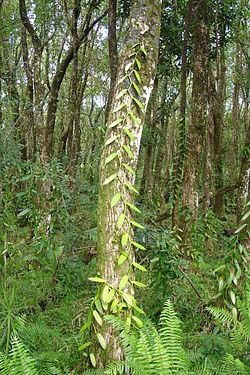
A vanilla plantation in a forest of Réunion Island

Grading vanilla beans at Sambava, Madagascar

vanilla-grading in Madagascar

A vanilla powder preparation made from sucrose and vanilla bean extracts

Vanilla rum, Madagascar

Illustration of allergic contact dermatitis