Tulsa race massacre
The Greenwood District was a thriving economic enclave built in the shadow of institutionalized segregation.
The Greenwood District was a thriving economic enclave built in the shadow of institutionalized segregation.
Greenwood was established in 1906 as a self-sufficient community where Black Americans could prosper despite Oklahoma’s harsh Jim Crow laws. By 1921, it was colloquially known as "Black Wall Street," featuring a dense concentration of affluent professionals, luxury hotels, theaters, and two newspapers. This prosperity existed in a state that had aggressively disenfranchised non-white voters and enforced strict residential segregation.
The social atmosphere was a powder keg of post-WWI tensions. Black veterans returned from Europe demanding the full citizenship they had fought for, while white residents faced an economic slump and rising unemployment. The Ku Klux Klan was resurgent, and lynchings were a frequent tool used to maintain white supremacy in the newly formed state.
A mundane elevator encounter was transformed into a catalyst for violence by sensationalist journalism.
A mundane elevator encounter was transformed into a catalyst for violence by sensationalist journalism.
On May 30, 1921, 19-year-old Dick Rowland, a Black shoeshiner, entered an elevator to use the only "colored" restroom in downtown Tulsa. A clerk heard a scream and saw Rowland run; though it is widely believed Rowland simply tripped and grabbed the arm of the white operator, Sarah Page, rumors of sexual assault spread instantly. While Page declined to press charges and the police investigation was low-key, the Tulsa Tribune published a sensationalist headline: "Nab Negro for Attacking Girl in an Elevator."
The newspaper report—and a rumored editorial calling for a lynching—ignited a mob. By evening, hundreds of white residents gathered at the courthouse where Rowland was being held. Sheriff Willard McCullough, determined to prevent a lynching, barricaded his deputies on the top floor with orders to shoot anyone who tried to take the prisoner.
The violence began as a stand against lynching and escalated into a state-sanctioned campaign of destruction.
The violence began as a stand against lynching and escalated into a state-sanctioned campaign of destruction.
Fearing a repeat of previous lynchings, a group of approximately 75 armed Black men, many of them WWI veterans, arrived at the courthouse to support the sheriff. A confrontation ensued when an elderly white man tried to disarm a Black veteran. A shot was fired, sparking a "rolling gunfight" that forced the outnumbered Black defenders to retreat toward Greenwood.
Throughout the night and into June 1, white mobs—some of whom were officially deputized and armed by city officials—invaded the Greenwood District. The attackers systematically looted and burned homes and businesses. The carnage only ended when the Oklahoma National Guard imposed martial law at noon, by which time 35 square blocks of the wealthiest Black community in the U.S. had been reduced to ash.
The systematic destruction of 35 square blocks erased decades of generational wealth and thousands of homes.
The systematic destruction of 35 square blocks erased decades of generational wealth and thousands of homes.
The immediate human cost was staggering: as many as 300 people died, 800 were hospitalized, and 6,000 Black residents were interned in camps for several days. Roughly 10,000 people were left homeless. In 1921 dollars, the property damage exceeded $1.5 million in real estate and $750,000 in personal property—equivalent to nearly $40 million today.
Recovery was hampered by institutional resistance. City officials and insurance companies refused to compensate the victims for their losses. While many residents courageously rebuilt their homes by the end of 1922, the lack of capital and the psychological trauma forced many others to leave Tulsa permanently, effectively ending the era of "Black Wall Street."
Decades of institutional silence were finally broken by a modern effort to document the truth and provide reparations.
Decades of institutional silence were finally broken by a modern effort to document the truth and provide reparations.
For over 75 years, the massacre was largely omitted from local and national history books, and even within Tulsa, the event was rarely discussed in public. It wasn't until 1997 that the state legislature authorized a formal commission to study the event. Their 2001 report confirmed the city's complicity in the violence and recommended reparations for survivors and their descendants.
While the state has yet to provide direct financial restitution, it has established scholarships for descendants and integrated the massacre into the mandatory school curriculum as of 2020. Today, the event is recognized as one of the deadliest incidents of racial violence in American history, serving as a critical case study in the destruction of Black economic progress.

Image from Wikipedia

A map of Tulsa in 1920. The Greenwood District was in northern Tulsa.

One of the news articles that contributed to tensions in Tulsa

Smoldering ruins of African American homes following the massacre

Photo postcard showing fires burning along Archer and Greenwood during the massacre

Flames across the Greenwood section of Tulsa
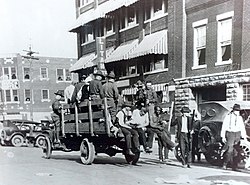
National Guard with the wounded

"Little Africa" taken from the roof of the Hotel Tulsa on 3rd St. between Boston Ave. and Cincinnati Ave. The first row of buildings is along 2nd St. The smoke cloud on the left (Cincinnati Ave. and the Frisco Tracks) is identified in the Tulsa Tribune version of this photo as being where the fire started.

Taken from the southeast corner of the roof of Booker T. Washington High School, this panorama shows much of the damage within a day or so. The road running laterally through the center is Greenwood Avenue; the road slanting from the center to the left is Easton, and the road slanting off to the right is Frankfort.

The Chicago Whip newspaper 30 July 1921 with a photo of Tulsa Police Chief John A. Gustafson

President Biden speaks at a ceremony marking the 100th anniversary of the Tulsa Massacre

Tulsa Race Massacre: Traveling Panels

A drive through the present-day Greenwood District (March 2021)