Triangular trade
Triangular trade solves the problem of "one-way" demand by linking disparate regional needs.
Triangular trade solves the problem of "one-way" demand by linking disparate regional needs.
Trade imbalances occur when Region A has goods that Region B wants, but Region B has nothing that Region A needs. To solve this, merchants look for a third region to complete a circuit. By finding a "three-way" exchange, ships rarely sail empty, maximizing profit by ensuring that the cargo from the last port is always the currency for the next.
While the Atlantic slave trade is the most famous example, this logic applied to many global routes. In the 19th century, British ships carried general cargo to Australia, swapped it for coal to sell in China, and finally loaded up on tea and silk for the return journey to London. This wasn't just about moving goods; it was about balancing the books of global commerce.
The Atlantic slave trade used human lives to fuel a self-sustaining cycle of sugar, rum, and guns.
The Atlantic slave trade used human lives to fuel a self-sustaining cycle of sugar, rum, and guns.
The "Golden Triangle" of the 16th to 19th centuries was a brutal but efficient economic engine. It began in Europe with the shipment of manufactured goods—cloth, metal tools, and notably gunpowder—to West Africa. These items were bartered for enslaved people, who were then forced across the "Middle Passage" to the Americas.
In the final leg, the labor of these enslaved people produced raw materials like sugar, molasses, cotton, and tobacco, which were shipped back to Europe. This created a horrific feedback loop: sugar was distilled into rum, which was then traded for more slaves, who were then used to grow more sugar. A 2017 study noted that just a 1% increase in gunpowder exports to Africa set in motion a five-year "gun-slave cycle" that significantly increased the volume of human trafficking.
Low-grade "refuse cod" became a secondary commodity that powered the Caribbean plantation complex.
Low-grade "refuse cod" became a secondary commodity that powered the Caribbean plantation complex.
In the 17th century, the "Sack Trade" linked Newfoundland and New England to the Mediterranean. Sailors carried salted cod to Southern Europe—where it was in high demand for Catholic fasting days—and returned to England with wine, olive oil, and silver. However, as curing processes changed, much of the fish produced was "refuse-grade," deemed too poor for European tables.
New England merchants pivoted, finding a grim new market for this low-quality protein: the Caribbean. Sugarcane planters required cheap, bulk food to sustain the enslaved populations working their fields. This transformed the fishing industry from a simple Atlantic crossing into a crucial pillar of the slave-holding economy, as "refuse cod" was traded for the molasses used to make New England rum.
Natural currents and trade winds dictated the shape of global commerce during the Age of Sail.
Natural currents and trade winds dictated the shape of global commerce during the Age of Sail.
The "triangle" wasn't just an economic choice; it was a geographic necessity. During the Age of Sail, ships were at the mercy of the Earth's atmospheric circulation. To reach the Americas from Europe, it was significantly easier to sail south of 30° N latitude to catch the "trade winds" that pushed vessels west into the Caribbean, rather than fighting the winds to go straight to North America.
Returning to Europe required a different path. Ships utilized the Gulf Stream, a powerful Atlantic current, and the "westerlies" to pull them in a northeasterly direction. These permanent environmental "conveyor belts" effectively forced trade into a clockwise loop, shaping the history of empires based on where the wind happened to blow.
The "perfect triangle" is often an economic abstraction rather than a single ship's itinerary.
The "perfect triangle" is often an economic abstraction rather than a single ship's itinerary.
Modern historians note that the classic "triangle" is a simplified model of a much messier reality. In practice, the route was rarely completed by a single ship in a single voyage. Slave ships were specialized vessels designed to carry human beings, not bulk agricultural goods. Because they were often out of sync with harvest seasons, they frequently returned to Europe with "ballast" (heavy weights to stabilize the ship) rather than full loads of sugar.
The true triangular trade was a web of specialized fleets. One group of ships moved humans from Africa to the Americas, while an entirely separate fleet of merchant vessels moved sugar and tobacco from the Americas to Europe. While the economic ties formed a triangle, the physical movement of ships was a complex network of "piecemeal operations" and overlapping interests.

The classical model of the triangular trade
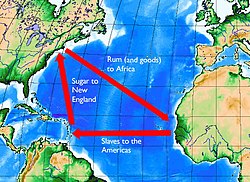
The triangular trade of slaves, sugar, and rum, with New England instead of Europe as the third corner
![The number of slaves embarked to America from 1450 until 1800 by country[citation needed]](https://upload.wikimedia.org/wikipedia/commons/thumb/d/d6/Slaves_embarked_to_America_from_1450_until_1800_by_country.jpg/330px-Slaves_embarked_to_America_from_1450_until_1800_by_country.jpg)
The number of slaves embarked to America from 1450 until 1800 by country[citation needed]
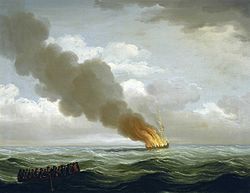
The loss of the slave ship Luxborough Galley in 1727 ("I.C. 1760"), lost in the last leg of the triangular trade, between the Caribbean and Britain.

The North Atlantic Gyre

The number of slaves imported from Africa from 1501 to 1866