Triangle Shirtwaist Factory fire
The victims were mostly teenage girls caught in a deadly bottleneck between smoke and a ten-story drop.
The victims were mostly teenage girls caught in a deadly bottleneck between smoke and a ten-story drop.
On Saturday, March 25, 1911, a fire broke out in a scrap bin on the 8th floor of the Asch Building in Manhattan. Within minutes, 146 workers were dead—123 of them women and girls, primarily Italian and Jewish immigrants aged 14 to 23. These workers, who earned roughly $7 to $12 a week (about $5 to $8 an hour today), represented the backbone of the "shirtwaist" (women's blouse) industry.
The tragedy was defined by its visibility. Because the fire occurred in the late afternoon in a busy neighborhood near Washington Square Park, a massive crowd of bystanders watched as 62 people jumped to their deaths to escape the flames. Reporter William Gunn Shepherd famously described the "thud" of bodies hitting the stone sidewalk as a "new sound" more horrible than anything he had ever experienced.
Systemic negligence, including locked exits and inadequate ladders, turned a survivable fire into a massacre.
Systemic negligence, including locked exits and inadequate ladders, turned a survivable fire into a massacre.
The high death toll was not an accident of fate but a result of deliberate management choices. To prevent unauthorized breaks and petty theft, the factory owners had locked the doors to the stairwells. When the fire spread, workers found their primary escape routes barred. The single exterior fire escape was so flimsy that it collapsed under the weight of the panicked workers, dropping them 100 feet to the concrete below.
Even the city’s emergency infrastructure was outmatched. The New York Fire Department arrived quickly, but their horse-drawn ladders could only reach the 7th floor—three floors below the trapped workers. Elevator operators Joseph Zito and Gaspar Mortillaro saved dozens by making multiple trips through the smoke until the heat warped the elevator rails, making further rescue impossible.
The factory owners prioritized theft prevention over safety and ultimately profited from the tragedy.
The factory owners prioritized theft prevention over safety and ultimately profited from the tragedy.
Owners Max Blanck and Isaac Harris, known as the "Shirtwaist Kings," had a history of suspicious fires at their properties, often occurring when inventory was high and demand was low. While arson wasn't proven in this case, the "moral hazard" of their business model was clear. Following the fire, they were acquitted of manslaughter because the prosecution could not prove the owners personally knew the doors were locked at the exact moment the fire started.
The legal aftermath added insult to injury. In a 1913 civil suit, the families of the deceased were awarded just $75 per victim. Meanwhile, the owners’ insurance company paid them $64,925 more than their reported losses—essentially a profit of about $445 per life lost. This disparity became a rallying cry for labor activists who argued that under current laws, a worker's life was worth less than a bolt of fabric.
The horror catalyzed a permanent shift in American labor law, transforming New York into a laboratory for progressive reform.
The horror catalyzed a permanent shift in American labor law, transforming New York into a laboratory for progressive reform.
The fire ended the era of "do-nothing" government regarding industrial safety. Eyewitness Frances Perkins, who later became the first female U.S. Secretary of Labor, called the fire "the day the New Deal was born." In the aftermath, the New York State Legislature created the Factory Investigating Commission, which interviewed over 200 witnesses and inspected hundreds of factories.
This commission’s work led to 38 new laws regulating fire safety, ventilation, and working hours. It also forced a political realignment: the powerful Tammany Hall machine, sensing the public's shift in mood, pivoted from protecting business interests to championing the working class. This legislative wave modernized labor standards and spurred the growth of the International Ladies' Garment Workers' Union (ILGWU), fundamentally changing the relationship between American workers and their employers.

Image from Wikipedia

A horse-drawn fire engine on the way to the burning factory

A photograph of the building's south side, which ran the day after the disaster in the March 26, 1911, issue of The New York Times. Windows marked by an X are those from which 50 women jumped.

62 people jumped or fell from windows.
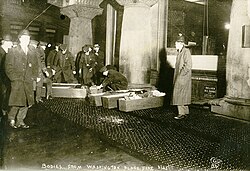
Bodies of victims being placed in coffins on the sidewalk

People and horses draped in black walk in procession in memory of the victims

A wrapped corpse being lowered by rope from the Asch Building after the Triangle fire

Max Blanck and Isaac Harris, owners of the Triangle Waist Company
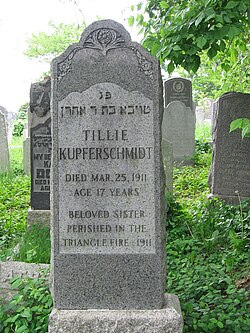
Tombstone of fire victim Tillie Kupferschmidt at the Hebrew Free Burial Association's Mount Richmond Cemetery

A 1911 cartoon referring to the Triangle fire depicts a factory owner, his coat bedecked with dollar signs, holding a door closed while workers shut inside struggle to escape amid flames and smoke.

The commemoration drew thousands of people, many holding aloft "146 Shirtwaist-Kites" conceived by artist Annie Lanzillotto and designed and fabricated by members of the Remember the Triangle Fire Coalition, with the names of the victims on sashes, as they listened to speakers.

Hilda Solis, the American Secretary of Labor, seen on an overhead screen, speaking at the Centennial Memorial. The Brown (Asch) Building is on the far right.

Triangle Shirtwaist Factory Memorial, Mount Zion Cemetery, Maspeth, Queens