Tomato
The tomato is a biological opportunist that uses microscopic hairs to clone itself and self-fertilizing flowers to conquer new climates.
The tomato is a biological opportunist that uses microscopic hairs to clone itself and self-fertilizing flowers to conquer new climates.
Tomato plants are "decumbent" vines, meaning they naturally sprawl across the ground. They are covered in a fine layer of hairs called pubescence; when these hairs come into contact with moisture and soil, they can transform into roots. This allows the plant to "walk" along the ground or survive even if its original root system is severed, making it exceptionally resilient in diverse environments.
While the flowers are bisexual and capable of self-fertilization, they are not strictly self-pollinating. In their native South American range, specialized bees handle the task, but in greenhouses or new climates, the plants require physical vibration—from wind or mechanical "bumblebees"—to release their pollen. This biological flexibility allowed the tomato to adapt quickly when humans moved it far from its original pollinators.
Long shunned as a "devil’s apple," the tomato’s path to the kitchen was delayed for centuries by its toxic nightshade relatives.
Long shunned as a "devil’s apple," the tomato’s path to the kitchen was delayed for centuries by its toxic nightshade relatives.
Because the tomato is a member of the Solanaceae (nightshade) family, which includes the poisonous belladonna and mandrake, many Europeans initially viewed it with intense suspicion. In 16th-century Britain, influential herbalists like John Gerard incorrectly labeled the fruit as unfit for eating. For nearly two hundred years, much of the Western world treated the tomato purely as an ornamental plant, grown for the "singularity" of its appearance rather than its flavor.
The fruit's scientific name, lycopersicum, literally translates to "wolf peach," a name rooted in ancient lore about plants used to create "werewolf" potions. It wasn't until the late 17th and early 18th centuries—first in Spain and Italy, then later in the Americas—that the tomato shed its sinister reputation and became a culinary staple.
Modern industrial breeding has successfully prioritized visual perfection at the direct expense of sweetness and complex flavor.
Modern industrial breeding has successfully prioritized visual perfection at the direct expense of sweetness and complex flavor.
The "classic" red tomato found in modern supermarkets is the result of intensive selection for uniform ripening. In the late 19th century, breeders like Alexander Livingston focused on creating tomatoes with smooth contours and consistent sizing for commercial shipping. However, the specific genetic process that allows a tomato to turn perfectly, evenly red also impairs the fruit’s ability to produce sugar and aromatic compounds.
Inside the fruit, the structure varies significantly by cultivar. Smaller varieties typically have two "locules" (the seed-filled cavities), while beefsteak tomatoes have many. This structural diversity, along with the fruit's high concentration of savory umami, makes it a unique "vegetable" in culinary terms, despite being a botanical berry.
The tomato’s global dominance began with a 16th-century biological exchange that reshaped Asian and Mediterranean cuisines.
The tomato’s global dominance began with a 16th-century biological exchange that reshaped Asian and Mediterranean cuisines.
Though it originated in western South America, the tomato was first domesticated in Mesoamerica. By 500 BCE, the Aztecs were already cultivating a massive variety of "xitomatl" in every color from bright yellow to deep red. Following the Spanish conquest of the Aztec Empire in 1521, the fruit was distributed via the "Columbian Exchange" to the Caribbean, the Philippines, and eventually China.
In Italy, the tomato's adoption was surprisingly slow. While it grew well in the Mediterranean climate, it was initially seen as "low status" because it grew close to the ground and was not as filling as grain crops. The earliest Italian recipes for tomato sauce didn't appear in print until 1692, and they were notably borrowed from Spanish sources, marking the beginning of what would become the most iconic partnership in culinary history.
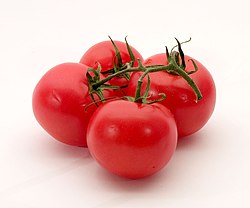
Image from Wikipedia

Solanum lycopersicum var. lycopersicum: one of the oldest surviving tomato specimens. Page from the En Tibi Herbarium, 1558. Naturalis Leiden.

Soon after Hernán Cortés's conquest of the Aztecs, the tomato was brought from Mexico (his arrival there pictured) to Europe in the Columbian exchange.

The San Marzano is a well-known plum tomato highly prized for making pizza.

Tomatoes for sale in a UK supermarket

Tomatoes in Ghana

Plum, cherry, and grape varieties in Hawaii.

Seedlings 7 days after planting

27 days after planting

Flower

52-day-old plant, first fruits

Unripe fruit on the vine

Evolution of genetic diversity in cultivated tomatoes

Heirloom varieties in a French market

Heirloom cultivars Brandywine (biggest red), Black Krim (lower left) and Green Zebra (top left)