Titanic
White Star Line prioritized palatial luxury and massive scale over the record-breaking speed of its rivals.
White Star Line prioritized palatial luxury and massive scale over the record-breaking speed of its rivals.
The Titanic was born from a 1907 strategic pivot by J. Bruce Ismay and financier J.P. Morgan. While their rival, Cunard Line, focused on winning the "Blue Riband" for the fastest Atlantic crossing with ships like the Lusitania, White Star chose to compete on "insight-per-mile." They commissioned a trio of Olympic-class liners designed to be the "last word" in comfort. By building ships so large they could maintain a weekly service with only three vessels instead of four, they optimized for efficiency and opulence rather than raw velocity.
The construction agreement with Belfast shipbuilder Harland & Wolff was unusually flexible. Rather than a fixed-bid contract, the builders were given a "cost-plus" arrangement: they could spend whatever was necessary to achieve the desired luxury, adding a 5% profit margin on top. This resulted in a vessel that cost £1.5 million at the time (roughly £185 million today) and featured unprecedented amenities for first-class passengers, including a Victorian-style Turkish bath, a squash court, and a high-powered radiotelegraph for personal use.
The ship’s ten decks functioned as a rigid vertical hierarchy of social class and mechanical function.
The ship’s ten decks functioned as a rigid vertical hierarchy of social class and mechanical function.
The Titanic was a floating microcosm of Edwardian society, organized by altitude. The uppermost "Boat Deck" was the preserve of the elite, offering unobstructed views and access to the Grand Staircase. As one descended, the luxury faded into utility. "B Deck" featured palatial staterooms with private promenades, while "E Deck" contained "Scotland Road," a long arterial corridor used by crew and third-class passengers to navigate the length of the ship.
Beneath the passenger areas lay the "Orlop" decks and the tank top, a world of pure industry that passengers were strictly prohibited from seeing. This subterranean level housed the massive boilers, engines, and electrical generators. While the top decks were finished in oak and marble, the bottom of the ship was a labyrinth of steel, coal bunkers, and heat, connected to the upper levels by specialized "fireman’s passages" so the working class could move between their berths and the furnaces without disturbing the wealthy.
A massive mechanical heart required the manual labor of 176 firemen to fuel 159 furnaces.
A massive mechanical heart required the manual labor of 176 firemen to fuel 159 furnaces.
To propel 52,000 tonnes through the water, the Titanic utilized a hybrid engine system: two massive four-cylinder reciprocating engines for the wing propellers and a low-pressure Parsons turbine for the center. This configuration was chosen to minimize the uncomfortable vibrations common in all-turbine ships while maximizing fuel efficiency. Despite this "modern" engineering, the energy source was primitive: coal.
The ship’s bunkers held over 6,600 tonnes of coal, which had to be shoveled by hand around the clock. The "Black Gang"—the 176 firemen working in the boiler rooms—labored in dangerous, sweltering conditions to feed 159 furnaces. They shoveled over 600 tonnes of coal every day and disposed of 100 tonnes of ash by ejecting it into the sea. This relentless human effort produced the steam that powered not just the propellers, but an electrical plant more capable than many city power stations of the era.
Outdated maritime regulations created a lifeboat deficit that doomed half the ship's population.
Outdated maritime regulations created a lifeboat deficit that doomed half the ship's population.
The Titanic’s lack of lifeboats is often cited as a sign of arrogance, but it was actually a failure of regulatory scaling. The British Board of Trade’s safety rules were based on a ship's tonnage, not its passenger count. In 1912, the regulations only required 14 lifeboats for a ship of 10,000 tonnes or more. The Titanic, at over 46,000 tonnes, actually exceeded the legal requirement by carrying 20 boats, yet this only provided space for 1,178 people—roughly half of those on board.
The disaster was exacerbated by a lack of emergency preparedness. The ship was equipped with advanced "Welin" davits capable of handling 48 lifeboats, but the additional boats were never supplied to avoid cluttering the elite promenade views. When the sinking occurred, the existing capacity was further wasted: many lifeboats were lowered before they were full, leaving them at an average of 60% occupancy. The tragedy ultimately spurred an immediate overhaul of international maritime law, ensuring that "lifeboats for all" became a universal standard.

Image from Wikipedia

RMS Olympic's rudder with central and port wing propellers; the man at the bottom shows scale.

Marconi Company receiving equipment for a 5-kilowatt ocean liner station in the wireless radio room of Titanic's sister ship, Olympic
![La Circassienne au Bain by Merry-Joseph Blondel; the most highly valued item of cargo lost on Titanic. This image is of a copy.[c]](https://upload.wikimedia.org/wikipedia/commons/thumb/e/e4/La_Circassienne_au_Bain%2C_After_Blondel.JPG/250px-La_Circassienne_au_Bain%2C_After_Blondel.JPG)
La Circassienne au Bain by Merry-Joseph Blondel; the most highly valued item of cargo lost on Titanic. This image is of a copy.[c]
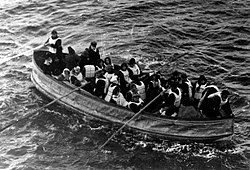
A collapsible lifeboat with canvas sides

Construction in gantry, 1909–11

Titanic departing Belfast for sea trials on 2 April 1912

Titanic at Southampton docks, prior to departure

Proposed sailings for Olympic, Titanic and Oceanic for the year 1912. Titanic would have spent Christmas 1912 at White Star dock #59 in New York (Manhattan) leaving for Plymouth on 28 December.

Edward Smith, captain of Titanic, on board the Olympic in 1911

John Jacob Astor IV in 1909. He was the wealthiest person aboard Titanic; he did not survive.

The ship's voyage from Southampton to Cherbourg and Queenstown

SS New York breaking free of her moorings in Southampton. RMS Oceanic is to her left.

The tender Nomadic

Titanic's itinerary in the North Atlantic, from Fastnet Light (Ireland) to Ambrose Light (New York)