Introduction to evolution
Source: WikipediaEvolution functions through a filtered cycle of random genetic errors and non-random environmental survival.
Biological change is driven by a two-step process: the introduction of variation and the "sieve" of the environment. Variations arise randomly through mutations—essentially typing errors in the DNA code during replication—or through the reshuffling of genes during sexual reproduction. These changes are undirected; they do not occur because an organism "needs" a new trait.
The non-random part is natural selection. Because environments have limited resources, not every individual can survive to reproduce. If a random genetic change provides even a slight advantage in gathering food or avoiding predators, that individual is more likely to pass the trait to the next generation. Over vast timescales, these tiny, successful accidents accumulate, gradually reshaping the entire population to fit its environment.
Modern genetics provided the physical "instruction manual" that Darwin’s original theory was missing.
When Charles Darwin published On the Origin of Species in 1859, he could prove that evolution happened, but he couldn't explain how traits were physically passed down. He actually leaned toward the incorrect theory of "Lamarckism"—the idea that a giraffe stretches its neck and passes that physical stretch to its offspring. It wasn't until the rediscovery of Gregor Mendel’s work with pea plants that scientists understood inheritance as the shuffling of discrete "factors" (genes).
We now know these genes are made of DNA, a long molecule that serves as a biological instruction manual. Within a population, the "gene pool" is like a deck of cards being constantly reshuffled. While sexual reproduction mixes existing cards to create unique individuals, mutations add entirely new cards to the deck. This genetic variability is the raw material that allows evolution to occur.
Biological change is an inevitable byproduct of imperfect replication, not a drive toward "intelligence" or "perfection."
A common misconception is that evolution is a ladder leading toward "higher" or more complex life forms. In reality, evolution has no goal and no finish line. It is simply the result of organisms that are "good enough" to survive their current conditions. If an environment is stable, a species may remain unchanged for millions of years; if it changes rapidly, the species must adapt or go extinct—a fate that has claimed 99.9% of all species that ever lived.
Complexity is not always the winner. For example, the ancestors of snakes had legs, and the ancestors of fleas had wings; both lineages "lost" these complex features because their specific environments favored a simpler body plan. Evolution doesn't strive for the "best" possible design, but rather the most functional design for the immediate "here and now."
The "Tree of Life" model reveals that all living organisms share a single, common ancestor.
Darwin and his contemporary Alfred Russel Wallace revolutionized biology by proposing "descent with modification." They envisioned the history of life not as a series of independent creations, but as a massive branching tree. Every fork in a branch represents a common ancestor. Based on the fundamental similarities in the DNA of all living things, scientists trace this tree back to a single "last universal common ancestor" that lived at least 3.5 billion years ago.
This common ancestry is why evolution is the bedrock of modern science. Because humans, animals, plants, and bacteria share the same basic genetic machinery, discoveries in one area—like how a virus infects a cell or how a gene regulates growth—can be applied across medicine, agriculture, and forensics. Evolution isn't just a study of the past; it is a tool used to solve modern problems, from tracking disease outbreaks to developing new crop varieties.
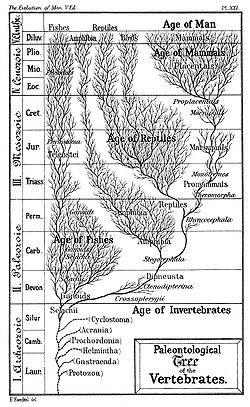
The "Paleontological Tree of the Vertebrates," from the 5th edition of The Evolution of Man (London, 1910) by Ernst Haeckel. The evolutionary history of species has been described as a tree, with many branches arising from a single trunk.
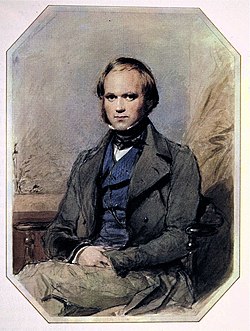
Charles Darwin proposed the theory of evolution by natural selection.

Darwin noted that orchids have complex adaptations to ensure pollination, all derived from basic floral parts.

Model of population bottleneck illustrates how alleles can be lost.

In the founder effect, small new populations contain different allele frequencies from the parent population.

During the second voyage of HMS Beagle, naturalist Charles Darwin collected fossils in South America, and found fragments of armour which he thought were like giant versions of the scales on the modern armadillos living nearby. On his return, the anatomist Richard Owen showed him that the fragments were from gigantic extinct glyptodons, related to the armadillos. This was one of the patterns of distribution that helped Darwin to develop his theory.

A bat is a mammal and its forearm bones have been adapted for flight.

The bird and the bat wing are examples of convergent evolution.
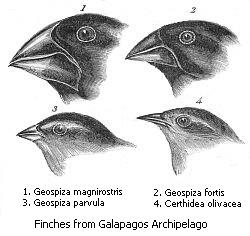
Four of the Galápagos finch species, produced by an adaptive radiation that diversified their beaks for different food sources
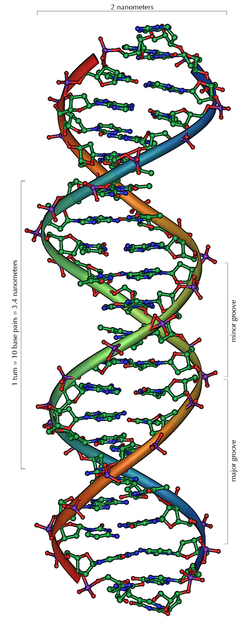
A section of DNA

The results of artificial selection: a Chihuahua mix and a Great Dane
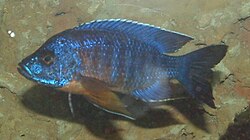
There are numerous species of cichlids that demonstrate dramatic variations in morphology.

Richard Dawkins