Silk Road
Source: WikipediaThe "Silk Road" is a 19th-century brand that mislabels a massive, multi-commodity network
Though the term feels ancient, "Silk Road" was coined in 1877 by German geographer Ferdinand von Richthofen. Critics argue the name is a "myth" of modern academia that oversimplifies history. By focusing on Chinese silk, the term "privileges sedentary empires" at the ends of the route while ignoring the vital contributions of Central Asian steppe nomads. It also sidelines the "Golden Road" of India, where maritime trade was often five times cheaper and more economically significant than overland travel.
In reality, the network was never a single road. Some scholars prefer "Silk Routes" to describe the intricate web of land and sea paths connecting East Asia to East Africa and Europe. For thousands of years before silk became the primary export, segments like the "Jade Road" were already moving precious stones from Khotan to Central China.
Trade functioned as a decentralized "relay" where goods traveled much further than people
Few individuals ever traveled the entire 6,400 km (4,000 mi) span. Instead, the network relied on a "relay trade" system where goods changed hands many times via middlemen. Merchants would navigate specific segments—such as the treacherous Taklamakan Desert or the Hindu Kush mountains—before offloading cargo at commercial hubs like Merv or Samarkand.
This decentralization made security a constant gamble. While the Han Dynasty extended the Great Wall to protect trade products, travelers generally faced "sparse security," enduring threats from nomadic raiders and bandits. The system only saw true "unrestricted trade" and ease of movement during the later period of the Mongol Empire, which unified vast stretches of the continent under a single administration.
Four distinct corridors carved through Earth’s most inhospitable geography
The network was divided into specific land and sea routes shaped by deserts and mountains. The Northern Route bypassed the Taklamakan Desert, bringing Persian dates and saffron to China in exchange for lacquer-ware and porcelain. The Southern Route (or Karakoram route) climbed through northern Pakistan and Afghanistan, eventually linking Iranian land routes to Mediterranean ships. The Southwestern Route utilized the Ganges Delta as a hub for bullion and gemstones.
The Maritime Silk Road was perhaps the most transformative. Established by Austronesian sailors and later utilized by Persian, Arab, and Tamil merchants, it connected the South China Sea to the Red Sea. Unlike the land routes, maritime traders could span the entire distance of the route themselves. Because ships could carry far larger volumes than camel caravans, the economic impact of a single voyage was significantly higher.
The network’s most enduring legacy was the exchange of "invisible" cargo: religion, technology, and disease
While luxury goods like silk, tea, and perfumes generated wealth for a new mercantile class, the Silk Road’s true historical "payload" was intellectual and biological. It served as the primary artery for the spread of Buddhism, which was syncretized by various societies along the way. Scientific thought and philosophical ideas moved as freely as the merchants who carried them.
Two Chinese inventions moved west and altered the trajectory of global politics: paper and gunpowder. However, the same connectivity also facilitated the spread of the plague. The movement of people and animals along these routes likely contributed to the transmission of the Black Death, which devastated populations across Eurasia in the 14th century.
Ottoman dominance forced the world into the sea, triggering the Age of Discovery
The decline of the traditional Silk Road began in 1453 when the Ottoman Empire gained control over the overland routes. By competing with other "gunpowder empires" and restricting access, the Ottomans forced European polities to look for alternative paths to the riches of the East. This search for a bypass directly prompted the Age of Discovery, leading to European colonialism and the first wave of true globalization.
Today, the spirit of the network is being revived through "New Silk Road" infrastructure projects. The most prominent is China’s Belt and Road Initiative (BRI), a massive global investment program. Meanwhile, UNESCO has begun designating specific "Silk Road Corridors" as World Heritage Sites, recognizing that these paths remain the most significant historical bridge between the Eastern and Western worlds.

Map of Eurasia with drawn lines for overland routes

Woven silk textile from Tomb No. 1 at Mawangdui, Changsha, Hunan province, China, dated to the Western Han Era, 2nd century BCE

Main routes of the Silk Road on a relief map, with city and country names labeled

The Silk Road in the 1st century
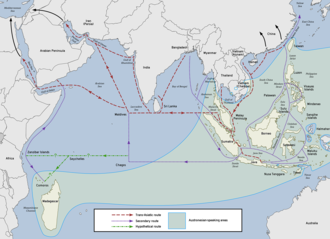
Austronesian proto-historic and historic (Maritime Silk Road) maritime trade network in Southeast Asia and the Indian Ocean
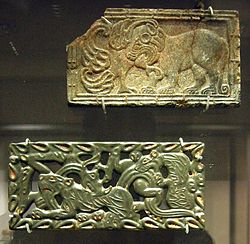
Chinese jade and steatite plaques, in the Scythian-style animal art of the steppes. 4th–3rd century BCE. British Museum.

Soldier with a centaur in the Sampul tapestry, wool wall hanging, 3rd–2nd century BCE, Xinjiang Museum, Urumqi, Xinjiang, China.

Woven silk textiles from Tomb No. 1 at Mawangdui, Changsha, Hunan province, China, Western Han dynasty period, dated 2nd century BCE

A ceramic horse head and neck (broken from the body), from the Chinese Eastern Han dynasty (1st–2nd century CE)

Bronze coin of Constantius II (337–361), found in Karghalik, Xinjiang, China.

Central Asia during Roman times, with the first Silk Road

Indian art also found its way into Italy: in 1938 the Pompeii Lakshmi was found in the ruins of Pompeii (destroyed in an eruption of Mount Vesuvius in 79 CE).

A Westerner on a camel, Northern Wei dynasty (386–534)

Map showing Byzantium along with the other major silk road powers during China's Southern dynasties period of fragmentation.

Coin of Constans II (r. 641–648), who is named in Chinese sources as the first of several Byzantine emperors to send embassies to the Chinese Tang dynasty