The Scream
The painting depicts a visceral panic attack triggered by a "blood red" sunset over Oslo.
The painting depicts a visceral panic attack triggered by a "blood red" sunset over Oslo.
Munch did not set out to paint a literal landscape, but rather a subjective experience of "existential dread." While walking at sunset along a fjord path, he felt the sky turn "blood red" and sensed an "infinite scream passing through nature." While scholars have pinpointed the exact location on the hill of Ekeberg, the figure in the foreground is not "screaming" but rather reacting to a scream that the artist felt vibrating through the environment.
The unnaturally vibrant sky has sparked multiple scientific and psychological theories. Some meteorologists suggest Munch witnessed rare nacreous clouds or the atmospheric aftermath of the 1883 Krakatoa eruption, which tinted Western skies for months. Others point to a more personal origin: the site overlooked both a slaughterhouse and a mental asylum where Munch’s sister was hospitalized, suggesting the "scream" was a projection of internal and external trauma.
Munch produced four distinct versions of the image, including one secretly inscribed with a "madman’s" confession.
Munch produced four distinct versions of the image, including one secretly inscribed with a "madman’s" confession.
The Scream is not a single canvas but a series consisting of two oil paintings, two pastels, and a lithograph stone. The most famous 1893 version, housed in Norway’s National Museum, contains a tiny, barely visible pencil inscription in the corner: "Could only have been painted by a madman!" Long attributed to a disgruntled critic, infrared technology recently confirmed the handwriting belongs to Munch himself, likely a defensive response to public questioning of his sanity.
The physical makeup of the works reveals a bridge between traditional and modern techniques. Analysis shows Munch used 19th-century pigments like cadmium yellow and ultramarine, but his application was revolutionary for the Expressionist movement. He wasn't interested in "pretty" art; he wanted to "desacralize" the image, eventually creating a lithograph stone so the "scream" could be mass-reproduced—a move that anticipated the pop art movement by decades.
Two high-profile thefts turned the masterpiece into a target for ransom and armed robbery.
Two high-profile thefts turned the masterpiece into a target for ransom and armed robbery.
Because of its status as a global icon, the painting has been stolen twice from Oslo museums. In 1994, thieves broke into the National Gallery during the Winter Olympics, leaving a mocking note that read, "Thanks for the poor security." It was recovered three months later in a sting operation involving British police. In 2004, a more violent theft occurred when masked gunmen entered the Munch Museum in broad daylight, tearing the 1910 version from the wall in front of terrified tourists.
These thefts caused significant, though repairable, damage. The 2004 heist left the painting with moisture stains and tears, leading to a massive restoration effort and a total overhaul of museum security in Norway. Despite these vulnerabilities, the paintings remain central to Norwegian identity; when the stolen works were recovered, they were briefly exhibited in their damaged state, drawing thousands of viewers who treated the scars on the canvas as part of the artwork's history.
The image has evolved from a personal nightmare into a universal visual shorthand for modern anxiety.
The image has evolved from a personal nightmare into a universal visual shorthand for modern anxiety.
Once a shocking piece of avant-garde art, The Scream is now a pillar of popular culture, famously described as "a Mona Lisa for our time." Its influence stretches from Andy Warhol’s silk screens to the "Face Screaming in Fear" emoji (😱). It even inspired the wide-eyed expression of Macaulay Culkin on the Home Alone poster. Contrary to popular belief, however, the "Ghostface" mask from the Scream horror franchise was based on a 1991 novelty mask, not Munch's painting.
The painting's power lies in its ability to represent a feeling of "depersonalization"—the sense that the environment and the self are distorting. This universality has made it a symbol for everything from anti-nuclear warnings to resources for chronic pain sufferers. In the art market, this cultural dominance translates to staggering value: in 2012, a pastel version sold for nearly $120 million, setting a record at the time for the highest price ever paid for an artwork at public auction.

Figure on cliffside walkway holding head with hands
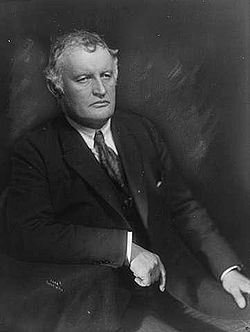
Edvard Munch, 1921

A Peruvian mummy at La Specola, Florence

1895 lithography

Two men breaking into the National Museum of Art, Architecture and Design, Oslo, to steal the gallery's version (1893 tempera on cardboard) of The Scream, February 1994

The Scream back in the National Gallery after recovery and before restoration, September 2006

"The Silence" from Doctor Who have an appearance partially based on The Scream.

1893, pastel on cardboard. As possibly the earliest execution of The Scream, this appears to be the version in which Munch mapped out the essentials of the composition.
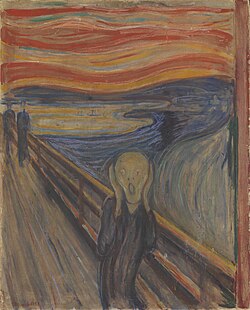
1893, oil, tempera and pastel on cardboard. The first version publicly displayed, and perhaps the most recognizable, is located at the National Museum of Norway in Oslo.

1895, lithograph print. About 45 prints were made before the printer re-used the lithograph stone. A few were hand-coloured by Munch.
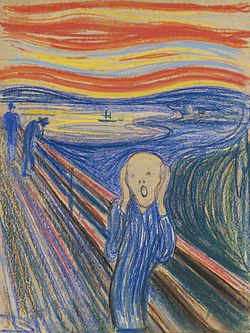
1895, pastel on cardboard. It was sold for nearly US$120 million at Sotheby's in 2012 and is in the private collection of Leon Black.

1910, tempera on cardboard. This version was stolen from the Munch Museum in 2004 but recovered in 2006.

Undated, ink drawing. This composition, which features the central figure from The Scream, is in the collection of the University Museum of Bergen.