The School of Athens
Commissioned by a Pope, the fresco serves as a visual manifesto for the "rebirth" of ancient wisdom within the heart of the Vatican.
Commissioned by a Pope, the fresco serves as a visual manifesto for the "rebirth" of ancient wisdom within the heart of the Vatican.
Between 1509 and 1511, Pope Julius II commissioned the young Raphael to decorate his private apartments, now known as the Stanze di Raffaello. The School of Athens was not a standalone work but one of four frescoes representing the branches of human knowledge: Philosophy, Theology, Poetry, and Justice. By placing this celebration of "pagan" Greek philosophy directly across from La Disputa (Theology), the Vatican messaged that reason and faith were two halves of a single truth.
The painting's original title wasn't "The School of Athens"; it was simply labeled Causarum Cognitio ("Knowledge of Causes"). This reflects the Aristotelian idea that true wisdom comes from understanding why things happen. The scene depicts a "polyphony" of thinkers—mathematicians, scientists, and philosophers—interacting in a vast, idealized space that bridges the gap between the ancient world and the Renaissance.
The painting’s core is a physical debate between Plato’s idealism and Aristotle’s realism, frozen in a single set of gestures.
The painting’s core is a physical debate between Plato’s idealism and Aristotle’s realism, frozen in a single set of gestures.
At the exact vanishing point of the painting stand the two giants of Western thought: Plato and his student, Aristotle. Their disagreement is captured entirely through their body language. Plato, depicted as an old man, points his finger toward the heavens, symbolizing his "Theory of Forms"—the belief that the real world is just a shadow of a higher, spiritual reality. He carries his Timaeus, a book focused on the cosmos and the soul.
In contrast, Aristotle gestures palm-down toward the earth, representing his focus on concrete particulars, ethics, and the observable world. He carries his Nicomachean Ethics, a text grounded in human behavior and physical reality. This visual "shorthand" allows the viewer to instantly grasp the fundamental tension of Western philosophy: the pull between the abstract ideal and the tangible world.
Raphael blurred history by casting his Renaissance contemporaries as the greatest thinkers of antiquity.
Raphael blurred history by casting his Renaissance contemporaries as the greatest thinkers of antiquity.
The fresco is an anachronistic "hall of fame" where 16th-century artists "play" the roles of ancient philosophers. Plato is widely believed to be a portrait of Leonardo da Vinci. The brooding, isolated figure of Heraclitus—leaning on a block of marble in the foreground—is a tribute to Raphael’s rival, Michelangelo. Interestingly, this figure was not in the original sketches; Raphael likely added him after sneaking a look at Michelangelo’s progress on the nearby Sistine Chapel.
The painting also includes a rare moment of direct eye contact: Hypatia of Alexandria is the only figure looking out at the viewer. Near the bottom right, Raphael included a subtle self-portrait, standing beside Ptolemy and Zoroaster. By blending these faces, Raphael argued that the Renaissance was not just studying the past, but was a literal reincarnation of the "Golden Age" of Greece.
The immense, vaulted setting uses "perfect perspective" to create a stage for intellectual theater.
The immense, vaulted setting uses "perfect perspective" to create a stage for intellectual theater.
The architecture of the fresco is as important as the people within it. Raphael used accurate perspective projection—a technique he learned from Leonardo—to create an illusion of deep space that seems to extend the room's physical walls. The building itself is shaped like a Greek cross, harmonizing pagan philosophy with Christian architecture. The design was heavily influenced by Donato Bramante, who was then designing the new St. Peter’s Basilica.
The space is decorated with statues of Apollo (god of light and music) and Athena (goddess of wisdom), who preside over the assembly. The use of a "meander" or Greek key design on the arches reinforces the Hellenistic setting. By placing these diverse thinkers in a shared, open hall, Raphael suggests that the "dialogue of philosophy" is an ongoing, collaborative process rather than a collection of isolated ideas.
Beyond the Vatican, the image has become the universal shorthand for intellectual achievement.
Beyond the Vatican, the image has become the universal shorthand for intellectual achievement.
The School of Athens is regarded as the perfect embodiment of the "classical spirit." Because Raphael left no master key to the identities of the figures, the painting has invited five centuries of speculation and academic "detective work." This ambiguity has allowed the work to remain fresh, as each generation projects its own intellectual heroes onto the anonymous figures in the crowd.
The image's reach extends far beyond art history. It has been reproduced in tapestries for the French National Assembly and full-scale canvases in American universities. It has even permeated pop culture; the two figures standing to the left of Plotinus were famously used as the cover art for the Guns N' Roses albums Use Your Illusion I and II. It remains the world's most recognizable visual summary of the Western intellectual tradition.

Image from Wikipedia

The Stanza della Segnatura
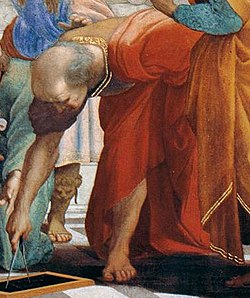
Bramante as Euclid

Zoroaster; Ptolemy; Raphael as Apelles; and Perugino, Il Sodoma, or Timoteo Viti as Protogenes
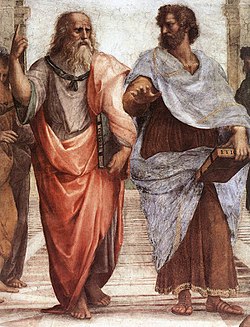
An elder Plato walks alongside a younger Aristotle.

Detail of the architecture

Plato's Academy mosaic from Pompeii

Leonardo da Vinci as Plato

Aristotle

Anaximander

Pythagoras

Aeschines and Socrates
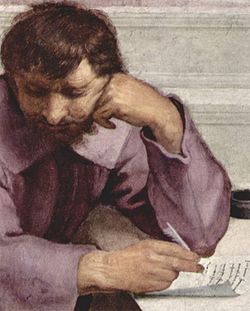
Michelangelo as Heraclitus

Diogenes

Alcibiades or Alexander the Great and Antisthenes or Xenophon