Abiogenesis
Source: WikipediaLife is not a sudden "spark" but a gradual transition from simple chemistry to complex biology.
The prevailing scientific view is that life emerged not in a single flash of lightning, but through a sequence of increasing complexity. This process, often called biopoesis, began with the formation of a habitable planet and progressed through the synthesis of organic molecules, self-replication, and the eventual assembly of cell membranes. While the exact moment "non-life" became "life" remains unobserved, researchers view it as a continuum where chemicals began to cooperate in ways that allowed for Darwinian evolution.
To build a living system, four chemical families must interact: lipids for membranes, carbohydrates for energy, amino acids for proteins, and nucleic acids (DNA/RNA) for heredity. A successful theory of abiogenesis must explain how these distinct classes of molecules first formed in the same place and then learned to work together. Currently, this transition is the "black box" of biology—we know the starting materials and the final result, but the middle steps remain a matter of intense investigation.
The "Chicken-and-Egg" paradox forces a choice between genetic-first or metabolism-first origins.
Modern life presents a logic puzzle: DNA is required to make proteins (enzymes), but those same proteins are required to replicate DNA. To solve this, the "RNA World" hypothesis suggests that RNA—which can both store information and catalyze chemical reactions—came first. In this scenario, RNA acted as both the blueprint and the builder until more stable DNA and efficient proteins took over the workload.
Alternative "metabolism-first" theories argue that life began with simple, self-sustaining chemical cycles. These researchers suggest that catalysis on the early Earth, perhaps near hydrothermal vents, provided the energy and precursor molecules needed for self-replication to eventually emerge. Rather than starting with a complex code, life might have started as a "hot dilute soup" of reactions that only later became packaged into cells.
Science replaced the ancient myth of "spontaneous generation" with the rigors of prebiotic chemistry.
For centuries, from Aristotle until the 1800s, it was widely believed that "lower" animals like maggots or mice spontaneously generated from decaying matter. It wasn't until the experiments of Francesco Redi and Louis Pasteur that this was debunked, proving that life only comes from life. This created a new scientific vacuum: if life doesn't pop into existence today, how did it begin in the first place?
The 1952 Miller–Urey experiment provided the first modern answer. By simulating the "reducing" atmosphere of early Earth and applying an electric spark, researchers successfully synthesized amino acids from inorganic gases. This proved that the building blocks of life could form spontaneously under the right conditions, shifting the study of origins from philosophical speculation to reproducible laboratory science.
Early Earth was a "productive outdoor laboratory" that fostered life with surprising speed.
The window for life to emerge was geologically narrow. Earth formed 4.54 billion years ago (Gya), and for a time, it was a hellish landscape of molten rock and toxic gases. However, evidence suggests liquid oceans existed as early as 4.4 Gya. Given that the earliest fossil evidence of life dates to roughly 3.8–4.1 Gya, the transition from a sterile rock to a biological world happened in a relatively short span of geological time.
Conditions that seem hostile to us were likely catalysts for early life. High levels of UV radiation, intense volcanism, and constant asteroid impacts (the Late Heavy Bombardment) provided the energy and chemical variety needed for "prebiotic synthesis." Life may have even found a safe haven at the bottom of the sea, where deep-sea hydrothermal vents—specifically "white smokers"—provided natural proton gradients that acted as a primitive power source for the first cells.
The hunt for the Last Universal Common Ancestor (LUCA) reveals a sophisticated early organism.
The "LUCA" is the most recent organism from which all modern life descends. While it lived roughly 4 billion years ago, genomic "detective work" has identified 355 genes shared across all major branches of life. This suggests that the LUCA was already quite complex: it was an anaerobic organism that lived in a high-temperature, mineral-rich environment, used a genetic code (DNA), and possessed ribosomes to build proteins.
The complexity of the LUCA is a hurdle for researchers because it implies that a vast amount of evolution had already occurred before the LUCA even appeared. This "ancestor" was already a highly refined biological machine. The challenge of abiogenesis is bridge the gap between the simple organic chemicals of the Miller-Urey experiment and the high-tech cellular machinery found in the LUCA.

Stages in the origin of life process range from the well understood, such as the habitable Earth and the abiotic synthesis of simple molecules, to the largely unknown, like the derivation of the last universal common ancestor (LUCA) with its complex molecular functionalities.

NASA's 2015 strategy for astrobiology aimed to solve the puzzle of the origin of life – how a fully functioning living system could emerge from non-living components – through research on the prebiotic origin of life's chemicals, both in space and on planets, as well as the functioning of early biomolecules to catalyse reactions and support inheritance.

The Miller–Urey experiment was a synthesis of small organic molecules in a mixture of simple gases in a thermal gradient created by heating (right) and cooling (left) the mixture at the same time, with electrical discharges.

If banded iron formation rocks of Archaean age (like these from Australia) are fossilized stromatolites, they would be among the earliest life-forms.
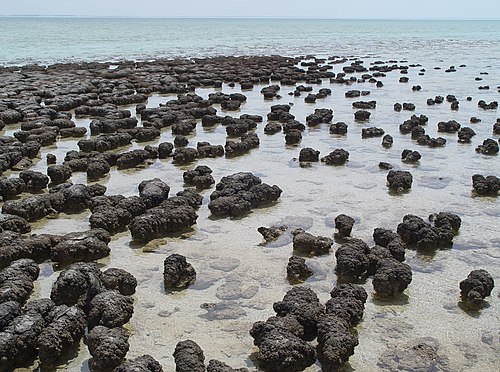
Modern stromatolites in Shark Bay, created by photosynthetic cyanobacteria

The Cat's Paw Nebula is inside the Milky Way Galaxy, in the constellation Scorpius.Green areas show regions where radiation from hot stars collided with large molecules and small dust grains called "polycyclic aromatic hydrocarbons" (PAHs), causing them to fluoresce. Spitzer Space Telescope, 2018.

The Breslow catalytic cycle for formaldehyde dimerization and C2-C6 sugar formation
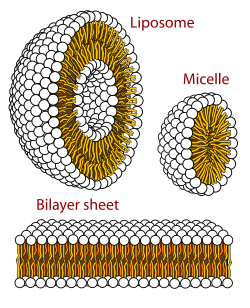
The three main structures composed of phospholipids form spontaneously by self-assembly in solution: the liposome (a closed bilayer), the micelle and the bilayer.

ATP synthase uses the chemiosmotic proton gradient to power ATP synthesis through oxidative phosphorylation.

Chemiosmotic coupling in the membranes of a mitochondrion
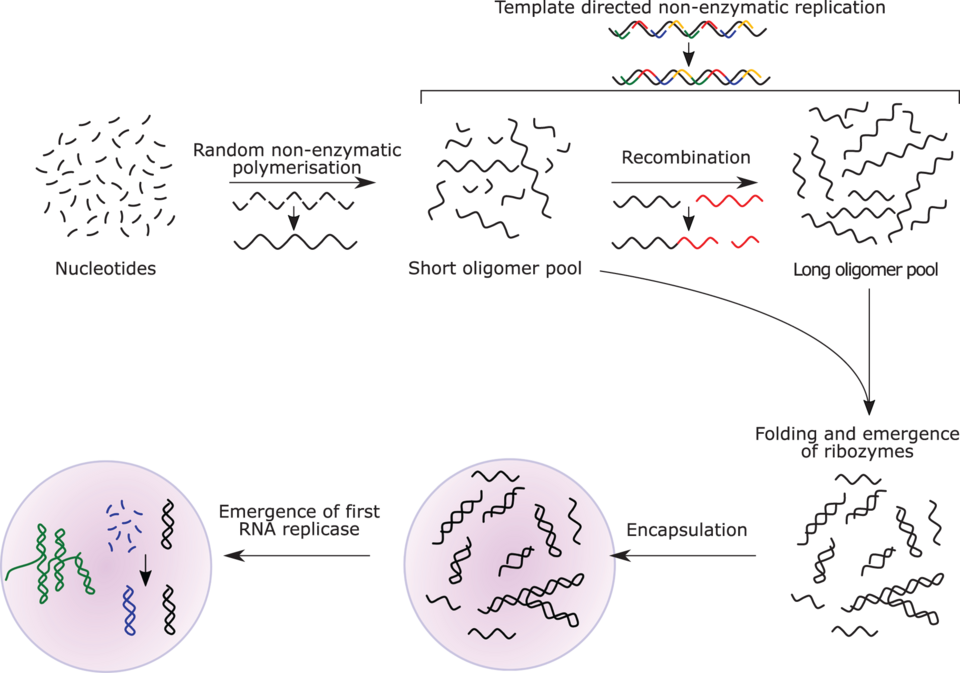
The RNA world hypothesis proposes that undirected polymerisation led to the emergence of ribozymes, and in turn to an RNA replicase.

Phylogenetic tree showing the last universal common ancestor (LUCA) at the root. The major clades are the Bacteria on one hand, and the Archaea and Eukaryota on the other.

LUCA systems and environment included the Wood–Ljungdahl pathway.
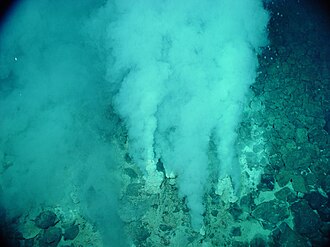
The earliest known life forms may be putative fossilized microorganisms, found in white smoker hydrothermal vent precipitates. They may have lived as early as 4.28 Gya (billion years ago), relatively soon after the formation of the oceans 4.41 Gya, not long after the formation of the Earth 4.54 Gya.

Proposed model of an early cell powered by external proton gradient near a deep-sea hydrothermal vent. As long as the membrane (or passive ion channels within it) is permeable to protons, the mechanism can function without ion pumps.