The Immortal Life of Henrietta Lacks
A single woman’s cancer cells became the world’s most vital medical tool, while her family remained unaware of her "immortality" for decades.
A single woman’s cancer cells became the world’s most vital medical tool, while her family remained unaware of her "immortality" for decades.
In 1951, Henrietta Lacks, a Black tobacco farmer, died of cervical cancer, but a sample of her cells survived. These cells, labeled "HeLa," became the first immortal human cell line, capable of dividing indefinitely in a laboratory. They underpinned major medical breakthroughs, from the polio vaccine to gene mapping, yet Henrietta’s identity was obscured by the scientific community for years.
Rebecca Skloot’s narrative bridges the gap between the sterile world of the laboratory and the lived experience of the Lacks family. While the cells were being bought and sold by the billions, Henrietta's children lived in poverty, often unable to afford the very healthcare their mother’s cells helped create. The book serves as a reclamation of Henrietta’s humanity, transforming her from a biological "specimen" back into a mother and a woman embedded in history.
Author Rebecca Skloot spent a decade navigating publishing hurdles and family trauma to synthesize science with soul.
Author Rebecca Skloot spent a decade navigating publishing hurdles and family trauma to synthesize science with soul.
The book was Skloot’s debut, born from a childhood curiosity sparked by a biology teacher who knew almost nothing about the woman behind the HeLa cells. Skloot spent ten years conducting exhaustive research, eventually earning the trust of Henrietta’s daughter, Deborah. By using Deborah’s personal journals and archival documents, Skloot was able to weave a narrative that feels as much like a detective story as a scientific biography.
The road to publication was nearly derailed by corporate shortsightedness. The book’s original contract was summarily canceled by an editor and sales director after their imprint was shuttered—a decision later "immortalized" as a mistake in the book's film adaptation. Skloot eventually found a home at Crown Publishing, leading to a global release that has been translated into over 25 languages.
The narrative forced a public reckoning with the ethics of race, class, and informed consent in medical research.
The narrative forced a public reckoning with the ethics of race, class, and informed consent in medical research.
The book is credited with bringing the "racial politics of medicine" into the mainstream. It details how the medical establishment of the mid-20th century often viewed Black patients as "material" for research rather than individuals with rights. Skloot explores the painful history of the Lacks family, who grappled with the "spookiness" of their mother’s cells being alive across the globe while her body lay in an unmarked grave.
This ethical interrogation resonated deeply within academia. More than 125 universities adopted the book as a common reading text, using it to teach undergraduate and doctoral students about the necessity of informed consent. It highlights a recurring tension in science: the drive for progress versus the moral obligation to the individual.
Despite its massive critical acclaim, the book faced scrutiny over scientific calculations and attempts at local censorship.
Despite its massive critical acclaim, the book faced scrutiny over scientific calculations and attempts at local censorship.
While largely praised for its lucidity, the book did face pushback from The New Atlantis, which questioned Skloot’s ethical arguments and specific scientific claims. One point of contention was a hypothetical calculation stating that all HeLa cells ever grown would weigh over 50 million metric tons. Skloot defended the figure as a verified, hypothetical doubling-rate calculation, though she clarified that the cells were never actually saved or weighed on such a scale.
In 2015, the book encountered a different kind of resistance in Tennessee, where a parent attempted to have it banned from classrooms. The parent alleged that the scene describing Henrietta discovering her own tumor was "pornographic." The challenge failed, but it underscored the book’s ability to provoke intense, sometimes irrational, reactions to its raw portrayal of human anatomy and illness.
The book's legacy extends beyond the page into a multi-media phenomenon and a philanthropic foundation.
The book's legacy extends beyond the page into a multi-media phenomenon and a philanthropic foundation.
The story’s cultural impact was cemented by a 2017 HBO film executive-produced by and starring Oprah Winfrey as Deborah Lacks. This adaptation brought the story to a massive television audience, emphasizing the emotional toll on the Lacks descendants. The book also makes a cameo in the 2018 sci-fi film Annihilation, where a biologist is seen reading it, signaling its status as a foundational text for understanding cell mutation.
Beyond media, the book created tangible change through the Henrietta Lacks Foundation. Founded by Skloot using a portion of the book’s proceeds, the non-profit provides financial assistance to individuals who have made contributions to scientific research without their consent, particularly the Lacks family. This move turned the book from a passive historical record into an active tool for restorative justice.
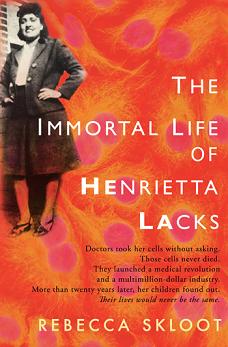
Image from Wikipedia