Human brain
Source: WikipediaThe brain is a soft, tofu-like organ protected by a high-security fluid and membrane system
The living brain is surprisingly fragile, possessing a gel-like consistency similar to soft tofu. To survive the rigors of physical movement, it is suspended in cerebrospinal fluid and encased in the skull. It is further insulated by the meninges—a system of three (and potentially four) membranes. The blood-brain barrier acts as a biological "bouncer," strictly regulating which substances from the bloodstream can enter the organ's sensitive environment.
This 1.2–1.4 kg organ is divided into grey matter—the processing "processors" consisting of neuronal cell bodies—and white matter, which acts as the high-speed "cabling" made of myelinated axons. Despite making up only 2% of total body weight, it is the metabolic engine of the body, demanding constant blood flow; any interruption, such as a stroke, leads to rapid and often irreversible damage.
The cerebrum acts as a folded command center where geography dictates mental ability
The largest part of the brain is the cerebrum, which is split into two hemispheres connected by the corpus callosum. Its outer surface, the cerebral cortex, is deeply folded into ridges (gyri) and grooves (sulci) to pack more processing power into a limited space. This cortex is divided into four main lobes: the frontal (executive function), parietal (sensory integration), temporal (memory and language), and occipital (vision).
While the hemispheres look identical, they are functionally specialized—a concept known as lateralization. Generally, the left hemisphere handles the heavy lifting for language, while the right is more attuned to visual-spatial tasks. Below this surface lies the neocortex, a sophisticated six-layered structure that is the hallmark of higher intelligence and complex thought.
Subcortical structures serve as the brain's "inner office" for hormones and movement
Deep beneath the folded surface of the cortex lie the basal ganglia and the limbic system, which regulate behavior, movement, and survival instincts. The thalamus acts as a central relay station, sorting sensory data before sending it to the cortex, while the hypothalamus sits below it, governing the pituitary gland and regulating essential bodily states like hunger and temperature.
This "inner office" is also responsible for the brain’s chemical messaging. Structures in the basal forebrain produce acetylcholine, a neurotransmitter distributed widely across the brain to maintain attention and memory. These deep regions, including the amygdala and hippocampus, are paired structures; for instance, you have two hippocampi, one in each hemisphere, dedicated to forming new memories.
Complexity emerges from 86 billion neurons and a vast "support staff" of glial cells
The human brain contains approximately 86 billion neurons, but they are not distributed evenly: a staggering 80% of these cells are packed into the cerebellum, leaving only about 19% for the much larger cerebral cortex. These neurons communicate through neurotransmission—sending electrical impulses that trigger the release of chemicals across gaps called synapses to form intricate neural circuits.
Equal in number to the neurons are the glial cells, which were once thought to be mere "glue." We now know they are active participants in brain health. Astrocytes provide structural support and help maintain the blood-brain barrier, while oligodendrocytes provide the insulation (myelin) that allows electrical signals to travel at high speeds. This cellular city is also monitored by microglia, which act as the brain's dedicated immune system.
The brainstem and cerebellum provide a high-performance autopilot for life
While the cerebrum handles conscious thought, the brainstem and cerebellum manage the "background processes" of existence. The brainstem controls involuntary essentials like breathing, heart rate, and eye movements. It also serves as the main conduit for nerve tracts traveling between the body and the higher brain, with 10 of the 12 cranial nerves originating directly from its structure.
The cerebellum, or "little brain," sits at the back of the skull. Its primary role is to smooth out and coordinate complex motor movements. It doesn't initiate movement but ensures that it is fluid and balanced. Damage to this area doesn't cause paralysis, but it does lead to a loss of precision, making even simple tasks like reaching for a cup look jerky and uncoordinated.

Image from Wikipedia

Human brain (sagittal section)

Human brain bisected in the sagittal plane, showing the white matter of the corpus callosum

Major gyri and sulci on the lateral surface of the cortex

Lobes of the brain

Cortical folds and white matter in horizontal bisection of head

Human brain viewed from below, showing cerebellum and brainstem

Cerebrospinal fluid circulates in spaces around and within the brain
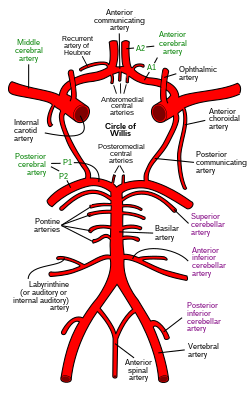
Two circulations joining at the circle of Willis (inferior view)
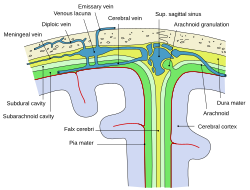
Diagram showing features of cerebral outer membranes and supply of blood vessels

Neurulation and neural crest cells

Primary and secondary vesicle stages of development in the early embryo to the fifth week

Brain of a human embryo in the sixth week of development
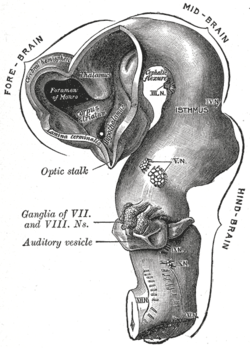
Brain of human embryo at 4.5 weeks, showing interior of forebrain

Brain interior at 5 weeks