The Godfather
A family chronicle serves as a ruthless metaphor for the American dream and capitalist expansion.
A family chronicle serves as a ruthless metaphor for the American dream and capitalist expansion.
While on the surface a "gangster film," The Godfather is a generational epic centered on the moral disintegration of Michael Corleone. The story tracks his metamorphosis from a decorated World War II veteran and "family outsider" into a cold-blooded mafia Don. Director Francis Ford Coppola consciously pivoted away from typical mob tropes, instead treating the Corleone empire as a "family chronicle" that mirrors the rise of corporate America and the transition of power in the post-war era.
The narrative structure creates a stark juxtaposition between domestic ritual and professional violence. This is most famously captured in the climax, where Michael stands as a godfather at his nephew’s baptism while his assassins simultaneously eliminate the heads of the Five Families. By the film's end, Michael has "legitimized" the family through total domestic dominance, though at the cost of his own soul and the trust of his wife, Kay.
Paramount’s initial skepticism nearly derailed a production that eventually saved the studio.
Paramount’s initial skepticism nearly derailed a production that eventually saved the studio.
Paramount Pictures originally viewed Mario Puzo’s novel as just another "sleazy" mafia story and only purchased the rights for $80,000 to settle Puzo’s gambling debts. Following the failure of previous gangster films, the studio was terrified of another flop. They initially demanded the film be set in contemporary Kansas City to save money on backlots, but Coppola fought for an authentic, period-accurate 1940s New York and Sicily setting, arguing that the historical context of the Marine Corps and post-war growth was vital to the characters.
The production was defined by extreme friction. Coppola worked under the constant threat of being fired, at one point preemptively firing the film editor and assistant director whom he believed were conspiring against him. The studio even considered replacing Coppola with Elia Kazan. Ultimately, the film’s massive success—becoming the highest-grossing film ever made at the time—not only saved Paramount from financial ruin but also launched the "New Hollywood" era of director-driven blockbusters.
The casting of Marlon Brando and Al Pacino was a hard-won victory against studio executives.
The casting of Marlon Brando and Al Pacino was a hard-won victory against studio executives.
The iconic performances that define the film almost didn't happen. Studio executives were vehemently opposed to Marlon Brando, who was considered "box office poison" at the time, and they dismissed Al Pacino as being too short and unknown. Coppola had to perform secret screen tests and endure months of indecision from Gulf+Western executives before securing his preferred leads. Brando eventually won the Academy Award for Best Actor, though he famously refused it in protest.
To ensure "ethnic" authenticity, producer Robert Evans insisted on a director of Italian descent. This cultural specificity extended to the score by Nino Rota and the cinematography, which used deep shadows and "Rembrandt lighting" to create a sense of operatic gloom. This commitment to realism even extended to the script; under pressure from the Italian-American Civil Rights League, Coppola agreed to remove all mentions of the words "Mafia" and "Cosa Nostra" from the dialogue to avoid perpetuating stereotypes.
The screenplay was born from a surgical dissection of Puzo’s novel into a physical "bible."
The screenplay was born from a surgical dissection of Puzo’s novel into a physical "bible."
Coppola’s writing process was remarkably tactile. He took a copy of Puzo’s 1969 bestseller, tore out the pages, and pasted them into a massive notebook. He then annotated every scene with notes on five key criteria: the core "nugget" of the scene, its relationship to the theme, the period details, the staging, and potential pitfalls. This notebook became his primary reference on set, more so than the final 163-page screenplay.
While Puzo and Coppola wrote their drafts separately—Puzo in Los Angeles and Coppola in San Francisco—they collaborated to refine the themes of power and heritage. They even brought in "script doctor" Robert Towne to write the tender, pivotal garden scene between Brando and Pacino. This meticulous planning allowed them to condense a sprawling 400-page novel into a focused narrative that balances intimate character beats with the grand mechanics of organized crime.
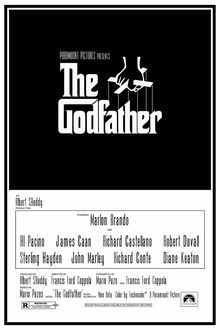
"The Godfather" written on a black background in stylized white lettering, above it, a hand holds puppet strings.

Brando (right) and Pacino as Don Vito and Michael Corleone, respectively

Francis Ford Coppola (pictured in 1973) was selected as director. Paramount wanted the picture to be directed by an Italian American to make the film "ethnic to the core".

Marlon Brando was chosen to portray Vito Corleone.

The Don Barzini assassination scene was filmed on the steps of the New York Supreme Court building on Foley Square in Manhattan.

1941 Packard Super Eight featured in The Godfather