Fall of the Western Roman Empire
Source: WikipediaThe "Fall" was a slow-motion evaporation of central authority rather than a single catastrophic defeat.
While 476 CE is the traditional date for the end of the Western Empire, it marks a symbolic transition rather than a sudden destruction. By the time the Germanic king Odoacer deposed the teenage emperor Romulus Augustulus, the office of the "Emperor" had already lost its military, financial, and political teeth. The Senate simply sent the imperial insignia to the Eastern Emperor in Constantinople, effectively acknowledging that the West was now a collection of independent barbarian kingdoms.
This process was characterized by the failure to enforce rule over vast territories. For centuries, Rome’s strength lay in its ability to project power; as that ability waned, the empire didn't just break—it dissolved into "successor polities." The legitimacy of the Roman name lasted for centuries, but the centralized state that could collect taxes and command legions from a single capital was gone.
Climate change and pandemic disease broke the demographic and economic backbone of the state.
Modern scholarship emphasizes that Rome was "assassinated" by its environment as much as by its enemies. During its height, Rome benefited from the "Roman Climatic Optimum"—a period of unusually warm, stable weather that made agriculture easy and tax collection predictable. When the climate shifted toward the "Late Antique Little Ice Age" around 450 CE, food security plummeted, making it impossible to support the massive populations and standing armies required to hold the frontiers.
Parallel to these climatic shifts were "invisible invaders": the Antonine Plague, the Plague of Cyprian, and later the Plague of Justinian. These pandemics caused massive demographic collapses, killing the taxpayers who funded the state and the soldiers who defended it. The interconnected nature of the Roman world—its famous roads and busy sea lanes—unknowingly served as a superhighway for pathogens, turning the empire’s greatest strength into its biological undoing.
Perpetual civil wars and a broken succession system turned the Roman military against itself.
The Empire’s greatest internal threat was the lack of a stable way to transfer power. From the third century onward, the army became the ultimate "kingmaker," leading to a cycle of "soldier-emperors" and usurpers. This meant that the Roman field armies—the most sophisticated fighting force in the world—spent much of their time destroying each other in civil wars rather than guarding the Rhine or Danube frontiers.
To manage the massive scale of the empire, leaders like Diocletian divided it into Western and Eastern halves. While intended to improve administration, this created a permanent tension. The two halves often mistrusted one another, hoarding resources or refusing to send military aid during crises. By the time mass migrations began in earnest, the Western army was a hollowed-out version of its former self, fragmented by internal politics and led by "incapable" figureheads.
The "Barbarian Invasions" were actually a failure of Rome’s traditional system of immigrant assimilation.
For centuries, Rome had a process called receptio: they would admit potentially hostile barbarian groups, break them up, and settle them as farmers or soldiers. This turned outsiders into tax-paying, Latin-speaking Romans within a generation or two. However, in 376 CE, a massive influx of Goths fleeing the Huns overwhelmed this system. Instead of being assimilated, they entered as an intact, armed nation that the Romans could neither expel nor subjugate.
This changed the nature of the "enemy." These groups weren't just raiding; they were looking for a home within the system. When the Roman government failed to manage them effectively, these groups became "states within the state." Eventually, the Roman military became so dependent on barbarian recruits (laeti) and mercenary leaders that the line between "Roman" and "Barbarian" blurred, leading to the establishment of independent kingdoms in Gaul, Spain, and Africa.
Historians now debate whether Rome truly "fell" or simply underwent a radical metamorphosis.
The classic view, popularized by Edward Gibbon in 1776, framed the era as a tragic "Decline and Fall" caused by moral decay and the rise of Christianity. Gibbon saw the Middle Ages as a "priest-ridden Dark Age" that interrupted human progress. This perspective dominated for centuries, framing the end of Rome as a catastrophic rupture in civilization.
More recent historians, however, prefer the term "Late Antiquity." They argue that Roman culture, law, and religion didn't disappear in 476; they simply changed shape. In this view, the "fall" was a complex transformation where Roman elites stayed in power by working with new Germanic kings, and the Church preserved Roman administrative structures. This "Pirenne Thesis" suggests that the true end of the ancient world didn't happen until the 8th century with the Muslim conquests, which finally broke the economic unity of the Mediterranean.

Routes taken by barbarian invaders of the Roman Empire during the Migration Period

Roman Empire in the early second century

The Roman Empire under the Tetrarchy, showing the dioceses and the four Tetrarchs' zones of responsibility
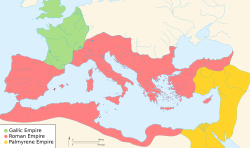
The divided Empire in 271 CE

Solidus of Julian, c. 361. Obverse: Julian with the beard appropriate to a Neoplatonic philosopher. Inscription: FL(AVIVS) CL(AVDIVS) IVLIANVS PP(=Pater Patriae, "father of the nation") AVG(=Augustus). Reverse: an armed Roman, military standard in one hand, a captive in the other. Inscription: VIRTVS EXERCITVS ROMANORVM, "the bravery/virtue of the Roman army"; the mint mark is SIRM, Sirmium.

The Eastern and Western Roman Empire at the death of Theodosius I in 395
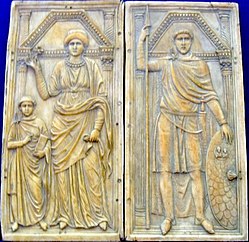
An ivory diptych, thought to depict Stilicho (right) with his wife Serena and son Eucherius, ca. 395 (Monza Cathedral)
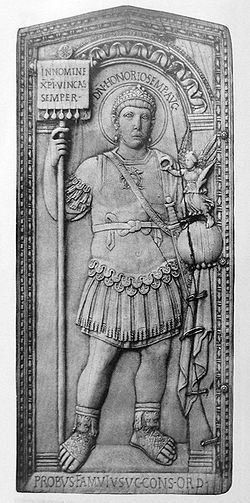
A contemporary depiction of Honorius on a consular diptych issued by Anicius Petronius Probus to celebrate Probus's consulship in 406, now in the Aosta museum

Chi-rho pendant of Empress Maria, daughter of Stilicho, and wife of Honorius, now in the Louvre, Paris. The pendant reads, around a central cross (clockwise):HONORIMARIASERHNAVIVATISSTELICHO.The letters form a Christogram.

Inscription honouring Honorius, as florentissimo invictissimoque, the most excellent and invincible, 417–418, Forum Romanum

Areas allotted to or claimed by barbarian groups in 416–418

During his four-year reign Majorian reconquered most of Hispania and southern Gaul, meanwhile reducing the Visigoths, Burgundians and Suevi to federate status.

Tremissis of Anthemius

Tremissis of Julius Nepos

Europe and the Mediterranean in AD 476