The Birth of Venus
Botticelli prioritizes poetic rhythm and "Gothic" flow over anatomical realism.
Botticelli prioritizes poetic rhythm and "Gothic" flow over anatomical realism.
While Venus stands in a classical contrapposto pose, her body is anatomically impossible. She possesses an unnaturally elongated neck and torso, and her weight is shifted so far over her left leg that she would tip over in the real world. Critics like Kenneth Clark note that she lacks "aplomb"—the balanced distribution of weight found in classical statues. Instead of standing, she appears to be floating.
The painting depicts a world of the imagination rather than a window into reality. Figures cast no shadows, and the landscape is stylized and out of scale. The beauty of the work lies in its "ecstatic movement," where the intricate, rhythmic curves of the hair and drapery sweep the viewer’s eye across the canvas. Botticelli’s goal was not naturalism, but a decorative, lyrical harmony that mirrors the flow of a Gothic ivory carving.
The painting revived the heroic female nude, a subject virtually unseen since antiquity.
The painting revived the heroic female nude, a subject virtually unseen since antiquity.
The Birth of Venus represents a massive shift in Western art history. Large-scale depictions of classical mythology were nearly unprecedented in the 1480s, as was the presence of a life-sized nude female figure. Before this period, nudity was generally reserved for depictions of Eve or the damned; here, it is celebrated as an embodiment of divine beauty.
Botticelli modeled Venus's pose on the Venus Pudica (modest Venus) type found in Greco-Roman sculpture, where the goddess covers her breasts and groin with her hands and hair. By scaling this ancient form to nearly life-size on a secular canvas, Botticelli signaled the Renaissance’s full embrace of the classical past, moving beyond religious icons to explore the humanistic ideals of the Greek and Roman world.
The use of canvas and heavy gold highlights suggests a lighter, more decorative purpose.
The use of canvas and heavy gold highlights suggests a lighter, more decorative purpose.
Unlike its counterpart, the Primavera, which was painted on expensive wood panels, the Birth of Venus is executed on canvas. At the time, canvas was a cheaper, more "cheerful" support often used for secular decorations in country villas rather than formal city palaces. This suggests the painting was intended for a private, leisurely environment—likely a Medici country estate—where a more relaxed atmosphere prevailed.
The technical execution is further distinguished by a heavy use of gold as a pigment. Botticelli applied gold highlights to the hair, wings, textiles, and even the landscape, likely after the painting was already framed. Over time, the colors have shifted; the green pigments in the orange trees and wings have darkened with age, and the blue of the sea has lost its original brilliance, meaning the painting we see today is more somber than the vibrant, shimmering spectacle originally delivered.
The scene functions as a Neoplatonic bridge between physical beauty and divine love.
The scene functions as a Neoplatonic bridge between physical beauty and divine love.
For the Florentine elite, Venus was not just a mythological character but a philosophical symbol. Under the influence of Neoplatonism, thinkers like Plato argued that the contemplation of physical beauty could lift the human mind toward an understanding of spiritual or "divine" beauty. Venus, as the most beautiful goddess, served as the perfect vehicle for this intellectual journey—looking at her was intended to arouse the viewer's mind toward higher truths.
The composition also deliberately mimics the traditional iconography of the Baptism of Christ. Just as Christ’s baptism marked the start of his ministry on earth, the arrival of Venus on the shore (blown by Zephyr and greeted by a Hora) marks the start of her "ministry of love." This overlap between pagan myth and Christian structure allowed Renaissance viewers to reconcile their interest in ancient Greece with their own religious faith.
The painting’s origins remain a mystery of Medici patronage and political puns.
The painting’s origins remain a mystery of Medici patronage and political puns.
For a century, it was assumed that the work was commissioned by Lorenzo di Pierfrancesco de' Medici for his villa at Castello. However, modern scholarship has cast doubt on this, as the painting does not appear in early family inventories. While the exact commissioner is debated, the visual evidence points toward the Medici circle: the laurel trees and the laurel wreath worn by the goddess of Spring are likely puns on the name "Lorenzo."
The timing of the work is also a subject of academic detective work. While once thought to be a companion to the Primavera, the Birth of Venus was likely painted several years later, around 1484–86. It represents a "next scene" in a story rather than a direct pair, showing Venus arriving at Cyprus or Cythera after her birth. Despite the uncertainty of its birth, the painting has remained paired with the Primavera in the public imagination for over 500 years.

Sandro Botticelli, The Birth of Venus (c. 1484–1486). Tempera on canvas. 172.5 cm × 278.9 cm (67.9 in × 109.6 in). Uffizi, Florence

Detail: the face of Venus

The Hora of Spring

Venus

Roman fresco from the "House of Venus" in Pompeii, 1st century AD

Roman glass cameo Venus Anadyomene

Capitoline Venus, derived from Aphrodite of Cnidus

Greco-Roman Venus Anadyomene

Greco-Roman bronze statuette

Greek terracotta, from Pontus

Zephyr and his companion

Calumny of Apelles, 1494–95, with "Truth" at left. Uffizi, Florence.

Berlin Venus, workshop of Botticelli. Gemäldegalerie, Berlin.
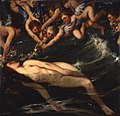
The Birth of Venus by Charles Haslewood Shannon, 1923

Image from Wikipedia