The Art of War
Sun Tzu frames war as a catastrophic drain on the state, advocating for victory through psychological leverage and economic preservation over brute force.
Sun Tzu frames war as a catastrophic drain on the state, advocating for victory through psychological leverage and economic preservation over brute force.
Unlike many historical military texts that glorify combat, The Art of War treats conflict as a costly, destructive last resort. Sun Tzu argues that prolonged warfare inevitably erodes the state’s resources faster than an enemy ever could. Consequently, the highest form of generalship is not winning a hundred battles, but subduing the enemy without fighting at all.
The strategy focuses heavily on "minimizing financial exposure" through speed and deception. By using intelligence operatives and espionage, a commander can keep a war brief and controlled. Sun Tzu’s philosophy rests on the idea that knowledge—of oneself and the enemy—is the only way to ensure that a conflict remains as cheap and efficient as possible.
The historical "Sun Tzu" remains elusive, but archaeological finds suggest the text represents a continuous intellectual tradition rather than a single author.
The historical "Sun Tzu" remains elusive, but archaeological finds suggest the text represents a continuous intellectual tradition rather than a single author.
For centuries, scholars debated whether Sun Tzu even existed, noting his suspicious absence from the Zuo Zhuan, a definitive historical record of the era. Some theorized the name was a descriptive pseudonym meaning "The Fugitive Warrior." In the early 20th century, the mystery deepened as critics argued the work was actually written by Sun Bin, a descendant who lived over a century later.
A breakthrough occurred in 1972 with the discovery of the Yinqueshan Han slips in an ancient tomb. These bamboo writings contained two distinct versions of The Art of War—one attributed to Sun Tzu and another to Sun Bin. This confirmed that the "Master Sun" lineage was likely a "continuously developing intellectual tradition" where the earlier text formed the core foundation that was later expanded upon.
Once the secret weapon of East Asian dynasties, the treatise is now mandatory reading for Western military elite and intelligence operatives.
Once the secret weapon of East Asian dynasties, the treatise is now mandatory reading for Western military elite and intelligence operatives.
For 1,500 years, the text was a pillar of the Seven Military Classics in China, but it didn't reach the West until a French translation in 1772. Its impact on Western theory surged after the U.S. defeat in the Vietnam War, as leaders realized their opponents—including General Võ Nguyên Giáp and the Viet Cong—had mastered Sun Tzu’s principles of guerrilla warfare and mobility.
Today, the book is a staple at West Point and on the U.S. Marine Corps Professional Reading Program. Its influence extends deeply into intelligence circles; the strategy of deception—forcing an enemy to "take our strength for weakness"—was famously studied and implemented by the KGB to manipulate the perceptions of rival superpowers.
The 13 chapters have transcended the battlefield to provide a strategic blueprint for high-stakes competition in business, law, and professional sports.
The 13 chapters have transcended the battlefield to provide a strategic blueprint for high-stakes competition in business, law, and professional sports.
The book’s core tenets—knowing the "terrain," timing an attack, and managing morale—translate seamlessly to the boardroom. Many Japanese corporations make the text required reading for executives, viewing corporate competition as a bloodless form of warfare. It provides a framework for negotiation and trial strategy in legal circles, focusing on how to win before the "battle" of the courtroom begins.
In the realm of sports, the book is cited by legendary figures like NFL coach Bill Belichick and Brazilian football coach Luiz Felipe Scolari. During the 2002 World Cup, Scolari famously slid passages of The Art of War under his players' doors at night. Whether in a stadium or a stock exchange, the book remains the definitive guide for anyone navigating a competitive "zero-sum" environment.
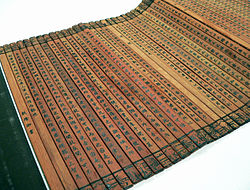
Image from Wikipedia

Fragments of The Art of War discovered as a part of the Yinqueshan Han Slips, showing the version of The Art of War that was popular in Han dynasty (206 BC – 220 AD)

The beginning of The Art of War in a classical bamboo book from the reign of the Qianlong Emperor

Running Press miniature edition of the 1994 Ralph D. Sawyer translation, printed in 2003