Arnolfini Portrait
Van Eyck used a domestic interior to broadcast the immense wealth and social status of the 15th-century merchant class.
Van Eyck used a domestic interior to broadcast the immense wealth and social status of the 15th-century merchant class.
While the room appears intimate, almost every object is a "flex" of the Arnolfini family’s purchasing power. The couple wears heavy, fur-trimmed overgarments despite the fruit tree outside suggesting warm weather—thick wool and dyed silk were exorbitant luxuries. Even the oranges on the windowsill, which seem like a casual detail, were expensive imports from the south, signaling a level of wealth that rivaled the aristocracy.
The setting is a "reception room" rather than a private bedroom. In the 1400s, beds were the most expensive pieces of furniture in a household and were frequently placed in public-facing rooms to impress visitors. By placing the Italian merchant Giovanni di Nicolao Arnolfini in this opulent Bruges setting, Van Eyck documented the rise of a new global middle class that used art to cement their social standing.
A convex mirror transforms the painting from a static image into a three-dimensional witness of a legal event.
A convex mirror transforms the painting from a static image into a three-dimensional witness of a legal event.
At the center of the composition hangs a small, circular mirror that acts as a visual pivot point for the entire room. If you look closely at the reflection, you see not just the backs of the couple, but two other figures entering the room through a door. One of these figures is widely believed to be Jan van Eyck himself, an interpretation supported by the flamboyant signature above the mirror: Johannes de Eyck fuit hic (Jan van Eyck was here).
This inclusion suggests the painting functioned as a legal document. In an era when many people were illiterate, a visual record of a contract or vow—witnessed by the artist and a second person—carried significant weight. The mirror doesn't just show the room; it validates the presence of the viewer and the artist, turning the canvas into a permanent, "notarized" testimony.
The mastery of oil glazes allowed Van Eyck to simulate the physical properties of light and texture with unprecedented realism.
The mastery of oil glazes allowed Van Eyck to simulate the physical properties of light and texture with unprecedented realism.
Before Van Eyck, painters primarily used tempera, which dried quickly and resulted in flat, opaque colors. Van Eyck perfected the use of translucent oil glazes, applying thin layer upon thin layer of pigment. This technique allowed light to pass through the paint and reflect off the white ground beneath, creating a "glow" that mimics the way light actually behaves on skin, velvet, and metal.
The level of detail achieved through this method is staggering. You can see the individual hairs of the terrier dog, the tiny carvings on the bedpost, and the specific way a single candle’s flame illuminates the brass chandelier. This was not just a stylistic choice; it was a technological breakthrough that defined the Northern Renaissance and set the standard for Western realism for the next four centuries.
Modern scholarship suggests the portrait may be a haunting memorial rather than a celebratory marriage record.
Modern scholarship suggests the portrait may be a haunting memorial rather than a celebratory marriage record.
For decades, the standard interpretation was that this depicted a wedding or a betrothal. However, more recent research has noted a darker possibility: it might be a posthumous tribute. Giovanni’s wife, Costanza Trenta, died in 1433—one year before the painting was dated. This theory explains why the husband is dressed in somber black and why the iconography is split down the middle.
The "living" side of the painting (the left) features the husband and a healthy citrus tree. The "dead" side (the right) features the wife and symbols of mortality. Specifically, the chandelier holds a single lit candle on his side, while the candle on her side has gone out, leaving only a trail of smoke. Even the carvings on the bedframe on her side depict Saint Margaret, the patron saint of childbirth, hinting that she may have died in labor.

Image from Wikipedia

Detail showing the male subject, probably Giovanni di Nicolao Arnolfini

Detail showing the female subject and convex mirror

Jan van Eyck, Portrait of Giovanni di Nicolao Arnolfini. Gemäldegalerie, Berlin

Charles the Bold surprising David Aubert, a miniature with an unusual variant of the presentation portrait, probably alluding to Alexander the Great, who surprised one of his artists in similar fashion. The rear wall seems to refer to the Arnolfini Portrait of forty years earlier, containing many of the same objects like the convex mirror and in particular the painted inscription on the wall. Loyset Liédet, before 1472.

Johannes de eyck fuit hic 1434 (Jan van Eyck was here. 1434).

Detail showing the couple's joined hands
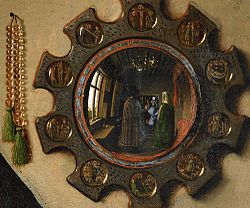
Detail of the convex mirror

Detail of the dog
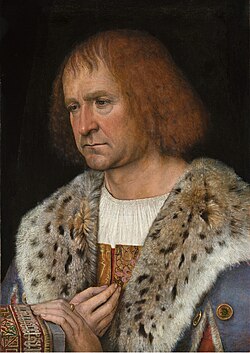
Diego de Guevara, who gave the painting to the Habsburgs, by Michael Sittow, c. 1517