The 7 Habits of Highly Effective People
Effectiveness is built on a "Character Ethic" rather than superficial personality traits.
Effectiveness is built on a "Character Ethic" rather than superficial personality traits.
Stephen Covey argues that most self-help literature focuses on the "personality ethic"—surface-level techniques like public relations skills and positive thinking. He identifies these as "band-aid" solutions that fail to address the underlying values. Instead, he advocates for the "character ethic," which aligns one’s internal value system with universal, timeless principles like integrity, humility, and courage.
The book posits that lasting success is not about manipulating others or managing perceptions, but about fundamental personal change. By shifting one's "paradigm"—the way we perceive and interpret the world—an individual can move from a state of dependence to independence, and ultimately to a higher state of interdependence.
True independence requires taking mental ownership before taking physical action.
True independence requires taking mental ownership before taking physical action.
The first three habits focus on the "Private Victory," moving an individual from dependence to independence. Covey asserts that "proactivity" is the foundation; it is the realization that between a stimulus and a response, humans have the freedom to choose. By focusing on their "Circle of Influence" rather than their "Circle of Concern," people stop being victims of circumstances and start becoming architects of their own lives.
Effectiveness also requires a "mental creation" before a "physical creation." Covey challenges readers to "Begin with the End in Mind" by drafting a personal mission statement. This vision is then operationalized through rigorous time management—specifically by focusing on "Quadrant II" activities: those that are important but not urgent. By prioritizing long-term development over immediate crises or frivolous distractions, an individual gains the discipline to "follow the program" they have written for themselves.
Interdependence is achieved through empathetic listening and the pursuit of mutual gains.
Interdependence is achieved through empathetic listening and the pursuit of mutual gains.
Habits four through six move the individual into the "Public Victory," where success is found in collaboration. Covey rejects the "Win-Lose" scarcity mindset, proposing "Win-Win" as a character-based code for human interaction. This is not about being "nice," but about finding mutually beneficial solutions that are more sustainable than one-sided victories.
To reach these solutions, one must practice empathetic listening—seeking first to understand the other party before trying to be understood. Covey utilizes the Greek concepts of Ethos (credibility), Pathos (emotional connection), and Logos (logic) to explain the sequence of persuasion. When people feel truly understood, they lower their defenses, allowing for "Synergy"—a state where the collective strength of a team produces results that no individual could achieve alone.
Sustainable growth is an "Upward Spiral" fueled by consistent renewal of the self.
Sustainable growth is an "Upward Spiral" fueled by consistent renewal of the self.
The seventh habit, "Sharpen the Saw," is the principle of balanced self-renewal. Covey warns that effectiveness is lost if a person does not take the time to maintain their greatest asset: themselves. This renewal occurs across four dimensions: physical (exercise), mental (reading and planning), spiritual (prayer or meditation), and social/emotional (service and connection).
Covey describes this process as an "Upward Spiral" of growth. By iteratively practicing the cycle of "learn, commit, and do," an individual masters the habits at progressively higher levels. This continuous education of the conscience ensures that personal development is not a destination but a permanent trajectory toward greater freedom, wisdom, and power.
The book’s massive cultural footprint includes presidential counsel and multi-generational adaptations.
The book’s massive cultural footprint includes presidential counsel and multi-generational adaptations.
Since its 1989 publication, The 7 Habits has become one of the most influential business books in history, selling over 20 million copies. Its impact reached the highest levels of government; in 1994, President Bill Clinton invited Covey to Camp David to discuss how the book's principles could be integrated into his presidency. Time magazine later named it one of the 25 most influential business management books ever written.
The legacy of the book has been extended through the work of Covey’s son, Sean Covey, who adapted the framework for different age groups. These adaptations—including versions for teens and children using anthropomorphic characters—simplify the habits into "The 7 Habits of Happy Kids" and "The 7 Habits of Highly Effective Teens," ensuring the "character ethic" remains accessible to younger generations.

Image from Wikipedia
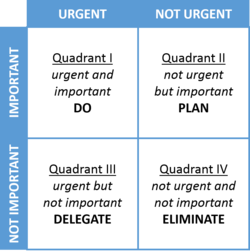
Matrix of importance versus urgency as discussed in the book