Surrealism
Surrealism seeks to dissolve the boundary between dream and waking life to create an absolute "super-reality."
Surrealism seeks to dissolve the boundary between dream and waking life to create an absolute "super-reality."
The movement was defined by its leader, André Breton, as a quest to resolve the contradictory conditions of sleep and consciousness. Rather than simply painting "weird" pictures, Surrealists aimed to reach a state of "surreality"—a higher level of truth where the logic of the unconscious mind could operate without the interference of reason, morality, or aesthetic convention.
While the movement produced world-famous artifacts in painting and film, the artists themselves often viewed these works as secondary. To them, the art was merely a byproduct of "pure psychic automatism," a process of experimentation designed to explore the "real functioning of thought" in its rawest, most uncensored state.
The movement was born from a fierce 1924 rivalry that redefined artistic rebellion as a structured philosophy.
The movement was born from a fierce 1924 rivalry that redefined artistic rebellion as a structured philosophy.
The term "Surrealism" was coined by Guillaume Apollinaire in 1917 to describe the "New Spirit" in the arts, but the movement only became an organized force in October 1924. This founding was marked by a literal battle for the term between two rival factions: one led by Yvan Goll and the other by André Breton. Breton eventually won through "tactical and numerical superiority," establishing a disciplined, almost dogmatic group centered in Paris.
This transition marked a break from the Dada movement of the 1910s. While Dada was a protest of "anti-art" fueled by the horrors of World War I, Surrealism sought to build something more constructive. It replaced Dada’s chaotic nihilism with a structured inquiry into the human psyche, heavily influenced by the psychoanalytic methods of Sigmund Freud.
By bypassing rational control through "psychic automatism," artists tapped into the jarring logic of the unconscious.
By bypassing rational control through "psychic automatism," artists tapped into the jarring logic of the unconscious.
The primary tool of the Surrealist was automatism—writing or drawing spontaneously without censoring thoughts. Influenced by Freud’s free association, practitioners like Breton and Philippe Soupault produced works like The Magnetic Fields (1920) by allowing their pens to move without conscious direction. They believed that the less a creator "thought," the more the work revealed the hidden truths of the mind.
A key aesthetic principle was the "startling juxtaposition." By placing two distant, unrelated realities in the same frame—like a sewing machine and an umbrella on a dissecting table—the artists created a "poetic reality" that reason could not explain. This was not meant to be "nonsense," but rather a way to spark an emotional power that conventional, logical art could not achieve.
Though initially a literary pursuit, Surrealism conquered the visual world by embracing "chance" techniques.
Though initially a literary pursuit, Surrealism conquered the visual world by embracing "chance" techniques.
Breton was originally skeptical that visual arts could truly be Surrealist, fearing that the slow process of painting was too "malleable" and lacked the speed of automatic writing. This changed as artists discovered techniques that allowed chance to take the lead, such as frottage (rubbing over textured surfaces) and decalcomania (squeezing paint between surfaces to create random patterns).
Visual pioneers like Giorgio de Chirico provided the "metaphysical" foundation, using stark shadows and illogical perspectives that would later influence Salvador Dalí and René Magritte. By the mid-1920s, the movement had successfully transitioned from a poets' circle in Parisian cafes to a global visual phenomenon, incorporating everything from photography and sculpture to film and theatre.
Surrealism was a radical political project intended to liberate the human psyche from the constraints of "false rationality."
Surrealism was a radical political project intended to liberate the human psyche from the constraints of "false rationality."
At its core, Surrealism was a revolutionary movement, not just an art style. Breton and his followers believed that the same "excessive rational thought" and bourgeois values that led to the slaughter of World War I were still enslaving the human spirit. They aligned themselves with radical political causes, including communism and anarchism, viewing the liberation of the imagination as a necessary step toward social revolution.
By embracing the "omnipotence of the dream" and the "disinterested play of thought," the Surrealists aimed to ruin existing psychic mechanisms. Their goal was to free the individual from restrictive social customs and structures, asserting that a true change in society required a total transformation of how humans perceived reality itself.

The Treachery of Images, by René Magritte (1929)

Max Ernst, The Elephant Celebes, 1921

Cover of the first issue of La Révolution surréaliste, December 1924

Yvan Goll, Surréalisme, Manifeste du surréalisme, Volume 1, Number 1, October 1, 1924, cover by Robert Delaunay

Giacometti's Woman with Her Throat Cut, 1932 (cast 1949), Museum of Modern Art, New York City
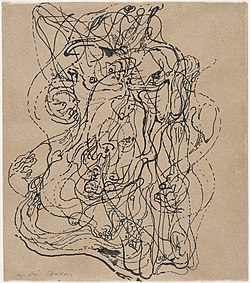
André Masson. Automatic Drawing. 1924. Ink on paper, 23.5 × 20.6 cm. Museum of Modern Art, New York.

Giorgio de Chirico, The Red Tower (La Tour Rouge), 1913, Guggenheim Museum

Max Ernst, L'Ange du Foyer ou le Triomphe du Surréalisme (1937), private collection

Yves Tanguy Indefinite Divisibility, 1942, Albright Knox Art Gallery, Buffalo, New York

The Conspirators by Colin Middleton (1942), the Irish Surrealist's response to the Belfast Blitz