Sugar
Sugar is a molecular hierarchy where "simplicity" determines how the body fuels itself.
Sugar is a molecular hierarchy where "simplicity" determines how the body fuels itself.
At its most basic level, sugar consists of monosaccharides like glucose and fructose. These "simple sugars" are the fundamental units of energy for living things. When two of these units bond—such as glucose and fructose joining to form sucrose (table sugar)—they become disaccharides. During digestion, your body must chemically "unlock" these compound sugars, hydrolyzing them back into simple units before they can enter the bloodstream.
While we use "sugar" as a catch-all term, chemistry draws a hard line at chain length. Longer chains, like starch, are polysaccharides. Though starch is a polymer of glucose and the most abundant energy source in the human diet, it isn't classified as a sugar. Similarly, sweet-tasting substances like sugar alcohols or ethylene glycol may mimic the flavor, but they lack the specific molecular structure to be categorized as true sugars.
The global spread of sugar transformed it from an ancient Indian luxury into a catalyst for colonialism and slavery.
The global spread of sugar transformed it from an ancient Indian luxury into a catalyst for colonialism and slavery.
The word "sugar" itself is a linguistic fossil, tracing a path from the Sanskrit śarkarā (ground sugar) through Persian shakar and Arabic sukkar before entering European languages. First produced from sugarcane in the Indian subcontinent, the technology for mass production moved west via the Arabs into Sicily and Spain. By the 15th century, it had reached the Canary Islands, and Christopher Columbus eventually introduced the crop to the New World.
This expansion turned sugar into a global commodity that reshaped the world map. The 19th-century explosion in demand for sugar as a household essential drove the colonization of under-developed lands and was inextricably linked to the transatlantic slave trade. Between 1850 and 2000, world consumption increased more than 100-fold, shifting sugar from a rare spice to a fundamental—and often controversial—pillar of the global economy.
Two distinct plants—a giant tropical grass and a temperate root—supply the world’s two-billion-tonne appetite.
Two distinct plants—a giant tropical grass and a temperate root—supply the world’s two-billion-tonne appetite.
Modern sugar production is a tale of two climates. Sugarcane, a giant grass originating in South Asia, accounts for the vast majority of the world's supply, with Brazil and India producing over 60% of the global total. It requires a frost-free environment and massive amounts of water—roughly 2,500 liters for every kilogram of sugar produced. The juice is extracted by crushing the stalks, then boiled and crystallized into raw sugar.
Sugar beets provide a temperate alternative, a discovery refined in 19th-century Prussia. These tuberous roots are sliced and processed via diffusion, a method that produces white sugar directly without the need for a separate refining stage. Regardless of the source, the end goal of refining is the removal of molasses and impurities to reach a high-purity state of sucrose, measured by "ICUMSA" numbers; the lower the number, the whiter and purer the sugar.
Industrial efficiency has created a consumption surplus that far outpaces human biological requirements.
Industrial efficiency has created a consumption surplus that far outpaces human biological requirements.
In the modern era, sugar has become ubiquitous and cheap, largely due to industrial innovations like corn syrup—produced by breaking down corn starch into glucose and fructose. This availability has led to a massive spike in intake; while the global average is 24 kg per person per year, consumption in North and South America climbs as high as 50 kg (110 lbs).
This surplus is a primary driver of the global rise in obesity, diabetes, and cardiovascular disorders. Because "free sugars" (those added to foods rather than naturally occurring in whole fruits) provide dense calories without fiber or nutrients, the World Health Organization now recommends that humans limit sugar to less than 10%—and ideally 5%—of their total energy intake.
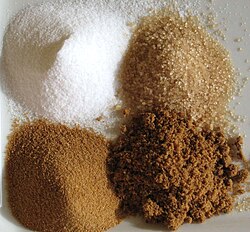
Sugars (clockwise from top-left): white refined, unrefined, brown, unprocessed cane sugar

Sugar cane plantation

Sucrose: a disaccharide of glucose (left) and fructose (right)

World production of raw sugar, main producers

Misri crystals

Sugar cubes

Brown sugar examples: Muscovado (top), dark brown (left), light brown (right)
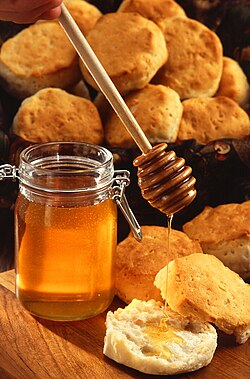
A jar of honey with a dipper and a biscuit

Brown sugar crystals

Whole date sugar

Whole cane sugar (grey), vacuum-dried

Whole cane sugar (brown), vacuum-dried

raw sugar closeup