Suez Crisis
The Suez Canal transitioned from a vital British colonial artery into a flashpoint for Egyptian nationalist defiance.
The Suez Canal transitioned from a vital British colonial artery into a flashpoint for Egyptian nationalist defiance.
Opened in 1869 and largely financed by the French and Egyptians, the canal provided the shortest sea route between Europe and the Indian Ocean. Britain, recognizing its strategic value for trade and troop movement, bought a 44% stake in 1875 and eventually occupied Egypt in 1882 to secure its "lifeline" to India. Although the 1888 Convention of Constantinople declared the canal a neutral zone, Britain repeatedly closed it to enemies during the World Wars, treating the sovereign Egyptian territory as a private military asset.
After WWII, the canal became even more critical for oil shipments, with two million barrels passing through daily. However, the presence of one of the world's largest military bases at Suez became an unbearable symbol of colonialism for Egyptians. The 1952 revolution, led by the Free Officers Movement and Gamal Abdel Nasser, overthrew the monarchy and set the stage for a final showdown over who truly controlled the desert waterway.
Nasser’s attempt to balance Cold War superpowers forced the U.S. into a diplomatic crisis with its own NATO allies.
Nasser’s attempt to balance Cold War superpowers forced the U.S. into a diplomatic crisis with its own NATO allies.
In the early 1950s, the Eisenhower administration attempted a policy of "even-handedness," trying to court Arab nationalists like Nasser to prevent Soviet expansion in the Middle East. Nasser, however, refused to join Western-backed defense pacts, preferring an Egyptian-led Arab bloc. He skillfully played both sides, accepting a $3 million bribe from the CIA while simultaneously negotiating a massive arms deal with the Soviet bloc in 1955 to counter Israeli military power.
The tension peaked in 1956 when Nasser officially recognized Communist China. This move, combined with concerns over Egypt's stability, prompted Secretary of State John Foster Dulles to withdraw American funding for the Aswan High Dam. Nasser retaliated within days by nationalizing the Suez Canal, intending to use its tolls to fund the dam himself. This unilateral act blindsided the British and French, effectively ending the era of "gentlemanly" colonial diplomacy.
The 1956 invasion was a "Tripartite Aggression" driven by three distinct, secret agendas.
The 1956 invasion was a "Tripartite Aggression" driven by three distinct, secret agendas.
The military response was not a unified front but a marriage of convenience. Israel struck first on October 29, 1956, seeking to break an eight-year Egyptian blockade of the Straits of Tiran and stop fedayeen raids. France joined the conspiracy primarily to punish Nasser for supporting Algerian rebels fighting for independence. Meanwhile, the British, led by a Prime Minister Anthony Eden who was increasingly obsessed with Nasser, sought to reclaim the canal and restore Britain's waning prestige as a global power.
This secret alliance backfired when the "joint ultimatum" issued by Britain and France was revealed as a pretext for invasion. Rather than a quick victory, the intervention triggered immediate and heavy political pressure from both the U.S. and the Soviet Union. Eisenhower was particularly incensed that his allies had launched a colonial war without his consent, threatening the stability of the Western alliance and handing a propaganda victory to the USSR.
The conflict’s resolution signaled the end of European imperial dominance and the birth of modern UN peacekeeping.
The conflict’s resolution signaled the end of European imperial dominance and the birth of modern UN peacekeeping.
The withdrawal of British and French forces under American financial and political pressure was a watershed moment in history. It proved that the old colonial powers could no longer act independently of the two new superpowers. While Israel achieved its goal of opening the Straits of Tiran, Britain suffered a "national humiliation" that many historians cite as the definitive end of its status as a global superpower. Prime Minister Eden’s career never recovered.
The crisis also produced a lasting diplomatic innovation: the first United Nations Emergency Force (UNEF). Canadian diplomat Lester B. Pearson won the Nobel Peace Prize for organizing this force to patrol the Egypt-Israel border, creating the blueprint for modern international peacekeeping. Ironically, while the West was fractured by the crisis, the Soviet Union likely used the distraction to invade Hungary, demonstrating that the Suez Crisis had global ripples far beyond the banks of the canal.

Image from Wikipedia
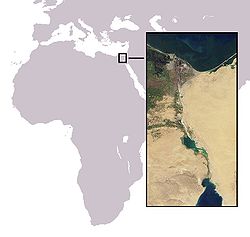
The location of the Suez Canal, which connects the Mediterranean and the Indian Ocean via the Red Sea

Port Said, at the entrance to the Suez Canal from the Mediterranean

Australian prime minister Robert Menzies led an international committee in negotiations with Nasser in September 1956, which sought to achieve international management of the Suez Canal. The mission was a failure.

Israeli M4A4 Shermans were also used in the Sinai campaign.

An Israeli AMX-13, shown here from the rear and side

Anglo-French para drops on the Suez Canal and Israeli conquest of Sinai

Israeli paratrooper near the Mitla Pass

Israeli paratroopers dig in near the Parker Memorial.

Ibrahim el Awal after its capture by the Israeli Navy

A battle-damaged de Havilland Sea Venom on HMS Eagle

A Hawker Sea Hawk of 899 Naval Air Squadron, armed with rockets, about to be launched from the aircraft carrier HMS Eagle for a strike on an Egyptian airfield
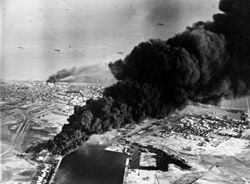
Smoke rises from oil tanks beside the Suez Canal hit during the initial Anglo-French assault on Port Said, 5 November 1956.

Troops of the Parachute Regiment escort a captured Egyptian soldier at Port Said.

A British link up between the 3rd Battalion, The Parachute Regiment, and the Commandos at the Coast Guard barracks in Port Said. The paratroopers have with them a captured SU-100 tank destroyer, and the Commandos a Buffalo amphibious assault vehicle.