String theory
Fundamental reality is composed of vibrating loops rather than point-like particles
Fundamental reality is composed of vibrating loops rather than point-like particles
In traditional physics, electrons and quarks are treated as zero-dimensional points. String theory replaces these "dots" with one-dimensional "strings." Just as a guitar string can produce different musical notes depending on how it vibrates, these fundamental strings produce different particles. One vibration frequency makes an electron; another makes a photon or a graviton.
This shift resolves a massive headache in physics: the "smearing" of interactions. When point-particles collide, the math often results in "infinities" that break the equations. Because strings have length, they spread out these interactions over a small amount of space, making the mathematics of the universe significantly more manageable and consistent.
The universe requires six or seven "hidden" dimensions to function mathematically
The universe requires six or seven "hidden" dimensions to function mathematically
We experience a world of four dimensions (up-down, left-right, forward-back, and time). However, the mathematics of string theory only works if there are at least 10 or 11 dimensions. To explain why we don’t see them, theorists suggest these extra dimensions are "compactified"—curled up so tightly into complex shapes called Calabi-Yau manifolds that they are invisible to our current technology.
The specific way these dimensions are curled determines the laws of physics in our macro-world. If the geometry of these hidden shapes were slightly different, the particles in our universe would have different masses or charges. This suggests that the "constants of nature" aren't random; they are dictated by the geometry of the unseen.
String theory provides the first viable bridge between gravity and the quantum world
String theory provides the first viable bridge between gravity and the quantum world
For a century, physics has been a "house divided." General Relativity explains the big stuff (stars, gravity) perfectly, while Quantum Mechanics explains the tiny stuff (atoms, subatomic forces). However, they refuse to work together; at the center of a black hole, the math of both theories collapses into nonsense.
String theory is the leading candidate for a "Theory of Everything" because it naturally includes a particle for gravity—the graviton—within a quantum framework. By treating gravity as just another vibrational state of a string, it allows the large-scale curvature of space-time to coexist with the jittery, probabilistic nature of the subatomic world.
Five competing versions of the theory turned out to be different perspectives of a single "M-theory"
Five competing versions of the theory turned out to be different perspectives of a single "M-theory"
In the 1980s, physicists were frustrated to find five distinct, mathematically consistent versions of string theory. It seemed unlikely that there were five different "Theories of Everything." In 1995, physicist Edward Witten sparked the "Second Superstring Revolution" by showing that these five theories were actually just different limits of a more fundamental, 11-dimensional framework called M-theory.
M-theory introduced "branes" (membranes)—objects with more than one dimension that strings can attach to. This realization suggested that our entire three-dimensional universe might be a "3-brane" floating in a higher-dimensional space, potentially explaining why gravity feels so much weaker than other forces: it might be "leaking" out into the extra dimensions.
The theory's greatest strength—its vast mathematical flexibility—is also its primary criticism
The theory's greatest strength—its vast mathematical flexibility—is also its primary criticism
Despite its elegance, string theory has a "falsifiability" problem. There are an estimated $10^{500}$ different ways to curl up the extra dimensions, each resulting in a different universe with different physics. This "Landscape" is so vast that the theory can essentially be tuned to explain almost any observation, making it difficult to prove or disprove through traditional experiments.
Critics argue that because string theory functions at the "Planck scale"—sizes trillions of times smaller than an atom—we may never have a particle accelerator powerful enough to see a string directly. For some, this moves string theory out of the realm of hard physics and into the realm of "mathematical philosophy" until a definitive, testable prediction can be made.

The fundamental objects of string theory are open and closed strings.

Interaction in the quantum world: worldlines of point-like particles or a worldsheet swept up by closed strings in string theory

An example of compactification: At large distances, a two dimensional surface with one circular dimension looks one-dimensional.
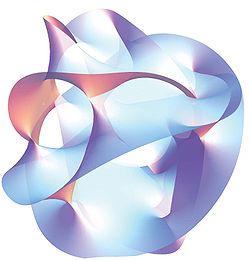
A cross section of a quintic Calabi–Yau manifold

A diagram of string theory dualities. Blue edges indicate S-duality. Red edges indicate T-duality.

Open strings attached to a pair of D-branes

A schematic illustration of the relationship between M-theory, the five superstring theories, and eleven-dimensional supergravity. The shaded region represents a family of different physical scenarios that are possible in M-theory. In certain limiting cases corresponding to the cusps, it is natural to describe the physics using one of the six theories labeled there.

A tessellation of the hyperbolic plane by triangles and squares

Three-dimensional anti-de Sitter space is like a stack of hyperbolic disks, each one representing the state of the universe at a given time. The resulting spacetime looks like a solid cylinder.

A magnet levitating above a high-temperature superconductor. Today some physicists are working to understand high-temperature superconductivity using the AdS/CFT correspondence.

A map of the cosmic microwave background produced by the Wilkinson Microwave Anisotropy Probe

The Clebsch cubic is an example of a kind of geometric object called an algebraic variety. A classical result of enumerative geometry states that there are exactly 27 straight lines that lie entirely on this surface.

An equilateral triangle can be rotated through 120°, 240°, or 360°, or reflected in any of the three lines pictured without changing its shape.

A graph of the j-function in the complex plane

Leonard Susskind