Spice trade
Austronesian sailors established the first global maritime networks millennia before the European Age of Discovery.
Austronesian sailors established the first global maritime networks millennia before the European Age of Discovery.
Long before the rise of Rome or the Silk Road, Austronesian peoples in Southeast Asia were the true architects of maritime trade. By 1500 BC, ancient Indonesian sailors had mastered the Indian Ocean, establishing routes from Southeast Asia to India and eventually reaching East Africa. Using advanced boat-building technology—like catamarans and outrigger boats—they moved cloves and nutmeg from the endemic Maluku Islands to distant civilizations.
This early network was so expansive that it led to the Austronesian colonization of Madagascar. These sailors didn't just move goods; they carried a biological and technological "kit" that included coconuts, bananas, and sugarcane. Their mastery of the westerlies and monsoon winds created a "Maritime Silk Road" that linked the material cultures of India, China, and the Arab world long before Western explorers arrived.
For centuries, the spice trade was a high-stakes game of "middlemen" that funneled massive wealth into the Islamic world and Italian city-states.
For centuries, the spice trade was a high-stakes game of "middlemen" that funneled massive wealth into the Islamic world and Italian city-states.
Following the rise of Islam in the 7th century, Arab traders gained a near-total monopoly over the western Indian Ocean. Merchants from Yemen and Oman navigated to the secret "Spice Islands" (the Moluccas), bringing goods back to ports like Basra and Jeddah. From there, spices were moved overland through the Levant to the Mediterranean. This era inspired the legends of Sinbad the Sailor and turned Baghdad into a global hub of wealth and culture.
At the European end of the chain, the Republics of Venice and Genoa acted as the exclusive gatekeepers. Because they controlled the maritime routes of the Mediterranean, they could dictate prices to the rest of Europe. Spices like black pepper and ginger became so expensive they were used as currency and medicine, making these Italian maritime republics the wealthiest entities in the Western world during the Middle Ages.
The European Age of Discovery was effectively an economic insurgency designed to break the Venetian and Ottoman monopoly.
The European Age of Discovery was effectively an economic insurgency designed to break the Venetian and Ottoman monopoly.
By the 15th century, the fall of Constantinople to the Ottoman Turks squeezed the traditional land routes, forcing Western European powers to look for a "back door" to Asia. The Portuguese were the first to bypass the Mediterranean middlemen by sailing around the southern tip of Africa. In 1498, Vasco da Gama reached India, opening the Cape Route and allowing Portugal to establish the first European seaborne empire.
This shifted the center of global gravity from the Mediterranean to the Atlantic. Soon, Spain entered the fray, funding Christopher Columbus and later Ferdinand Magellan to find a westward route. This competition resulted in the first truly global trade network: the Manila Galleon route, which linked Asia to the Americas (Mexico) and then to Europe. By the 17th century, the Dutch further optimized this by pioneering direct ocean routes that bypassed traditional coastal ports entirely.
Trade routes served as a massive biological and technological conveyor belt, spreading religions and crops across three continents.
Trade routes served as a massive biological and technological conveyor belt, spreading religions and crops across three continents.
The spice trade was the primary engine of cultural diffusion for two thousand years. Hinduism and Buddhism traveled along these routes from India into Southeast Asia, where religious establishments often acted as economic patrons for local commerce. Later, Islam spread through the same maritime networks, following the path of Arab merchants into Indonesia and Malaysia.
Technologically, the world owes much of its early maritime expertise to this trade. The "lateen" sail, plank-sewn hulls, and catamarans were all innovations introduced or refined through the needs of spice merchants. The trade also permanently altered global diets and landscapes; crops like ginger, turmeric, and yams were introduced to Africa and the Middle East, while the search for "Indies" spices accidentally led to the global exchange of New World foods like chili peppers and potatoes.

The Silk Road (red) and spice trade routes (blue).

The spice trade from India attracted the attention of the Ptolemaic Kingdom, and subsequently the Roman Empire.
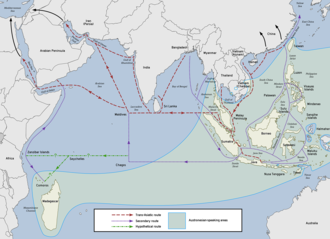
Austronesian proto-historic and historic maritime trade network in the Indian Ocean
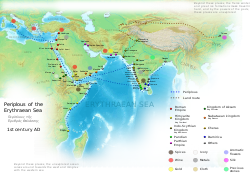
Roman trade with India according to the Periplus of the Erythraean Sea, 1st century.

Trade route in the Red Sea linking Italy to south-west India

Spice merchant in Nuremberg, 1453.
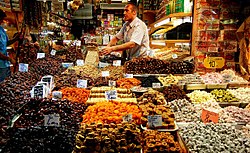
Spice Bazaar used for the spice trade during the Ottoman Empire in Istanbul

Portuguese India Armadas trade routes (blue) since Vasco da Gama 1498 travel and its rival Manila-Acapulco galleons and Spanish treasure fleets (white) established in 1568

Image of Calicut, India from Georg Braun and Frans Hogenberg's atlas Civitates orbis terrarum, 1572.

Dutch ships in Table Bay docking at the Cape Colony at the Cape of Good Hope, 1762.

Portugal claimed the Indian Ocean as its mare clausum during the Age of Discovery.

One of the Borobudur ships from the 8th century. These were depictions of large Javanese outrigger vessels. One is shown here with the characteristic tanja sail of Southeast Asian Austronesians.

Ipanitika