Maluku Islands
The Maluku archipelago once held a global monopoly on spices that fueled the Age of Discovery.
The Maluku archipelago once held a global monopoly on spices that fueled the Age of Discovery.
For centuries, the world’s entire supply of nutmeg, mace, and cloves came from this handful of islands and nowhere else. This biological lottery made the archipelago some of the most valuable real estate on Earth, drawing Arab, Chinese, and eventually European traders into a high-stakes race for control.
The quest for Malukan spices was the primary engine of global exploration. It was the desire to find a direct route to these "Spice Islands" that motivated Christopher Columbus to sail west and Ferdinand Magellan to circumnavigate the globe. These tiny volcanic outcrops were the pivot point upon which the modern global economy began to turn.
Positioned across the Wallace Line, the islands are a living laboratory of evolutionary divergence.
Positioned across the Wallace Line, the islands are a living laboratory of evolutionary divergence.
Maluku sits within "Wallacea," a biological transition zone between the Asian and Australian continental shelves. Because the islands are separated by deep-water trenches that never formed land bridges during ice ages, they host a surreal mix of species: placental mammals from the west meet marsupials from the east.
The isolation of these 1,000+ islands has fostered extreme endemism. From the vibrant Birds of Paradise to unique kingfishers and giant butterflies, the region served as a critical site for Alfred Russel Wallace to independently conceive the theory of evolution by natural selection while he collected specimens there in the mid-19th century.
The Dutch East India Company enforced spice control through systematic violence and corporate militarization.
The Dutch East India Company enforced spice control through systematic violence and corporate militarization.
When the Dutch (VOC) arrived, they transitioned the spice trade from commerce to conquest. To secure a total monopoly on nutmeg, the VOC orchestrated the 1621 massacre of the Banda Islands' indigenous population, replacing them with enslaved laborers and Dutch overseers.
To maintain artificially high prices, the Dutch practiced "extirpation"—the systematic uprooting and burning of clove and nutmeg trees on any island not under their direct supervision. This turned the archipelago into a "spice fortress," where the ecological landscape was dictated by European ledger books rather than local needs.
Modern Maluku is a complex tapestry of religious and ethnic identities shaped by centuries of migration.
Modern Maluku is a complex tapestry of religious and ethnic identities shaped by centuries of migration.
The islands have long been a crossroads where Islam (introduced via trade in the 14th century) and Christianity (introduced by Portuguese and Dutch missionaries) exist in close proximity. This diversity created a unique social fabric but also became a fault line during the sectarian conflict that erupted between 1999 and 2002.
Since the peace agreements, the region has focused on "Pela-Gandong," a traditional system of inter-village alliances that transcends religious boundaries. This indigenous social contract has been vital in restoring stability, proving that the islands' oldest traditions are often their most effective tools for modern survival.
The archipelago’s geography is a tectonic jigsaw puzzle defined by intense volcanic activity.
The archipelago’s geography is a tectonic jigsaw puzzle defined by intense volcanic activity.
Maluku is one of the most seismically active regions on the planet, situated at the meeting point of four tectonic plates. The islands are essentially the tops of submerged mountain ranges or volcanic peaks rising sharply from some of the deepest ocean trenches in the world.
This geology is a double-edged sword. While the volcanic ash provides the incredibly fertile soil required for the demanding spice trees to thrive, it also leaves the population in a state of constant vigilance against eruptions and tsunamis. The landscape is a testament to the raw power of the "Ring of Fire," where beauty and fertility are inextricably linked to geological danger.

Image from Wikipedia

Map by Willem Blaeu (1630)

Drawing of Ternate by a presumably Dutch artist. Inset shows Saint John Baptist Portuguese-built fort on the island

An orembai, a common traditional sailing vessel of the Maluku Islands

Fort Duurstede in Saparua, 1846

Tanimbar warriors
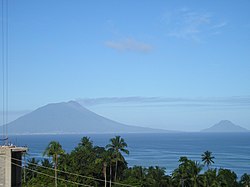
Ternate Island, as seen from Halmahera

From The Malay Archipelago by Alfred Wallace (1869): illustration of king and twelve-wired birds-of-paradise by John Gerrard Keulemans.
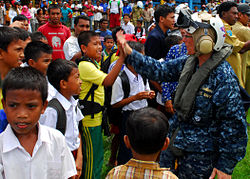
People of Tidore during visit by hospital ship USNS Mercy (T-AH-19)