Battle of Stalingrad
Hitler’s obsession with the Caucasus oil fields turned a tactical flank-guard into a fatal strategic trap.
Hitler’s obsession with the Caucasus oil fields turned a tactical flank-guard into a fatal strategic trap.
Originally, Stalingrad was not the primary target of the 1942 German summer offensive, Case Blue. The goal was the oil-rich Caucasus to the south. Stalingrad was meant to be a secondary objective—a way to cut the Soviet supply line on the Volga River and protect the German flank. However, as the German 6th Army approached, the city’s symbolic name and its industrial capacity drew both Hitler and Stalin into a prestige-driven meat grinder.
The German High Command diverted massive resources away from the primary oil objective to seize the city. This created a strategic overextension: the deeper the Germans pushed into the ruins of Stalingrad, the longer and thinner their flanks became. These flanks were eventually held by poorly equipped Romanian, Italian, and Hungarian troops, creating a vulnerability that the Soviet leadership was quick to identify and exploit.
The ruins of the city leveled the playing field, transforming blitzkrieg into "Rattenkrieg."
The ruins of the city leveled the playing field, transforming blitzkrieg into "Rattenkrieg."
The German military was built for Bewegungskrieg (maneuver warfare), but Stalingrad forced them into a static, claustrophobic nightmare they called "Rat War." Massive aerial bombardments by the Luftwaffe initially cleared the way but backfired by creating a labyrinth of rubble. These ruins provided the perfect cover for Soviet snipers and small "storm groups" to negate the German advantages in tanks and heavy artillery.
Fighting was measured not in miles, but in meters, floors, and rooms. The "hugging the enemy" tactic—where Soviet troops stayed as close to German lines as possible to prevent German air and artillery support—turned every basement and sewer into a fortress. It was a war of attrition where the survival of a soldier was often measured in hours, and the industrial capacity of the Soviet Union to funnel "human material" into the city began to outpace German logistics.
Operation Uranus exploited a massive intelligence failure to execute the most decisive encirclement in history.
Operation Uranus exploited a massive intelligence failure to execute the most decisive encirclement in history.
While the German 6th Army was focused on the bitter street fighting, the Soviet Stavka (High Command) quietly amassed over a million men and thousands of tanks for a massive double-envelopment. German intelligence failed to realize the scale of this buildup, believing the Red Army was too exhausted for a major offensive. On November 19, 1942, the Soviets struck the weak Romanian forces guarding the German flanks, collapsing them in days.
The pincer movement met at Kalach, trapping approximately 250,000 Axis soldiers in a pocket known as the Kessel (Cauldron). Hitler, refusing to allow a breakout or surrender, ordered the 6th Army to hold its ground, promising they would be supplied by air. This decision doomed the army; the Luftwaffe could provide only a fraction of the necessary food and fuel, leaving the trapped soldiers to freeze and starve while the Soviet ring tightened.
The German surrender shattered the myth of Wehrmacht invincibility and shifted the war's momentum permanently.
The German surrender shattered the myth of Wehrmacht invincibility and shifted the war's momentum permanently.
The surrender of Field Marshal Friedrich Paulus in February 1943 was a psychological earthquake. It was the first time an entire German field army had been destroyed and its commander captured. Of the 91,000 Germans who went into captivity at the end of the battle, only about 5,000 would ever return home. The loss of equipment and experienced manpower was a blow from which the Axis forces on the Eastern Front never fully recovered.
Beyond the numbers, Stalingrad ended the era of German strategic initiative. From this point forward, the German military was largely in a state of retreat or "active defense," while the Soviet Union gained the confidence and logistical rhythm to push toward Berlin. It remains the bloodiest battle in human history, with combined casualties estimated at nearly two million, marking the moment when the eventual defeat of Nazi Germany became a matter of "when," not "if."

Image from Wikipedia

Case Blue: German advances from 7 May 1942 to: 7 July 22 July 1 August 18 November

German and Romanian command personnel consult in a field position near the Don River, August 1942.

The German advance to the Don River between 7 May and 23 July

German infantry and a supporting StuG III assault gun during the battle

The German advance to Stalingrad between 24 July and 18 November

Smoke over the city centre after aerial bombing by the German Luftwaffe on the central station

German soldiers clearing the streets in Stalingrad
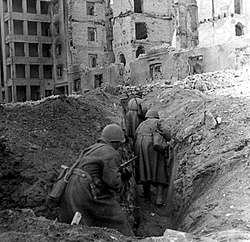
Soviet soldiers running through trenches in the ruins of Stalingrad

October 1942: A German soldier with a Soviet PPSh-41 submachine gun in Barrikady factory rubble

Pavlov's House (1943)

Soviet soldiers in the Red October Factory

Soviet soldiers in one of the shops of the Red October Factory

Junkers Ju 87 Stuka dive bombers above the burning city

Clouds of smoke and dust rise from the ruins of the canning factory in Stalingrad South after German bombing of the city on 2 October 1942.