Salt
Salt is a simple ionic crystal that radically alters the physical properties of water.
Salt is a simple ionic crystal that radically alters the physical properties of water.
At its core, salt is sodium chloride (NaCl), a mineral that forms translucent, cubic crystals. While it appears white when granulated, impurities can tint it blue or purple. Its most profound characteristic is its interaction with water: it is highly soluble (359g per liter) and significantly lowers the freezing point of water to as low as -21°C. This chemical "magic" is why salt is indispensable for de-icing winter roads and why a saturated salt solution boils at a much higher temperature (108.7°C) than pure water.
When salt dissolves, it separates into sodium (Na+) and chlorine (Cl−) ions. This transformation makes it a powerful electrolyte, capable of conducting electricity and managing the movement of fluids across biological membranes. In its natural, unrefined state—as sea salt or "halite" rock salt—it often contains trace minerals like magnesium and calcium, which contribute to the varied "mineralities" and bitter overtones prized by chefs.
For millennia, salt was a strategic currency that built roads, financed empires, and sparked revolutions.
For millennia, salt was a strategic currency that built roads, financed empires, and sparked revolutions.
Before modern refrigeration, salt was the world's most vital preservative, making it a "white gold" that dictated the flow of power. Civilizations like the ancient Egyptians and Phoenicians built entire trade empires on salted fish. In Africa, slabs of rock salt were used as literal coins, while the Roman Empire constructed specialized "salt roads" to ensure a steady supply to the capital. The word "salary" derives from the Latin for salt, and "salad" literally means "salted," reflecting the Roman practice of seasoning greens.
Because salt is a universal necessity, governments have historically used it as a tool for revenue and control. Oppressive salt taxes were a primary trigger for the French Revolution and inspired Mahatma Gandhi’s 1930 "Dandi March," a 240-mile act of civil disobedience against British colonial salt laws. Nations have even gone to war over salt deposits, such as the El Paso Salt War in the 1860s, proving that control over this mineral was once synonymous with national security.
Humans are biologically wired to crave the very mineral that enables nerve function but threatens heart health in excess.
Humans are biologically wired to crave the very mineral that enables nerve function but threatens heart health in excess.
Salt is one of the five basic human tastes, and for good reason: sodium is an essential electrolyte required for nerve impulses and muscle function. Without it, the body cannot maintain fluid balance. However, the modern diet has turned this biological necessity into a health risk. While the World Health Organization recommends a limit of 5 grams (about one teaspoon) of salt per day, most people consume far more, primarily through processed foods.
The danger lies in salt’s role as an osmotic solute. High salt intake increases blood volume, which puts persistent pressure on the cardiovascular system. This has made excessive salt consumption a leading driver of hypertension and heart disease globally. Despite its reputation as a "seasoning," salt is physiologically active, and the gap between a "therapeutic" dose and a "toxic" dose is surprisingly narrow in the context of the modern food environment.
The vast majority of global salt production is consumed by machines and chemical plants, not people.
The vast majority of global salt production is consumed by machines and chemical plants, not people.
While we associate salt primarily with the kitchen, human consumption accounts for only a tiny fraction of the 300 million tonnes produced annually. Salt is the primary "feedstock" for the global chemical industry. It is broken down to produce caustic soda and chlorine, which are essential for manufacturing everything from polyvinyl chloride (PVC) plastics to paper pulp. If you are touching plastic or using paper, salt was likely involved in its creation.
Beyond the factory, salt is used on a massive scale for infrastructure and agriculture. It is the primary tool for highway de-icing and is used extensively in water conditioning systems to "soften" hard water. In the agricultural sector, salt is a necessary supplement for livestock, particularly for herbivores whose plant-based diets are naturally low in sodium compared to animal tissues.
Table salt serves as a global delivery vehicle for essential micronutrients that prevent widespread disability.
Table salt serves as a global delivery vehicle for essential micronutrients that prevent widespread disability.
Because salt is used by almost everyone regardless of socioeconomic status, it has become the world’s most effective "bio-hack" for public health. Since 1924, many countries have added minute amounts of iodine to table salt. This simple addition has been the single most effective tool in preventing iodine deficiency—the leading cause of preventable intellectual disabilities and goiters worldwide, affecting roughly two billion people.
In the developing world, fortification goes even further. "Doubly fortified salt" includes iron to combat anemia, which affects 40% of infants in some regions. Other additives include folic acid to prevent birth defects and fluoride to reduce tooth decay in areas without fluoridated water. To keep this fortified salt usable, manufacturers add anti-caking agents like sodium ferrocyanide or magnesium carbonate, ensuring the salt remains free-flowing even in humid environments.

Rock salt (halite)

Salt production in Halle, Saxony-Anhalt, 1670

Ponds near Maras, Peru, fed from a mineral spring and used for salt production since pre-Inca times

A SEM image of a grain of table salt

Comparison of table salt with kitchen salt. Shows a typical salt shaker and salt bowl with salt spread before each on a black background.

Himalayan salt is halite with a distinct pink colour.

The Sifto Canada salt mine and processing plant at the harbor in Goderich, Ontario, Canada
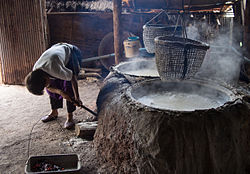
Brine from salt wells is boiled to produce salt at Nan Province, Thailand
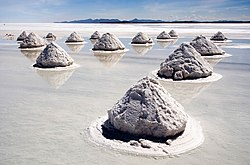
Salt mounds in Salar de Uyuni, Bolivia

Sea-salt pans in Tamil Nadu, India

Salt balls in Borkou province, Chad

Bread and salt at a Russian wedding ceremony