Sake
Sake is a "brewed" beverage, more akin to beer than wine, utilizing a rare simultaneous fermentation process.
Sake is a "brewed" beverage, more akin to beer than wine, utilizing a rare simultaneous fermentation process.
While often called "rice wine," sake’s chemistry is closer to beer. In wine, fruit provides natural sugars for yeast to consume. In beer, starch is converted to sugar, and then sugar to alcohol. Sake is unique because it uses "Multiple Parallel Fermentation." A specific mold called kōji converts rice starch into sugar at the exact same time that yeast converts that sugar into alcohol in the same vat.
This complex synchronization results in a naturally high alcohol content. Undiluted sake typically sits at 18–20% ABV, significantly higher than most wines (9–16%) or beers (3–9%). Though it is often diluted with water before bottling to make it more approachable, the "raw" strength of the beverage is a byproduct of this hyper-efficient dual fermentation.
Medieval Buddhist temples served as the R&D centers that standardized the core techniques of modern brewing.
Medieval Buddhist temples served as the R&D centers that standardized the core techniques of modern brewing.
The origins of sake are murky, likely arriving from China around 500 BCE, but the "true" sake we recognize today was perfected by monks. During the Muromachi period (1333–1573), the Shōryaku-ji temple became a laboratory for innovation. Monks developed the "three-stage fermentation" and the use of polished rice, which stabilized quality and allowed for larger-scale production.
Remarkably, these monks were practicing pasteurization (hiire) hundreds of years before Louis Pasteur was born. They also developed the "starter mash" technique using lactic acid fermentation to keep batches from spoiling. These temple-born methods were so effective that they remain the bedrock of the industry today, earning the period the reputation as the birthplace of refined, clear sake (seishu).
Aggressive government taxation in the Meiji era fundamentally reshaped the industry by banning home brewing and traditional wooden tubs.
Aggressive government taxation in the Meiji era fundamentally reshaped the industry by banning home brewing and traditional wooden tubs.
In the late 19th century, the Japanese government became heavily reliant on sake taxes, which at one point accounted for nearly 40% of all national tax revenue. To maximize this "liquid gold," the government banned home brewing in 1899—an act that effectively killed a centuries-old folk tradition overnight to force citizens to buy taxed, commercial products.
The state also forced a shift from traditional wooden tubs to enamel-coated steel tanks. While the government claimed this was for hygiene, the real motivation was math: wooden tubs absorbed about 3% of the sake through evaporation. By switching to steel, the government could tax every drop that would have otherwise vanished into the wood. This policy almost erased the traditional craft of wooden-vat brewing, which is only now seeing a small, artisanal resurgence.
The 20th-century obsession with "polishing" rice transformed sake from a rustic staple into a refined, fruity luxury.
The 20th-century obsession with "polishing" rice transformed sake from a rustic staple into a refined, fruity luxury.
Modern premium sake (ginjō) is defined by the milling process. Because the outer layers of a rice grain contain fats and proteins that create "off" flavors, brewers use specialized machines to grind the grain down to its starchy core. In 1930, the invention of the vertical milling machine allowed brewers to polish away 50% or more of the grain, leading to a much cleaner, more aromatic profile.
This technical leap, combined with the isolation of specific yeast strains like "Kyokai No. 9," created a profile previously unknown in sake: notes of apple, banana, and melon. These "fruity" sakes were originally brewed only for competitions, but they became a global sensation in the 1980s, shifting the perception of sake from a warm, rough drink for the working class to a sophisticated chilled beverage for the global elite.
While domestic consumption is in a slow decline, a massive global export boom is fueling a 21st-century "Sake Renaissance."
While domestic consumption is in a slow decline, a massive global export boom is fueling a 21st-century "Sake Renaissance."
The rise of beer, wine, and Western spirits in Japan has caused domestic sake consumption to drop steadily since the 1970s, leading to the closure of over a thousand breweries. However, the international market is moving in the opposite direction. Sake exports have sextupled since 2009, driven by the global popularity of Japanese cuisine and a growing appreciation for premium grades like Daiginjō.
This "outward" focus is bringing new life to the craft. Brewers are now experimenting with ancient techniques, such as using "black kōji" (typically reserved for shōchū) or returning to open-air fermentation in wooden vats. As sake becomes a "world beverage," with new breweries opening in the US, Australia, and Europe, the industry is balancing 1,000 years of tradition with a high-tech, global future.

Image from Wikipedia

Sake bottle, Japan, c. 1740

Sake barrel offerings at the Shinto shrine Tsurugaoka Hachimangū in Kamakura

A pair of sake flasks painted in gold and black lacquer. Momoyama period, 16th century.

Title page of Bereiding van Sacki, by Isaac Titsingh: earliest explanation of the sake brewing process in a European language. Published in 1781, in Batavia, Dutch East Indies.

Sake brewery in Takayama, with a sugidama globe of cedar leaves indicating new sake

Yamada Nishiki

Sake made with Kyokai yeast "Akairo kōbo" for pink nigorizake
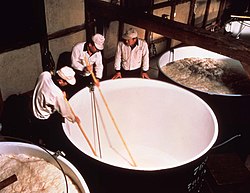
Moromi (the main fermenting mash) undergoing fermentation

The blue sake bottle displays "Yamada Nishiki" (山田錦) and "Junmai Daiginjo" (純米大吟醸) on the bottom label and "Bingakoi muroka nama genshu" (瓶囲無濾過生原酒) and "requiring refrigeration" (要冷蔵) on the top label. The label on the pink sake bottle indicates Usunigori muroka nama genshu.

Nigori, or unfiltered sake

Ine to Agave Brewery's Craft sake. The product on the left is made with hassaku as a secondary ingredient, the one in the middle with hops, and the one on the right with coffee.

Overflowing glass inside a masu

"Sake Ewer from a Portable Picnic Set", Japan, c. 1830–1839

Sugitama (杉玉), globes of cedar leaves, at a brewery