Saffron
Saffron is a sterile, man-made clone that relies entirely on human intervention to survive.
Saffron is a sterile, man-made clone that relies entirely on human intervention to survive.
Crocus sativus is a genetic oddity known as a triploid. Because it possesses three sets of chromosomes, it is incapable of producing viable seeds or reproducing sexually. Every saffron plant in existence today is a descendant of a specific mutant ancestor, propagated manually by humans over thousands of years through the physical division of underground corms (bulb-like organs).
If humans stopped digging up, dividing, and replanting these corms, the species would likely go extinct within a few seasons. This "domesticated" status means the plant is unknown in the wild; it is an obligate partner to human agriculture, thriving only where we provide the loose, well-drained clay soils and the specific "divide-and-set" labor it requires.
The spice’s staggering price is a direct reflection of a manual labor requirement that defies industrialization.
The spice’s staggering price is a direct reflection of a manual labor requirement that defies industrialization.
Saffron is the world's costliest spice—often exceeding $5,000 per kilogram—because it is a "hand-harvested concentration of effort." To produce just one kilogram of dry saffron, workers must hand-pick roughly 150,000 flowers. This translates to approximately 40 hours of intensive manual labor just for the picking, not including the delicate task of stripping the stigmas from the petals.
The yield is microscopic: one freshly picked flower produces only 7mg of dried spice. After the moisture is removed, the final product retains only about 13% of its original weight. Because the flowers bloom in a narrow one-to-two-week window and wilt within hours of sunrise, the harvest is a frantic, high-stakes race against time that cannot be automated.
A trio of specific phytochemicals defines saffron’s sensory profile and industrial value.
A trio of specific phytochemicals defines saffron’s sensory profile and industrial value.
Saffron’s identity is driven by three primary molecules: crocin provides the intense golden-yellow dye; picrocrocin provides the pungent, bitter flavor; and safranal creates the signature hay-like aroma. Interestingly, safranal is not present in high concentrations in the living flower; it is a "born" compound, created by heat and enzymatic action during the drying process.
These compounds are chemically volatile. Saffron is highly sensitive to light and fluctuating pH levels, which cause its molecular structure to break down. To maintain its potency, it must be stored in airtight containers; otherwise, the "gold-strung" threads lose their ability to color water and their complex fragrance profile rapidly fades into a generic bitterness.
Quality is a measure of "redness," driving a complex global grading system and frequent market fraud.
Quality is a measure of "redness," driving a complex global grading system and frequent market fraud.
In the saffron trade, "red is power." Potency is concentrated in the vivid crimson stigmas; the yellow styles (the stalks connecting the stigma to the plant) have almost no culinary value. The highest grades, such as Iranian Sargol or Spanish Coupé, consist only of the red tips. Lower grades, like Pushal, leave more of the yellow style attached to increase the weight.
Because Iran produces 90% of the world's supply, "origin fraud" is a significant industry issue. Iranian saffron is frequently shipped to Spain or Kashmir, mixed with local crops, and re-branded to fetch the premium prices associated with those regions. This has led to the creation of ISO 3632 laboratory standards and Protected Designation of Origin (PDO) status for genuine European varieties to protect consumers from diluted or mislabeled products.
The etymology of saffron traces 3,500 years of Persian cultural dominance.
The etymology of saffron traces 3,500 years of Persian cultural dominance.
The English word saffron traces its lineage back through Old French and Latin to the Persian word zarparān, meaning "gold-strung." This name refers to either the flower's valuable filaments or the rich golden hue it imparts to textiles and food. Saffron has been a staple of Eurasian trade for over three millennia, appearing in 7th-century BC Assyrian botanical treatises.
While it has been used historically in medicine, perfumery, and religious rituals, its most enduring legacy is in Persian cuisine. From the crispy crust of tahdig to the dessert sholeh-zard, saffron is the fundamental aromatic of the Iranian plateau, serving as a symbol of hospitality and ancient culinary heritage.

Saffron crocus, Crocus sativus, with its vivid crimson stigmas and styles
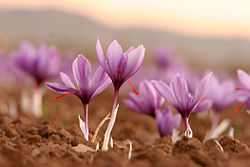
Crocus flowers which yield red saffron stigmas

Corms

Sargol saffron, the strongest Iranian grade

Structure of picrocrocin: β–D-glucopyranose derivative safranal moiety
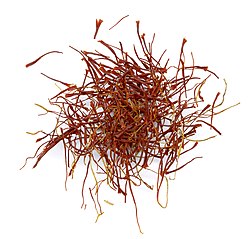
Red threads and yellow styles from Iran
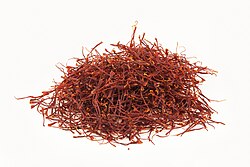
High quality red threads from Austrian saffron

Kashmiri saffron package

Saffron market in Mashad, Iran

Saffron threads soaked in hot water prior to use in food preparation

A detail from the "Saffron Gatherers" fresco of the "Xeste 3" building in the Bronze Age settlement of Akrotiri on the Aegean island of Santorini. It is one of many depicting saffron preserved at the excavation site

Buddhist adepts wearing saffron-coloured robes, pray in the Hundred Dragons Hall, Buddha Tooth Relic Temple and Museum, Singapore.

Preserved "Safran", Staatliches Museum für Naturkunde, Karlsruhe, Germany

Image from Wikipedia