Russian Revolution
The 1905 Revolution and systemic inequality created a "dress rehearsal" for the total collapse of the monarchy.
The 1905 Revolution and systemic inequality created a "dress rehearsal" for the total collapse of the monarchy.
The 1917 revolution was not a sudden explosion but the result of decades of structural rot. The 1905 Revolution, sparked by "Bloody Sunday," forced the creation of the Duma (parliament) and the first worker councils (Soviets), establishing the blueprint for the dual-power system that would eventually topple the Tsar. Despite these early warnings, the Romanovs failed to address the fundamental grievance of the peasantry: a feudal land-ownership system where 1.5% of the population controlled 25% of the land.
Social pressure was further magnified by a "late industrialization" surge that crammed workers into cities at a record pace. In Saint Petersburg, an average of 16 people shared a single apartment, with six people to a room and no running water. This high concentration of miserable, literate, and politically active workers created a "proletariat" far more dangerous to the regime than the scattered peasantry of the previous century.
World War I acted as a terminal stress test that broke the Russian economy through hyperinflation and logistics failure.
World War I acted as a terminal stress test that broke the Russian economy through hyperinflation and logistics failure.
While patriotism initially buoyed the Tsar, the war quickly exposed the regime's incompetence. Nicholas II took personal command of the army in 1915, making him the sole target for every military defeat. Meanwhile, at home, the government attempted to finance the war by printing millions of roubles. By 1917, prices had quadrupled. This hyperinflation destroyed the incentive for farmers to sell grain; they began hoarding food for subsistence, causing artificial famines in the cities despite stable harvests.
The entry of the Ottoman Empire into the war further choked Russia by blocking trade routes to the Mediterranean. As munitions ran low and morale plummeted, the social fabric tore. The traditional officer class, loyal to the Tsar, was decimated in battle and replaced by conscripts from the radicalized urban centers. By early 1917, the Russian Army was no longer a shield for the monarchy, but a reservoir of mutiny.
The "Dual Power" vacuum allowed the Bolsheviks to outmaneuver a government that refused to exit the war.
The "Dual Power" vacuum allowed the Bolsheviks to outmaneuver a government that refused to exit the war.
The February Revolution didn't create a single leader; it created a stalemate. The Provisional Government (parliamentary leaders) held formal state power but insisted on staying in World War I, a deeply unpopular move. Simultaneously, the Petrograd Soviet (worker/soldier councils) held the actual allegiance of the masses and control over the local militias. This "Dual Power" meant the official government could pass laws, but the Soviets decided whether they were actually obeyed.
Vladimir Lenin’s Bolshevik party weaponized this chaos with a simple, three-word program: "Peace, Land, Bread." While other socialist factions debated parliamentary procedure, the Bolsheviks focused on the Red Guards—militias of armed workers. By promising an immediate end to the war and the redistribution of land, they gained the popular leverage needed to launch the October Revolution, an armed insurrection that effectively deleted the Provisional Government in a single stroke.
The Civil War transformed a local political coup into a global socialist project enforced by terror.
The Civil War transformed a local political coup into a global socialist project enforced by terror.
The Bolshevik victory in Petrograd triggered a brutal five-year Civil War, pitting the "Reds" (Bolsheviks) against the "Whites" (a loose coalition of monarchists, liberals, and foreign powers). To survive, the Bolsheviks moved the capital to Moscow and militarized the state. Leon Trotsky organized the Red Army, while the Cheka (secret police) launched the Red Terror to eliminate "enemies of the people." This period shifted the party from a revolutionary movement into a disciplined, authoritarian machine.
By 1922, the Bolsheviks had emerged victorious, having reabsorbed breakaway territories like Ukraine and Georgia to form the Soviet Union (USSR). The revolution ended with the mass emigration of the old elite and the total victory of a single-party state. The resulting system—the world's first national experiment in "soviet democracy"—would dominate 20th-century geopolitics for the next six decades.

Image from Wikipedia

Soldiers blocking Narva Gate on Bloody Sunday

Vladimir Lenin, founder of the Soviet Union and leader of the Bolshevik party.
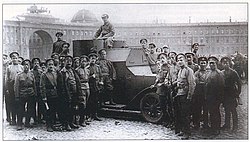
Provisional Government's volunteer soldiers secure Petrograd's Palace Square with the Austin Armoured Car, summer 1917.

The Petrograd Soviet Assembly meeting in 1917

Russian troops in trenches awaiting a German attack

Revolutionaries protesting in February 1917
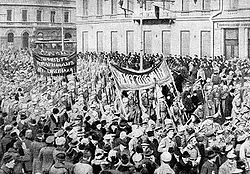
Soldiers marching in Petrograd, March 1917

Russian troops meeting German troops in No Man's Land

Meeting before the Russian wire entanglements

The 2nd Moscow Women Death Battalion protecting the Winter Palace as the last guards of the stronghold

Revolutionaries attacking the tsarist police in the early days of the February Revolution

A revolutionary meeting of Russian soldiers in March 1917 in Dalkarby of Jomala, Åland

The dissolution of the Constituent Assembly on 6 January 1918. The Tauride Palace is locked and guarded by Trotsky, Sverdlov, Zinoviev and Lashevich.
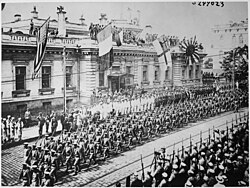
American, British, and Japanese Troops parade through Vladivostok in armed support to the White Army.