Renaissance art
Art served as the visual engine for Europe's transition from medieval mysticism to early modern humanism.
Art served as the visual engine for Europe's transition from medieval mysticism to early modern humanism.
Renaissance art was not merely a change in aesthetic style but a fundamental shift in how humans perceived their place in the universe. While the Middle Ages prioritized the spiritual and the afterlife, Renaissance scholars and artists turned their gaze toward the "present life." This movement, known as Humanism, sought to create an "ideal man" who was equally proficient in music, science, and the arts.
The transition was less an abrupt break and more of a "gradual birth" where medieval values coexisted with new ideas. By reviving Classical antiquity—specifically the philosophy and aesthetics of Greece and Rome—artists like Giotto began "rescuing" art from the flat, stylized Byzantine tradition, introducing three-dimensional forms and lifelike emotions that made religious figures feel human and relatable.
A convergence of Islamic mathematics, Medici capital, and the printing press fueled a creative explosion in Florence.
A convergence of Islamic mathematics, Medici capital, and the printing press fueled a creative explosion in Florence.
The "rebirth" of art required more than just inspiration; it required a specific set of socio-economic conditions. The establishment of the Medici Bank in Florence provided unprecedented wealth, allowing for a new type of patronage that wasn't strictly tied to the Church or the monarchy. This "secular" money gave artists the freedom to explore non-religious themes and experimental techniques.
Crucially, this era benefited from a global exchange of knowledge. European scholars gained access to advanced mathematics via Islamic texts and rediscovered lost Greek and Roman manuscripts. The invention of the printing press ensured these radical ideas—on everything from anatomy to architecture—spread too quickly for traditional authorities to suppress, turning local Italian innovations into a continental movement.
Artists transformed painting into a rigorous science by applying linear perspective and the chemistry of oil.
Artists transformed painting into a rigorous science by applying linear perspective and the chemistry of oil.
During the 15th century, painting moved from a craft to a discipline of scientific observation. In Florence, the architect Brunelleschi and the painter Masaccio pioneered linear perspective, using mathematical grids to create the illusion of deep space on a flat surface. This obsession with "correct" proportion was so intense that some artists, like Uccello, famously stayed up all night trying to solve perspective problems.
Meanwhile, in Northern Europe, artists like Jan van Eyck perfected the use of oil paint. Unlike the quick-drying tempera used in Italy, oil allowed for slow, meticulous blending, enabling artists to capture the texture of velvet, the glint of jewels, and the subtle play of light on skin. When these Northern techniques finally reached Italy around 1475, they revolutionized how the great masters of the High Renaissance approached color and atmosphere.
While Italy obsessed over classical geometry, Northern Europe achieved realism through microscopic detail and religious symbolism.
While Italy obsessed over classical geometry, Northern Europe achieved realism through microscopic detail and religious symbolism.
The "Renaissance" looked very different depending on which side of the Alps you were on. Italian artists were driven by a conscious desire to revive the grandeur of Rome, focusing on "solid" forms, anatomical accuracy, and clear, logical spaces. They looked at a human body and saw a temple of mathematical perfection.
In contrast, Netherlandish and French artists (the "Northern Renaissance") arrived at realism through a different path. They largely ignored classical ruins and instead focused on the "observation of nature" in its most minute forms. They maintained a medieval love for complex religious symbolism and hierarchical proportions but rendered the world with such surreal detail—as seen in the works of Hieronymus Bosch—that their paintings feel both more grounded and more fantastical than their Italian counterparts.
The era peaked as Leonardo, Michelangelo, and Raphael pushed human anatomy and emotion to their absolute expressive limits.
The era peaked as Leonardo, Michelangelo, and Raphael pushed human anatomy and emotion to their absolute expressive limits.
The High Renaissance (1495–1520) represents the moment when the technical experiments of the previous century reached a state of "perfection." Leonardo da Vinci utilized his scientific dissections of cadavers to master human anatomy and "sfumato" (a smoky blurring of edges) to create lifelike psychological depth. His Mona Lisa and Last Supper became the benchmarks for how art could capture not just a person, but a soul.
Michelangelo took a different path, focusing almost exclusively on the expressive power of the human body. His work on the Sistine Chapel ceiling rejected natural landscapes in favor of muscular, twisted figures that signaled a shift toward "Mannerism"—a style where emotion and drama began to take precedence over the calm balance of the Early Renaissance. Together with Raphael’s elegant portraits, these "universal geniuses" elevated the artist from a mere decorator to a divine intellectual.

Piero della Francesca, The Baptism of Christ in the Prado Museum, 1507
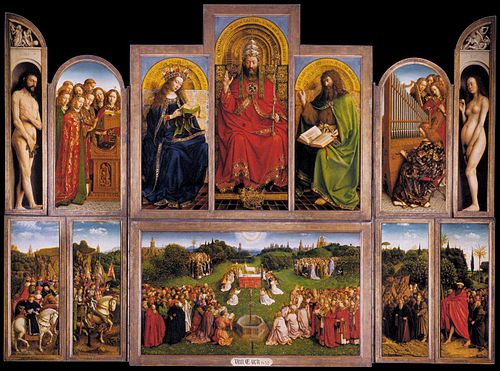
Jan van Eyck, The Ghent Altarpiece: The Adoration of the Mystic Lamb (interior view), 1432

Titian, Sacred and Profane Love, c. 1513 – 1514, Galleria Borghese, Rome

Albrecht Dürer, Adam and Eve, 1507, Museo del Prado, Madrid

Sandro Botticelli, The Birth of Venus, c. 1485, Uffizi, Florence

Giotto: The Lamentation, c. 1305, Scrovegni Chapel, foreshadows the Renaissance.

Donatello, David (1440s?). Museo Nazionale del Bargello.
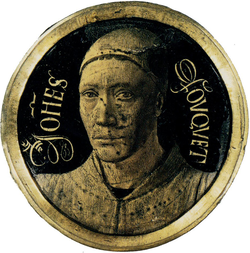
Jean Fouquet, self-portrait (1450). The earliest portrait miniature, and possibly the earliest formal self-portrait.

Rogier van der Weyden, The Descent from the Cross (c. 1435), oil on oak panel, 220 cm × 262 cm (87 in × 103 in). Museo del Prado, Madrid.

Jean Hey, The Moulins Triptych, c. 1498, oil on panel, Moulins Cathedral
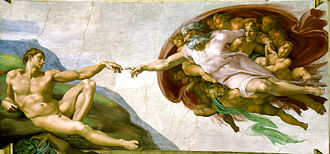
Michelangelo, The Creation of Adam, c. 1511, from the Sistine Chapel ceiling

Lucas Cranach the Elder, Apollo and Diana

Sandro Botticelli, Magnificat Madonna, 1480–1481, tempera on panel, Uffizi, Florence