Pre-Raphaelite Brotherhood
The Brotherhood formed a secret society to wage war against the "sloshy" conventions of the English art establishment.
The Brotherhood formed a secret society to wage war against the "sloshy" conventions of the English art establishment.
Founded in 1848 by seven young rebels—including William Holman Hunt, John Everett Millais, and Dante Gabriel Rossetti—the Pre-Raphaelite Brotherhood (PRB) was a reaction against the Royal Academy's rigid teachings. They loathed the influence of Sir Joshua Reynolds, whom they nicknamed "Sir Sloshua," believing his focus on elegant, conventional compositions had corrupted art into something "mechanical" and "scamped."
To the PRB, the turning point of artistic decay was Raphael. They sought to rewind the clock to the "Quattrocento" (15th-century Italian art), characterized by abundant detail, intense colors, and complex compositions. This wasn't just an aesthetic choice; it was a moral one. They believed that by returning to the honesty of art before the High Renaissance, they could recover a lost spiritual integrity.
Members used a "wet white ground" technique to achieve a jewel-like luminosity that rejected muddy shadows.
Members used a "wet white ground" technique to achieve a jewel-like luminosity that rejected muddy shadows.
The PRB’s visual signature—sharp focus and brilliant, transparent color—was the result of radical technical experimentation. While previous generations used "bitumen" (a tar-like substance) that created unstable, muddy shadows, Hunt and Millais developed a method of painting in thin glazes over a wet white background. This ensured the colors retained a clarity and vibrance that looked like stained glass or precious gems.
This technical precision was driven by a doctrine of "mimesis," or the absolute imitation of nature. They rejected the "learned by rote" poses of the Academy, choosing instead to study the natural world with scientific intensity. Every leaf, fabric fold, and facial expression was rendered with equal, unwavering focus, a style that felt jarringly "real" to a public accustomed to soft-focus backgrounds.
What began as a unified front quickly split into two camps: scientific realism and medieval romance.
What began as a unified front quickly split into two camps: scientific realism and medieval romance.
Though the Brotherhood was founded on shared principles, the members’ temperaments eventually pulled the movement in two different directions. The "Realists," led by Hunt and Millais, focused on the scientific observation of nature and contemporary life. Hunt even traveled to the Middle East to ensure his biblical scenes were geographically and ethnically accurate, seeking to reconcile religion with modern science.
In contrast, the "Medievalists," led by Rossetti and later joined by William Morris and Edward Burne-Jones, leaned into the atmospheric and the mythic. They were fascinated by Arthurian legends and Dante, moving away from strict realism toward a more symbolic, "femme fatale" aesthetic. Despite this split, both factions remained united in their hatred of materialism, viewing art as an essentially spiritual endeavor.
Their radical devotion to truth was condemned as "blasphemous" and "ugly" by critics like Charles Dickens.
Their radical devotion to truth was condemned as "blasphemous" and "ugly" by critics like Charles Dickens.
In 1850, the PRB faced a massive public backlash. Millais’s painting Christ in the House of His Parents was denounced for depicting the Holy Family as ordinary, "slum-dwelling" people with dirty fingernails and unidealized features. Charles Dickens was particularly vitriolic, describing Millais's Mary as "monstrous" and "ugly." To the Victorian public, the PRB’s hyper-realism felt like an attack on the sanctity of religious subjects.
The controversy was so intense it caused the group to fracture; member James Collinson resigned, fearing the PRB was bringing the Christian religion into disrepute. However, the movement was saved by the influential critic John Ruskin, who wrote to The Times defending their "devotion to nature." While the formal "Brotherhood" disbanded after only five years, Ruskin's endorsement ensured their ideas would dominate the British art scene for decades.
The movement’s influence transcended painting, birthing the Arts and Crafts movement and shaping the world of J.R.R. Tolkien.
The movement’s influence transcended painting, birthing the Arts and Crafts movement and shaping the world of J.R.R. Tolkien.
The PRB’s reach extended far beyond the canvas and into the very fabric of British life. Through Rossetti's partnership with William Morris, the group’s obsession with medieval craftsmanship sparked the Arts and Crafts movement. This shift influenced everything from wallpaper and furniture to architecture, advocating for hand-crafted quality in an age of soul-less industrial mass production.
Even the world of modern fantasy owes a debt to the Brotherhood. J.R.R. Tolkien was deeply influenced by the Pre-Raphaelite collections at the Birmingham Museum & Art Gallery. The mythological scenes and "northern" aesthetic portrayed by Burne-Jones and his peers provided a visual blueprint for the landscapes and cultures of Middle-earth, proving that the PRB's 19th-century rebellion continues to shape the modern imagination.
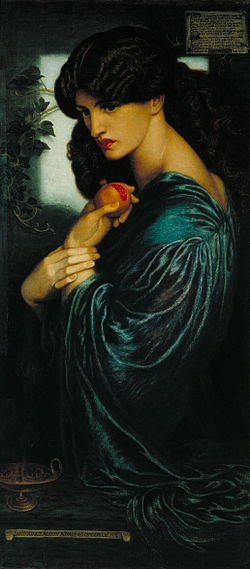
Proserpine, 1874, by Dante Gabriel Rossetti, with Jane Morris as model

Illustration by Holman Hunt of Thomas Woolner's poem "My Beautiful Lady", published in The Germ, 1850

Christ in the House of His Parents, by John Everett Millais, 1850
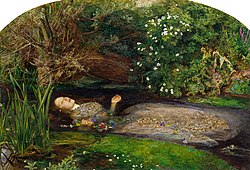
Ophelia, by John Everett Millais, 1851–52

Medea by Evelyn De Morgan, 1889, in quattrocento style
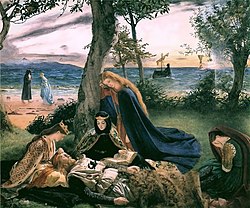
James Archer, The Death of King Arthur, c. 1860

Arthur Hughes, Fair Rosamund, 1854

William Holman Hunt, The Hireling Shepherd, 1851

Circe, 1885, by John Collier, depicts the seductive enchantress from Homer's Odyssey and was exhibited at the Chicago World Art Fair 1893, World's Columbian Exposition, Department K Britannica