Potato
The potato is an underground stem, not a root, and belongs to a notoriously toxic botanical family.
The potato is an underground stem, not a root, and belongs to a notoriously toxic botanical family.
While they grow in the dirt, potatoes are technically "stem tubers"—thickened parts of the plant's rhizomes used to store nutrients. Unlike roots, they feature "eyes," which are actually vegetative buds arranged in a spiral. These eyes allow the plant to clone itself, a handy survival mechanism that also makes commercial farming easier.
As members of the Solanaceae (nightshade) family, potatoes share a lineage with tobacco, mandrake, and deadly nightshade. This family connection is evident in their aerial parts: the plant produces small green fruits that look like cherry tomatoes but are loaded with the toxin solanine. Even the tubers can become toxic if exposed to light, which triggers the production of glycoalkaloids and turns the skin green as a warning.
A single domestication event in the Andes eventually fueled one-quarter of the Old World’s population growth.
A single domestication event in the Andes eventually fueled one-quarter of the Old World’s population growth.
Genetic evidence reveals that every cultivated potato on Earth originated from a single domestication point in southern Peru and northwestern Bolivia nearly 10,000 years ago. After the Spanish brought them to Europe in the 16th century, they transitioned from a botanical curiosity to an industrial-age engine. Between 1700 and 1900, the potato was responsible for an estimated 25% of the total population growth and urbanization in the Old World by providing more calories per acre than grain.
However, this success was built on a dangerous lack of genetic diversity. Because European farmers relied on a very small number of varieties, the crop was defenseless when Phytophthora infestans (late blight) arrived in the 1840s. This biological vulnerability led directly to the Great Irish Famine, demonstrating the catastrophic risk of monoculture in a staple food supply.
Modern cultivars are "evolutionary travelers" that moved from the Andes to Chile before conquering the globe.
Modern cultivars are "evolutionary travelers" that moved from the Andes to Chile before conquering the globe.
While the potato was first tamed in the high-altitude Andes, DNA analysis shows that over 99% of modern global varieties are actually descendants of a subspecies from the lowlands of south-central Chile. These Chilean varieties were pre-adapted to the "long-day" light conditions of higher latitudes, making them far more successful in Europe and North America than their original Andean ancestors.
Today, there are over 5,000 varieties of potatoes, with the vast majority still found only in the Andes. In a single valley in Peru, a household might maintain dozens of unique cultivars. This massive genetic reservoir is now a primary focus for international researchers looking to breed resistance to climate change and emerging pests into the relatively few varieties used in global trade.
Culinary performance is dictated by the precise molecular ratio of two specific starches.
Culinary performance is dictated by the precise molecular ratio of two specific starches.
A potato’s behavior in the kitchen—whether it mashes, boils, or fries perfectly—depends on its ratio of amylose to amylopectin. "Floury" or mealy potatoes have higher starch content (20–22%) and more amylose, which diffuses easily when cooked, making them ideal for light, fluffy mashed potatoes.
In contrast, "waxy" potatoes have less starch and more amypectin, a highly branched molecule that helps the potato cells stay glued together. This allows them to retain their shape during boiling or in salads. Even "new potatoes"—harvested while immature—are prized specifically for their low starch levels and thin, loose skins, which provide a different texture and flavor profile than fully mature storage tubers.
Genetic engineering is now focused on bypassing biological "self-incompatibility" to protect the future crop.
Genetic engineering is now focused on bypassing biological "self-incompatibility" to protect the future crop.
Most potatoes are "self-incompatible," meaning they cannot be easily bred with themselves to create stable, predictable traits. This has historically made breeding a slow, hit-or-miss process. Recently, scientists used CRISPR-Cas9 to disable the genes responsible for this incompatibility. By introducing the "Sli" gene, breeders can now create "self-compatible" lines, allowing for much faster and more focused development of new varieties.
The next frontier of potato tech is industrial and defensive. Geneticists have created varieties like the 'Amflora' potato, which produces only amylopectin for the paper and textile industries, and the 'Fortuna' potato, which incorporates resistance genes from wild Mexican relatives to finally defeat the blight that caused the Irish Famine. Despite these gains, public and regulatory resistance to GMOs remains a significant hurdle for widespread adoption in Europe and beyond.

Image from Wikipedia

Morphology of the potato plant; tubers are forming from stolons.

A variety of S. tuberosum tuberosum, the Chilean potato

Multiple potato varieties for sale in a market in France

Potato varieties are diverse in shape, color, and other attributes.

Amflora potatoes, modified to produce pure amylopectin starch

Planting
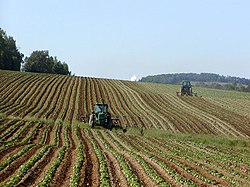
Field in Fort Fairfield, Maine

Immature potato plants

Potatoes grown in a tall bag are common in gardens as they minimize digging.

Late blight

A modern potato harvester

Transporting to cold storage in India

Potato production

Plant destroyed by Colorado potato beetle (Leptinotarsa decemlineata) larvae