Post-Impressionism
Post-Impressionism was a rebellion against the "triviality" of Impressionist light in favor of structural permanence.
Post-Impressionism was a rebellion against the "triviality" of Impressionist light in favor of structural permanence.
While Impressionism captured the fleeting, naturalistic effects of sunlight, the Post-Impressionists found this approach lacked substance. Emerging roughly between 1886 and 1905, artists like Paul Cézanne sought to "make of Impressionism something solid and durable, like the art of the museums." They shifted the focus from the optical experience of the world to the underlying geometric order of objects.
This shift was not a unified march but a collection of individual dissatisfactions. Georges Seurat brought a meticulous, scientific rigor to the canvas through Pointillism (tiny dots of color), while Cézanne reduced landscapes to their basic shapes. They retained the vibrant palettes of their predecessors but rejected the "soft" edges and spontaneous compositions of the 1870s.
Artists distorted reality and color to prioritize internal emotional expression over naturalistic accuracy.
Artists distorted reality and color to prioritize internal emotional expression over naturalistic accuracy.
The movement granted artists permission to use "unnatural" color and distorted forms to convey a state of mind rather than a literal view. Vincent van Gogh is the archetype of this shift, using conspicuous, swirling brushstrokes and vibrant impasto (thickly applied paint) to project his psyche onto the canvas. Paul Gauguin similarly moved toward flat areas of color and symbolic content, abandoning the three-dimensional illusions of traditional Western art.
By moving away from naturalism, these artists paved the way for the abstract movements of the 20th century. Their work suggested that a painting’s primary duty was to the canvas itself—its harmony, structure, and emotional resonance—rather than to the "real" world it supposedly depicted.
The "movement" was actually a retrospective catch-all coined by critics to describe a disparate group of radicals.
The "movement" was actually a retrospective catch-all coined by critics to describe a disparate group of radicals.
The term "Post-Impressionism" was not a banner the artists fought under; it was a label of convenience invented by British critic Roger Fry in 1910. Organizing an exhibition of modern French art, Fry needed a "vague and non-committal" name to group artists who were diverse in style but shared a chronological position after the Impressionist heyday.
Because it is a chronological umbrella rather than a specific stylistic manifesto, Post-Impressionism encompasses a dizzying array of sub-movements. It includes the scientific "Neo-Impressionism," the bold-outlined "Cloisonnism," the myth-heavy "Symbolism," and the "Synthetism" of the Pont-Aven School. These groups often disagreed on the "right" way forward, united only by their departure from the Impressionist norm.
It served as the essential bridge to Modernism, spreading global influence before shattering into Cubism and war.
It served as the essential bridge to Modernism, spreading global influence before shattering into Cubism and war.
Post-Impressionism acted as the experimental laboratory for the 20th century. Its emphasis on geometric form led directly to Cubism, while its expressive use of color birthed Fauvism. The influence eventually crossed the Atlantic, notably shaping Canadian art through figures like Emily Carr and the Group of Seven, who applied Post-Impressionist techniques to the rugged North American wilderness.
Historians generally agree that the movement concluded with the onset of World War I in 1914. The war signaled a major break in European cultural history, after which the experiments of the Post-Impressionists were absorbed into the more radical, fractured, and abstract languages of high Modernism.
*

Image from Wikipedia

Poster of the 1889 Exhibition of Paintings by the Impressionist and Synthetist Group, at Café des Arts, known as The Volpini Exhibition, 1889

Henri de Toulouse-Lautrec, Portrait of Émile Bernard, 1886, Tate Gallery London

Camille Pissarro, Haying at Eragny, 1889, Private Collection
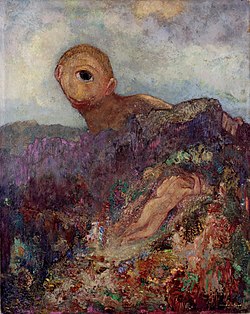
Odilon Redon (1840–1916)

Henri Rousseau (1844–1910)

Paul Gauguin (1848–1903)

Vincent van Gogh (1853–1890)

Charles Angrand (1854–1926)
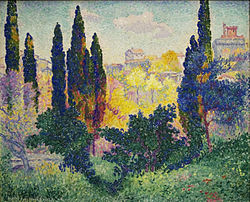
Henri-Edmond Cross (1856–1910)

Maximilien Luce (1858–1941)

Georges Seurat (1859–1891)

Eugène Chigot (1860-1923)

René Schützenberger (1860–1916)

Marius Borgeaud (1861–1924)