Platonism
Reality exists in a "third realm" where perfect archetypes outshine their physical shadows.
Reality exists in a "third realm" where perfect archetypes outshine their physical shadows.
Platonism rejects the idea that the physical world is the sum of reality. Instead, it proposes the Theory of Forms: a "third realm" distinct from both the external physical world and the internal world of consciousness. In this realm exist eternal, unchangeable, and perfect "Forms"—the blueprints for everything we perceive. For example, every chair on Earth is merely an imperfect, temporary copy of the one true "Form of a Chair."
This system was Plato's attempt to reconcile a massive contradiction in Greek thought. He took Heraclitus’s observation that the physical world is in constant flux (unintelligible) and merged it with Parmenides’s view that true reality is unchanging (intelligible). By placing "true being" in the realm of Forms, Plato argued that while we can have opinions about the physical world, we can only have true knowledge through the exercise of reason directed at these abstract archetypes.
The tradition evolved from a rigorous academy into a skeptical school, then a mystical religion.
The tradition evolved from a rigorous academy into a skeptical school, then a mystical religion.
The history of Platonism is a 2,000-year game of telephone. It began in the Old Academy with Plato’s nephew Speusippus, who focused on mathematical "speculations." However, by 266 BC, the school took a radical turn into "Academic Skepticism," arguing that nothing could be known for certain. This lasted until the 1st century BC, when thinkers like Antiochus rejected skepticism and began "Middle Platonism," which blended Plato’s ideas with Stoic and Peripatetic dogmas.
The final ancient evolution was Neoplatonism, founded by Plotinus in the 3rd century AD. This version transformed philosophy into something closer to a spiritual practice. Plotinus proposed "The One" (or The Good) as the ultimate source of all existence. In this view, the human soul’s purpose is to transcend the body through meditation and virtue, eventually "elevating" itself to a state of ecstasy and union with the One.
Christian theology repurposed the Forms as the thoughts of God, cementing Platonism in Western faith.
Christian theology repurposed the Forms as the thoughts of God, cementing Platonism in Western faith.
Platonism didn't die with the ancient world; it became the intellectual scaffolding of Christianity. Early Church fathers, most notably Saint Augustine, were deeply influenced by Neoplatonism. They solved the "problem" of where the Forms existed by moving them inside the mind of God—a position known as divine conceptualism. This allowed the Church to maintain that God’s thoughts were the eternal blueprints for the universe.
This merger was so successful that it created "Christoplatonism," a worldview where the spirit is seen as inherently good and the material world as secondary or even fallen. While this helped early theologians explain the immortality of the soul, it remains a point of tension today. Modern critics within the Church argue that this dualism actually contradicts the biblical narrative that God created the physical world and called it "good."
Modern Platonists trade ancient mysticism for the cold, undeniable reality of numbers and sets.
Modern Platonists trade ancient mysticism for the cold, undeniable reality of numbers and sets.
In contemporary analytic philosophy, Platonism has shed its mystical skin to focus on the "Theory of Abstract Objects." Modern Platonists, such as Gottlob Frege and Kurt Gödel, argue that things like numbers, sets, and propositions are real, even though they don't exist in space or time. This isn't about "perfect shapes" in the sky; it's a claim that mathematical truths are discovered, not invented.
If you believe that the statement "2 + 2 = 4" would be true even if no humans existed to think it, you are leaning toward mathematical Platonism. This view remains one of the most influential—and debated—positions in the philosophy of mathematics. It faces a major "epistemological challenge": if numbers are non-physical and exist in a separate realm, how do our physical brains ever manage to "touch" or perceive them?
Platonism defines the human experience as the soul's struggle to recall a truth it once knew.
Platonism defines the human experience as the soul's struggle to recall a truth it once knew.
To a Platonist, the person is not the body, but the soul. This soul is tripartite, consisting of reason, spirit (emotion), and appetite (desire). Ethics, in this framework, is a matter of internal "justice"—ensuring that reason remains in the driver’s seat, keeping spirit and appetite in their proper places. Virtue is not just good behavior; it is the "knowledge" of the Form of the Good.
Plato argued that because the soul is immortal and existed before the body, learning is actually a form of "recollection." We recognize a beautiful sunset or a just law because we have a dim, lingering memory of the perfect Forms of Beauty and Justice. Living a philosophical life is the process of "waking up" from the dream of the physical world to see the reality that has been there all along.
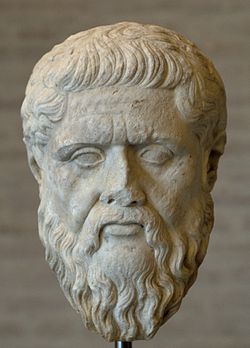
Head of Plato, Roman copy. The original was exhibited at the Academy after the death of the philosopher (348/347 BC).

Plato holding his Timaeus, detail from the Vatican fresco The School of Athens

Site of Plato's Academy in Athens

Many Western churchmen, including Augustine of Hippo, have been influenced by Platonism.

Most contemporary Platonists trace their views to those of Gottlob Frege.