Photosynthesis
Photosynthesis is a planetary-scale energy converter that harvests eight times more power than the sum of human civilization.
Photosynthesis is a planetary-scale energy converter that harvests eight times more power than the sum of human civilization.
The scale of biological light-harvesting is staggering. On average, photosynthetic organisms capture approximately 130 terawatts of energy from sunlight. To put that in perspective, our entire modern technological civilization runs on roughly one-eighth of that amount. This energy isn't just used for immediate survival; it is converted into 100 to 115 billion tons of biomass every year, effectively turning the atmosphere into the physical structures of the living world.
This process is the fundamental "bridge" between the inorganic and organic worlds. By stripping electrons from simple substances like water or hydrogen sulfide, organisms create the high-energy bonds of carbohydrates. When complex life—including humans—needs energy, we simply "undo" this process through cellular respiration, breaking those bonds to release the stored solar energy that was originally captured by a leaf or a microscopic cell.
The Earth’s oxygen-rich atmosphere is a byproduct of an ancient shift from sulfur to water as an electron source.
The Earth’s oxygen-rich atmosphere is a byproduct of an ancient shift from sulfur to water as an electron source.
Early photosynthesis was likely a "purple" affair. Before the evolution of cyanobacteria, ancient microbes used hydrogen sulfide as their electron source, releasing sulfur instead of oxygen. This "anoxygenic" process dominated the oceans for billions of years. It wasn't until organisms evolved the ability to split water—a much more abundant but harder-to-crack resource—that oxygen began to accumulate in the atmosphere.
This transition, known as the Great Oxidation Event, was a biological revolution. The "waste" product of water-splitting—oxygen—eventually became high enough in concentration to support the evolution of complex, oxygen-breathing life. Today, oxygenic photosynthesis remains the dominant form, but remnants of the old ways still exist in "shade-loving" bacteria and archaea that use retinal or bacteriochlorophyll to thrive in extreme environments.
The process functions as a two-stage molecular battery, first charging energy carriers and then using them to build physical matter.
The process functions as a two-stage molecular battery, first charging energy carriers and then using them to build physical matter.
Photosynthesis is divided into "light-dependent" and "light-independent" reactions. In the first stage, light hits pigments like chlorophyll, knocking electrons loose and sending them down an "electron transport chain" (the Z-scheme). This flow of electrons generates two high-energy molecules: ATP (the cell's immediate currency) and NADPH (a powerful reducing agent). At this point, the light has been successfully converted into chemical energy, but no "food" has been made yet.
In the second stage, known as the Calvin Cycle, the cell uses that stored ATP and NADPH to perform "carbon fixation." It pulls carbon dioxide from the air and stitches it into existing organic chains to create sugars like glucose. While the first stage requires a constant stream of photons, this second stage can happen in the dark, acting as the assembly line that uses the "batteries" charged during the day to manufacture the building blocks of life.
Biological solar panels are housed in specialized intracellular factories that selectively discard green light.
Biological solar panels are housed in specialized intracellular factories that selectively discard green light.
In plants and algae, photosynthesis is quarantined inside organelles called chloroplasts. These are highly organized structures packed with thylakoids—flattened disks that provide a massive surface area for light absorption. Within these membranes, pigments are arranged into "antenna proteins" that funnel energy toward a central reaction center. This architecture ensures that even a single photon has a high probability of being captured and put to work.
The characteristic green color of the natural world is actually a sign of "missed" energy. Chlorophyll is highly efficient at absorbing the high-energy blue and red ends of the light spectrum, but it reflects the green middle. This is an evolutionary compromise; by absorbing the most productive wavelengths, plants leave the green light to bounce off their surfaces, which is exactly why the interior of a forest or the depth of a leaf is bathed in a green glow.

Schematic of photosynthesis in plants. The carbohydrates produced are stored in or used by the plant.

Composite image showing the global distribution of photosynthesis, including both oceanic phytoplankton and terrestrial vegetation. Dark red and blue-green indicate regions of high photosynthetic activity in the ocean and on land, respectively.

Photosynthesis changes sunlight into chemical energy, splits water to liberate O2, and fixes CO2 into sugar.
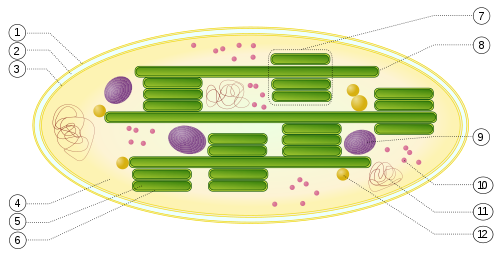
Chloroplast ultrastructure:outer membraneintermembrane spaceinner membrane (1+2+3: envelope)stroma (aqueous fluid)thylakoid lumen (inside of thylakoid)thylakoid membranegranum (stack of thylakoids)thylakoid (lamella)starchribosomeplastidial DNAplastoglobule (drop of lipids)

Light-dependent reactions of photosynthesis at the thylakoid membrane

The "Z scheme"

Overview of the Calvin cycle and carbon fixation
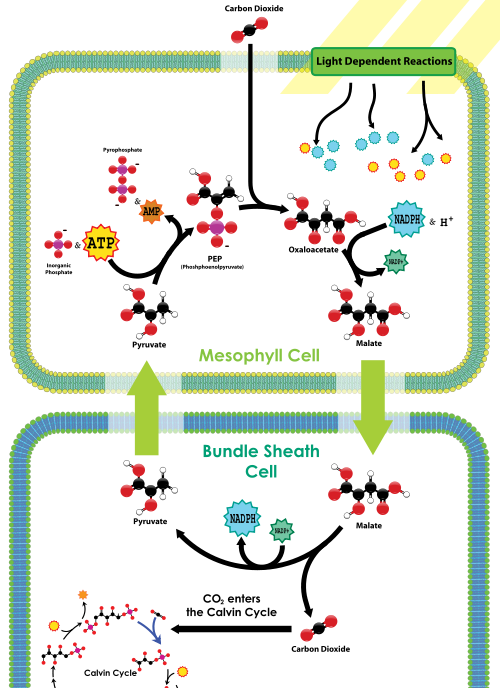
Overview of C4 carbon fixation. (This image mistakenly shows lactic acid instead of pyruvate, and all the species ending in "-ate" are shown as unionized acids, such as malic acid and so on).
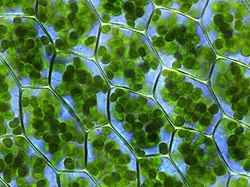
Plant cells with visible chloroplasts (from a moss, Plagiomnium affine)

Portrait of Jan Baptist van Helmont by Mary Beale, c. 1674

Melvin Calvin works in his photosynthesis laboratory.

The leaf is the primary site of photosynthesis in plants.

Absorbance spectra of free chlorophyll a (blue) and b (red) in a solvent. The action spectra of chlorophyll molecules are slightly modified in vivo depending on specific pigment–protein interactions.
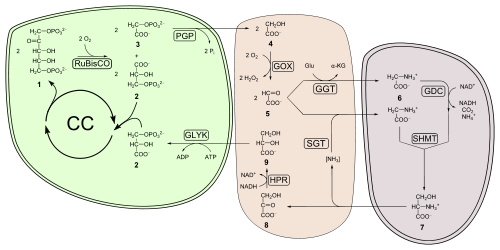
Photorespiration

Metro-style map of major metabolic pathways