Periodic table
The periodic law reveals that chemical traits are a predictable function of atomic number.
The periodic law reveals that chemical traits are a predictable function of atomic number.
The table is not a simple list, but a map of "periodic" recurrence. When elements are arranged by their atomic number—the count of protons in the nucleus—similar chemical properties emerge at regular intervals. This allows elements to be stacked into columns called "groups." For example, elements in the same group often behave like family members, sharing characteristics like reactivity or metallic nature.
While groups dominate vertical behavior, horizontal "periods" represent the filling of electron shells. As you move across a period, metallic character fades and nonmetallic character increases. This grid-like predictability makes it possible to guess the properties of an element just by looking at its neighbors, a trick that has been used to discover new elements for over a century.
Quantum mechanics provides the invisible blueprint for the table’s rows and columns.
Quantum mechanics provides the invisible blueprint for the table’s rows and columns.
The structure of the table is dictated by how electrons occupy space around a nucleus. Electrons inhabit specific energy levels called shells and subshells (labeled s, p, d, and f). A new row on the table begins exactly when a new electron shell starts to fill. Because the outermost "valence" electrons are the ones responsible for chemical bonds, elements with the same outer configuration naturally fall into the same vertical column.
This "filling order" follows the Madelung rule, which explains why the table has its characteristic uneven shape. The blocks of the table (s-block, p-block, etc.) correspond directly to the specific type of orbital being filled. Even the common practice of "cutting out" the f-block and placing it at the bottom is merely an editorial choice to save space; in reality, the table is a continuous 32-column sequence that tracks the precise quantum state of every known atom.
What began as inspired guesswork evolved into a rigorous account of subatomic structure.
What began as inspired guesswork evolved into a rigorous account of subatomic structure.
In 1869, Dmitri Mendeleev organized the first generally accepted table by atomic mass. Crucially, he left gaps for elements that hadn't been discovered yet, successfully predicting the properties of "missing" elements like germanium. However, Mendeleev didn't know why his system worked. It wasn't until the early 20th century, with the discovery of atomic numbers and quantum mechanics, that the internal logic of the atom finally illuminated the table’s design.
The table remains a work in progress. It was only in 1945 that Glenn T. Seaborg realized the actinides belonged in the f-block, shifting the table's modern shape. Even today, scientists debate the "optimal" form of the table and whether certain elements, like lutetium or lawrencium, are positioned correctly. The table is a living document, reflecting our deepening grasp of the physical universe.
Human synthesis has extended the table far beyond the limits of the natural world.
Human synthesis has extended the table far beyond the limits of the natural world.
Nature only provides the first 94 elements. Of these, 83 are primordial survivors from the Earth's formation, while 11 exist only as fleeting footprints in the decay chains of heavier elements like uranium. To go further, scientists must synthesize elements in laboratories. By 2010, the first 118 elements were officially recognized, finally completing the seventh row of the table.
The frontier is increasingly unstable. Elements heavier than einsteinium (99) cannot be seen in large quantities, and many exist for only fractions of a second. As we look toward an eighth row, theoretical calculations suggest we may hit a "region of uncertainty" where the established patterns of the periodic law begin to break down, potentially rendering our current table obsolete for the heaviest possible matter.

Periodic table of the chemical elements showing the most or more commonly named sets of elements (in periodic tables), and a traditional dividing line between metals and nonmetals. The f-block actually fits between groups 2 and 3; it is usually shown at the foot of the table to save horizontal space.

Image from Wikipedia

3D views of some hydrogen-like atomic orbitals showing probability density and phase (g orbitals and higher are not shown)

Idealized order of subshell filling according to the Madelung rule
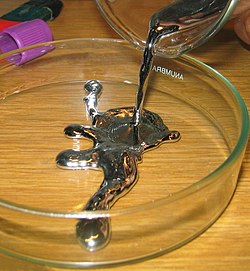
Liquid mercury. Its liquid state at standard conditions is the result of relativistic effects.

Graph of first ionisation energies of the elements in electronvolts (predictions used for elements 109–118)

Trend in electron affinities
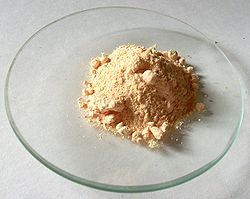
Lead(II) oxide (PbO, left) and lead(IV) oxide (PbO2, right), the two stable oxides of lead

Oxidation states of the transition metals. The solid dots show common oxidation states, and the hollow dots show possible but unlikely states.
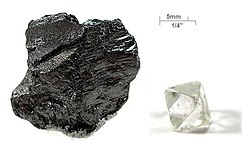
Graphite and diamond, two allotropes of carbon

Graph of carbon atoms being brought together to form a diamond crystal, demonstrating formation of the electronic band structure and band gap. The right graph shows the energy levels as a function of the spacing between atoms. When far apart (right side of graph) all the atoms have discrete valence orbitals p and s with the same energies. However, when the atoms come closer (left side), their electron orbitals begin to spatially overlap. The orbitals hybridize into N molecular orbitals each with a different energy, where N is the number of atoms in the crystal. Since N is such a large number, adjacent orbitals are extremely close together in energy so the orbitals can be considered a continuous energy band. At the actual diamond crystal cell size (denoted by a), two bands are formed, called the valence and conduction bands, separated by a 5.5 eV band gap. (Here only the valence 2s and 2p electrons have been illustrated; the 1s orbitals do not significantly overlap, so the bands formed from them are much narrower.)

Iron, a metal
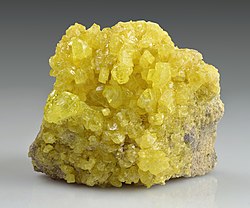
Sulfur, a nonmetal
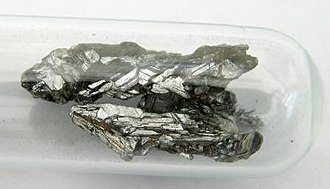
Arsenic, an element often called a semi-metal or metalloid

A periodic table colour-coded to show some commonly used sets of similar elements. The categories and their boundaries differ somewhat between sources. Lutetium and lawrencium in group 3 are also transition metals. Alkali metals Alkaline earth metals Lanthanides Actinides Transition metals Other metals Metalloids Other nonmetals Halogens Noble gases