Ophelia (painting)
Millais prioritized ecological accuracy over comfort, spending five months painting a riverbank "en plein air."
Millais prioritized ecological accuracy over comfort, spending five months painting a riverbank "en plein air."
In 1851, John Everett Millais spent eleven hours a day, six days a week, sitting by the Hogsmill River in Surrey. This was a radical departure from the mid-Victorian norm, where backgrounds were usually painted in a climate-controlled studio. Millais was plagued by midges, threatened by a trespassing lawsuit, and buffeted by winds, yet he refused to compromise on his "microscopic" study of nature.
The result is a botanical record so precise that modern scientists can identify the exact time of year (July) and the specific stage of the river’s ecosystem. By capturing the messy, uncurated chaos of a riverbank, Millais rebelled against the "slosh" of the Royal Academy, which favored idealized, blurry landscapes over the sharp truth of the natural world.
The painting’s haunting realism nearly killed its model, Elizabeth Siddal, during a grueling winter session in a bathtub.
The painting’s haunting realism nearly killed its model, Elizabeth Siddal, during a grueling winter session in a bathtub.
While the background was painted in the wild, the figure of Ophelia was added in Millais’s London studio. Nineteen-year-old Elizabeth Siddal, a poet and artist in her own right, was required to float in a bathtub filled with water for hours on end. To keep her warm during the winter months, Millais placed oil lamps under the tub.
One day, the lamps went out unnoticed, and the water turned ice-cold. Siddal, a "stoic" according to Millais, did not complain and stayed in the tub until the session ended. She contracted a severe cold—likely pneumonia—and her father eventually threatened Millais with legal action, forcing the artist to pay her medical bills. This physical suffering contributed to the eerily vacant, half-conscious expression that defines the work.
Every bloom in the painting is a botanical "subtitle," encoding themes of fidelity, vanity, and death.
Every bloom in the painting is a botanical "subtitle," encoding themes of fidelity, vanity, and death.
Millais followed the Victorian "Language of Flowers" with religious devotion. The weeping willow overhanging Ophelia is a symbol of forsaken love, while the nettles growing nearby represent pain. The daisies at her hand signify innocence, but they are juxtaposed with the purple loosestrife at the top right, which signifies "worthlessness" or the "dead men's fingers" mentioned in Shakespeare’s text.
The most ominous inclusion is the red poppy. Unlike the other flowers, which appear in the play, Millais added the poppy to represent sleep and death. To a Victorian audience, these were not just pretty decorations; they were a legible narrative of Ophelia’s character and her tragic end, reinforcing the painting’s status as a "floral biography."
This work represents the Pre-Raphaelite rejection of "Old Master" conventions in favor of microscopic truth.
This work represents the Pre-Raphaelite rejection of "Old Master" conventions in favor of microscopic truth.
The Pre-Raphaelite Brotherhood (PRB) believed that art had become corrupt and formulaic after the High Renaissance (specifically after Raphael). They sought to return to the intense colors and complex compositions of 15th-century Italian and Flemish art. Ophelia is a manifesto of this philosophy, utilizing a white ground (underpainting) to make colors pop with a jewel-like luminosity.
Millais ignored the traditional "rule of thirds" and the use of dark shadows to create depth. Instead, he treated every square inch of the canvas with equal importance. Whether it is a reed in the foreground or the embroidery on Ophelia’s dress, the detail is relentless. This lack of visual hierarchy was seen as "perverse" by contemporary critics who were used to central subjects being clearly highlighted.
Initial critics dismissed the scene as "perverse," yet it became the definitive visual for Shakespeare's most tragic heroine.
Initial critics dismissed the scene as "perverse," yet it became the definitive visual for Shakespeare's most tragic heroine.
When Ophelia was first exhibited at the Royal Academy in 1852, it was not an immediate hit. One critic compared the figure to a "dairymaid in a frolic," and others found the hyper-detailed greenery distracting from the human tragedy. They were unsettled by the lack of "sublimity"—Ophelia wasn't a distant, idealized ghost; she was a wet, heavy body in a muddy ditch.
Despite this rocky start, the painting’s reputation soared during the 20th century. It is now one of the most visited works at Tate Britain and has been referenced in everything from Salvador Dalí’s surrealism to modern cinema (notably Lars von Trier’s Melancholia). It succeeded because it captured the specific psychological horror of Ophelia’s death: a slow, beautiful, and utterly lonely surrender to the elements.
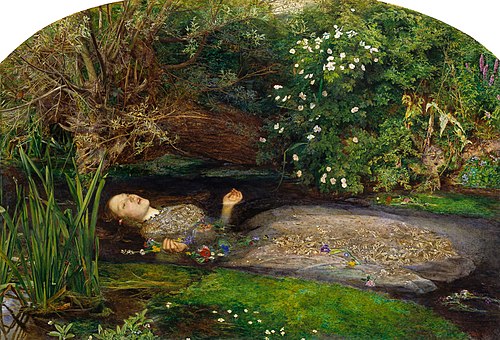
Image from Wikipedia

John Everett Millais in 1865, by Charles Dodgson (Lewis Carroll)

Study for the painting, 1852

An 1854 self-portrait by Elizabeth Siddal, who acted as Millais's model for Ophelia