Atomic nucleus
Source: WikipediaThe nucleus is an impossibly dense speck containing nearly all an atom’s mass within a fraction of its volume.
The nucleus is roughly 1/60,000th the diameter of a hydrogen atom, yet it accounts for almost the entire mass of the atom. To visualize this scale, if an atom were expanded to the size of a large stadium, the nucleus would be a small marble at center field, while the rest of the stadium would be virtually empty, occupied only by a sparse cloud of electrons.
Despite the vast range of elements, the density of the nucleus remains relatively constant. Whether it is a light hydrogen atom or a heavy uranium atom, protons and neutrons pack together like hard marbles in a tight bag. This concentration of matter is so extreme that the resulting density is billions of times greater than any bulk material found on Earth’s surface.
Rutherford’s gold foil experiment shattered the "Plum Pudding" model by proving atoms have a solid, charged heart.
In 1911, Ernest Rutherford upended the prevailing belief that atoms were soft spheres of positive charge with electrons scattered inside like fruit in a pudding. By firing alpha particles at thin gold foil, he expected them to pass straight through with minimal deviation. Instead, many particles were deflected at extreme angles, and some even bounced directly back toward the source.
Rutherford famously likened this result to firing a 15-inch artillery shell at a piece of tissue paper and having it come back and hit you. He concluded that the atom’s positive charge and mass could not be spread out; they had to be concentrated in a tiny, central "kernel" or nucleus. This discovery shifted physics from a vague understanding of atomic matter to a specific model of a nuclear atom.
A desperate tug-of-war between the strong force and electromagnetism determines if a nucleus holds together.
Protons are all positively charged, meaning they naturally want to fly apart due to electromagnetic repulsion. The only thing preventing the nucleus from exploding is the "residual strong force"—a powerful attraction that acts like a short-range glue between nucleons. However, this glue has a very limited reach, effectively dropping to zero just beyond the edge of the nucleus.
This range limit creates a ceiling for atomic size. Because the "glue" only works over distances of a few femtometers, it loses its grip as a nucleus grows too large. Lead-208 is the largest completely stable nucleus known; beyond this size, the electromagnetic repulsion of the protons begins to overwhelm the short-range nuclear force, leading to the instability and decay seen in heavier radioactive elements.
Neutrons act as a nuclear "buffer," providing the extra glue necessary to keep protons from flying apart.
While protons define an element's chemical identity, neutrons are the essential stabilizers. They contribute to the strong nuclear force without adding any repulsive electrical charge, effectively acting as a "buffer" that helps hold the protons together. By varying the number of neutrons, nature creates isotopes—atoms of the same element that share the same chemistry but differ in weight and stability.
At the extreme edges of stability, nuclei can form "halos," where extra neutrons or protons orbit at a distance from the central core. These halo nuclei, such as Lithium-11, are extremely short-lived and fragile. They represent the "drip lines" of physics—the absolute boundary where a nucleus can no longer hold onto its constituent particles.
Physicists treat the nucleus like a "Liquid Drop" because the fundamental math of the subatomic world is too complex to solve.
Even though we know the nucleus is made of quarks and gluons, the math required to calculate the behavior of a heavy nucleus from scratch (Quantum Chromodynamics) is currently too difficult for modern computers. Instead, scientists use simplified models, such as the Liquid Drop model, which treats the nucleus as a rotating droplet of incompressible fluid.
The Liquid Drop model is surprisingly effective at explaining binding energy and nuclear fission by accounting for factors like surface tension and electrical repulsion. However, no single model is perfect. While some treat the nucleus like a liquid, others (the Shell Model) treat it like a mini-solar system with energy levels. This theoretical gap means that nuclear physics remains a field of "best-fit" models rather than a single, perfectly solved equation.

A model of an atomic nucleus showing it as a compact bundle of protons (red) and neutrons (blue), the two types of nucleons. In this diagram, protons and neutrons look like little balls stuck together, but an actual nucleus (as understood by modern nuclear physics) cannot be explained like this, but only by using quantum mechanics. In a nucleus that occupies a certain energy level (for example, the ground state), each nucleon can be said to occupy a range of locations.

A figurative depiction of the helium-4 atom with the electron cloud in shades of gray. In the nucleus, the two protons and two neutrons are depicted in red and blue. This depiction shows the particles as separate, whereas in an actual helium atom, the protons and neutrons form a spherically symmetric distribution, with the result that the nucleus is spherically symmetric.
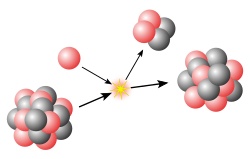
Image from Wikipedia

Image from Wikipedia