Noam Chomsky
Chomsky revolutionized the study of the mind by proving that language is a biological instinct rather than a learned behavior.
Chomsky revolutionized the study of the mind by proving that language is a biological instinct rather than a learned behavior.
In the 1950s, the dominant "behaviorist" view held that children learn language through trial, error, and reinforcement from their parents. Chomsky dismantled this consensus, arguing that the "poverty of the stimulus"—the fact that children learn complex grammar despite limited exposure—suggests humans are born with a "universal grammar." This shift triggered the Cognitive Revolution, moving the focus of psychology from external behavior to internal mental structures.
His landmark 1957 work, Syntactic Structures, introduced transformational grammar, which treats language as a system of rules that can generate an infinite variety of sentences. By categorizing languages into a "Chomsky hierarchy" based on their computational complexity, he bridged the gap between linguistics, mathematics, and computer science, earning him the title "the father of modern linguistics."
He redefined the role of the public intellectual as a "consistent critic" of state power and corporate influence.
He redefined the role of the public intellectual as a "consistent critic" of state power and corporate influence.
Chomsky’s transition from academic to activist was cemented during the Vietnam War. In his 1967 essay, "The Responsibility of Intellectuals," he argued that those with the privilege of education have a moral obligation to expose government lies and analyze the hidden motives of state violence. This stance made him a hero of the New Left, leading to multiple arrests and a spot on President Richard Nixon’s "enemies list."
His political philosophy is rooted in anarcho-syndicalism—the belief that all forms of hierarchy must justify their existence or be dismantled. This skepticism extends to contemporary capitalism, which he views as a system that prioritizes corporate profits over human needs. Over six decades, he has remained a prolific author of more than 150 books, maintaining a relentless critique of U.S. foreign policy as a form of imperialism.
The "Propaganda Model" explains how democratic media systems filter information to manufacture public consent.
The "Propaganda Model" explains how democratic media systems filter information to manufacture public consent.
Collaborating with Edward S. Herman in the book Manufacturing Consent, Chomsky argued that "fake news" isn't the primary problem in democracies; rather, it is the systematic framing of "acceptable" opinion. They identified five filters—including corporate ownership, advertising revenue, and "flak" (organized pressure)—that ensure the media serves elite interests without the need for overt government censorship.
Under this model, the media does not tell people what to think, but rather what to think about. By narrowing the spectrum of debate, the system allows for lively discussion within a strictly defined "corridor of opinion," effectively marginalizing radical or anti-corporate perspectives while maintaining the appearance of a free press.
A radical commitment to free speech and anti-imperialism has made him one of the most polarizing figures in modern history.
A radical commitment to free speech and anti-imperialism has made him one of the most polarizing figures in modern history.
Chomsky’s defense of "unconditional" free speech led to the "Faurisson affair" in the 1980s, where he was heavily criticized for defending the legal right of a Holocaust denier to publish. He maintained that defending the right to express even "loathsome" views is the only way to protect the principle of free speech for everyone, though the controversy led to accusations of personal bias.
Similarly, his analysis of international atrocities is often viewed through the lens of Western complicity. He has faced intense scrutiny for his commentary on the Cambodian and Bosnian genocides, where critics argue he downplayed certain crimes to focus on the hypocrisy of Western intervention. Despite these controversies, he remains one of the most cited living authors, respected by supporters as a "secular saint" of the left and dismissed by critics as a radical ideologue.
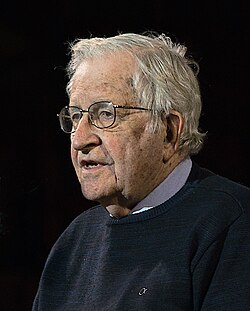
A photograph of Noam Chomsky
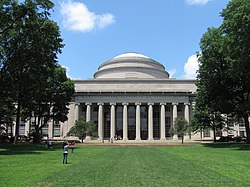
The Great Dome at the Massachusetts Institute of Technology (MIT); Chomsky began working at MIT in 1955.

Portrait of Chomsky, c. 1961

Portrait of Noam Chomsky, c. 1969

Chomsky in 1977

Chomsky speaking in support of the Occupy movement in 2011
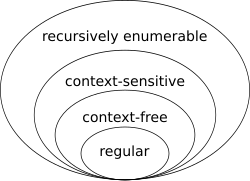
Set inclusions described by the Chomsky hierarchy
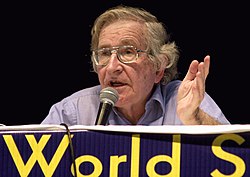
Chomsky at the 2003 World Social Forum, a convention for counter-hegemonic globalization, in Porto Alegre

Wasserman and Chomsky in 2014

Chomsky cautions against ignoring the threats of climate change and nuclear war in the wake of Donald Trump's election, in a 2017 speech.

Chomsky receiving an award from the president of the Nuclear Age Peace Foundation, David Krieger (2014)