No Country for Old Men
The film subverts Western conventions by denying the audience a traditional final confrontation between hero and villain.
The film subverts Western conventions by denying the audience a traditional final confrontation between hero and villain.
Unlike standard Hollywood thrillers, the protagonist (Llewelyn Moss) and the antagonist (Anton Chigurh) never actually share a scene of dialogue or a final showdown. The Coen brothers were specifically drawn to Cormac McCarthy’s novel because it "subverted genre," ignoring formulaic expectations where the "good guy" and "bad guy" eventually meet. This structural choice emphasizes the "pitiless quality" of the story, where violence is sudden, mechanical, and often occurs off-screen or away from the central characters.
This refusal to follow the "rules" extends to the ending. Sheriff Ed Tom Bell, the moral center of the story, arrives at the site of Moss's death too late to intervene. The narrative concludes not with a triumph of justice, but with a somber retirement and the quiet recitation of dreams, signaling that the world has become too violent for the "old men" tasked with guarding it.
The Coen brothers prioritized physical action and procedural detail over dialogue to reveal character.
The Coen brothers prioritized physical action and procedural detail over dialogue to reveal character.
A hallmark of the film is its extreme minimalism. Large sequences—such as Moss tracking a wounded animal or Chigurh meticulously cleaning his own wounds—take place in near-total silence. Director Joel Coen noted that they were fascinated by the "physical work" characters do to survive. These actions reveal more about their competence, desperation, and internal logic than any expository dialogue could.
This lack of script-based "acting" was a point of anxiety for the cast. Josh Brolin initially feared that without dialogue to "rest upon," he might become boring to watch. However, this restraint forces the audience to pay closer attention to the landscape and the "classicism" of the cinematography, creating a tension that is driven by what the characters do rather than what they say.
The title and themes are rooted in a lament for a lost era of moral coherence.
The title and themes are rooted in a lament for a lost era of moral coherence.
The title is lifted from the opening line of W.B. Yeats's poem "Sailing to Byzantium," which describes a "country" that neglects the wisdom of the past in favor of the sensory impulses of the young. In the film, Sheriff Bell acts as the chronicler of this transition. He represents an older generation of lawmen who find the new, motiveless brutality of criminals like Chigurh to be "out of alignment" with anything they understand.
While the film is a neo-Western, it functions as a meditation on fate versus agency. Chigurh’s use of a coin toss to decide the lives of his victims suggests that human life is subject to cold, mathematical chance. When Carla Jean Moss refuses to call the toss, she challenges this philosophy, insisting that the choice to kill remains a human responsibility, not a whim of fate.
Strategic "compression" of the source material focused the narrative on its three central archetypes.
Strategic "compression" of the source material focused the narrative on its three central archetypes.
The adaptation is remarkably faithful—Ethan Coen joked that one brother would type while the other held the book open—but they made surgical cuts to sharpen the film's impact. They removed a teenage runaway character and much of Sheriff Bell’s internal backstory. This "compression" turned the film into a leaner, more visual experience that gives the three leads (the hunter, the hitman, and the lawman) more space to dominate the screen.
One notable change from the book was the characterization of Carla Jean Moss. In the novel, she "falls apart" when confronted by Chigurh. In the film, Kelly Macdonald portrays her with a "quiet acceptance." Having already lost her husband and mother, she meets her fate with a dignity that makes Chigurh’s rigid adherence to his "vow" appear even more robotic and detached.

Josh Brolin, with a rifle in one hand and a briefcase in the other, is running through a field at night with lights behind him while the face of Javier Bardem can be seen above him. "No Country For Old Men" (no quotes) is shown in white text below Brolin.

Javier Bardem (left) with the Coen brothers at the 2007 Cannes Film Festival
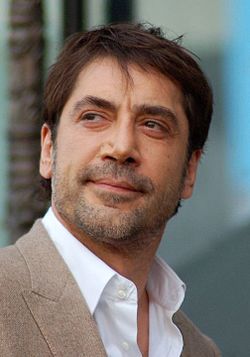
Javier Bardem's performance as Anton Chigurh received critical acclaim, earning him the Academy Award for Best Supporting Actor, thus becoming the first Spanish actor to win an Academy Award.