Neoclassicism
Neoclassicism was fueled by the literal excavation of antiquity and the intellectual rigor of the Enlightenment.
Neoclassicism was fueled by the literal excavation of antiquity and the intellectual rigor of the Enlightenment.
The movement was born in Rome during the mid-18th century, sparked by the rediscovery of Pompeii and Herculaneum. These archaeological breakthroughs provided a tangible link to a "lost" world, which theorist Johann Joachim Winckelmann synthesized into a new aesthetic philosophy. He argued that the only way for modern artists to become "inimitable" was to imitate the ancients, specifically praising the "noble simplicity and calm grandeur" of Greek art.
This was more than an art trend; it was the visual arm of the Age of Enlightenment. As European students completed their "Grand Tour" of Italy, they returned home with Greco-Roman ideals of reason and order. They sought to replace the complex, religious-heavy themes of previous eras with a secular, civic-minded focus on virtue and logic.
The movement prioritized "noble simplicity" as a moral and aesthetic antidote to the perceived decadence of the Rococo style.
The movement prioritized "noble simplicity" as a moral and aesthetic antidote to the perceived decadence of the Rococo style.
Before Neoclassicism, the dominant style was Rococo—a world of asymmetry, ornate curves, and playful frivolity. Neoclassicists viewed this as "insipid" or morally bankrupt. In response, they championed a return to symmetry and austerity. In architecture, this meant clean lines and mathematical proportions; in music, like the operas of Christoph Willibald Gluck, it meant stripping away unnecessary vocal ornamentation to focus on the raw drama of the chorus.
By the late 18th century, the style became synonymous with revolutionary and republican virtues. In France, Jacques-Louis David used Neoclassical severity to paint the Oath of the Horatii, a work that celebrated self-sacrifice and duty to the state. The movement rebranded "simplicity" not as a lack of skill, but as a sign of intellectual and moral clarity.
Painters and sculptors faced opposite challenges: a total lack of ancient painting models versus a confusing abundance of Roman copies.
Painters and sculptors faced opposite challenges: a total lack of ancient painting models versus a confusing abundance of Roman copies.
Because almost no Ancient Greek paintings survived, Neoclassical painters had to invent the style from scratch. They looked to bas-relief sculptures and pottery for cues, or borrowed the "classicizing" style of Renaissance masters like Raphael. This led to a "frieze-like" quality in painting, where figures were arranged in a shallow plane with sharp outlines, almost as if they were made of stone.
Sculptors, conversely, were overwhelmed by models. However, they were often looking at the "wrong" things: most of the "Greek" statues they admired were actually later Roman copies of Hellenistic works. This created a paradox where sculptors like Antonio Canova and Bertel Thorvaldsen were chasing a "pure" Greek ideal that was actually a Roman interpretation. Despite this, their work achieved a level of technical perfection and "idealized" beauty that dominated the 19th-century art market.
What was marketed as "pure" Greek art was actually a sanitized version of reality mediated through "corrected" drawings.
What was marketed as "pure" Greek art was actually a sanitized version of reality mediated through "corrected" drawings.
In the 18th century, Greece was part of the Ottoman Empire and was considered dangerous and difficult to visit. Most Neoclassicists never saw the Parthenon in person. Instead, their understanding of Greek architecture was mediated through engravings and drawings. These illustrators often "cleaned up" or "corrected" the ruins in their sketches, smoothing out irregularities to fit the Enlightenment’s demand for perfect geometry.
Furthermore, the movement largely ignored Archaic Greek art and late antiquity, cherry-picking only the "High Classical" period that fit their narrative of cultural maturity. This "filtered" antiquity meant that Neoclassicism was less a mirror of the past and more a projection of 18th-century values—order, stability, and "restored" perfection—onto ancient ruins.
Beyond a mere trend, Neoclassicism became the enduring aesthetic language of institutional power and national identity.
Beyond a mere trend, Neoclassicism became the enduring aesthetic language of institutional power and national identity.
While the movement eventually clashed with the emotional turbulence of Romanticism, its architectural influence never truly died. The "Empire style," popularized during Napoleon’s reign, spread across Europe and into the United States, where it became the "true style" of the new republic. It offered a sense of permanence and historical weight to young or transitioning nations.
Even into the 20th and 21st centuries, Neoclassicism remains the default setting for civic authority. From the federal buildings in Washington D.C. to the grand vistas of St. Petersburg, the style’s reliance on columns, domes, and symmetry continues to communicate power, stability, and the "timeless" values of Western civilization.

Image from Wikipedia
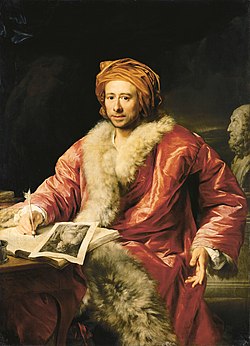
Johann Joachim Winckelmann, often called "the father of archaeology"

Fantasy View with the Pantheon and other Monuments of Ancient Rome; by Giovanni Paolo Panini; 1737; oil on canvas; 98.9 x 137.49 cm; Museum of Fine Arts, Houston, US

The ancient Capitol ascended by approximately one hundred steps . . .; by Giovanni Battista Piranesi; c.1750; etching; size of the entire sheet: 33.5 × 49.4 cm; Metropolitan Museum of Art, New York City

A Philosopher Lecturing on the Orrery; by Joseph Wright of Derby; c.1766; oil on canvas; 1.47 x 2.03 m; Derby Museum and Art Gallery, Derby, England

The Attributes of the Arts; by Anne Vallayer-Coster; 1769; oil on canvas; 90 x 121 cm; Louvre

Ariadne Abandoned; by Angelica Kauffmann; before 1782; oil on canvas; 88 x 70.5 cm; Gemäldegalerie Alte Meister, Dresden, Germany

Oath of the Horatii; by Jacques-Louis David; 1784; oil on canvas; 3.3 x 4.27 m; Louvre

Self-Portrait with a Harp; by Rose-Adélaïde Ducreux; 1791; oil on canvas; 193 x 128.9 cm; Metropolitan Museum of Art

Achilles mourning Patrocles; after John Flaxman; 1795; engraving after a drawing; unknown size; unknown location

Portrait of Jean-Baptiste Belley, Ex-Representative of the Colonies; by Anne-Louis Girodet; 1796–1797; oil on canvas; 1.59 x 1.11 m; Palace of Versailles, France

Cupid and Psyche; by François Gérard; 1798; oil on canvas; 186 x 132 cm; Louvre

Julie Lebrun as Flora; by Élisabeth Vigée Le Brun; c.1799; oil on canvas; 129.5 x 97.8 cm; Museum of Fine Arts (St. Petersburg, Florida), US

Portrait of a Black Woman, by Marie-Guillemine Benoist; 1800; oil on canvas; 81 x 65 cm; Louvre

Melancholy; by Constance Marie Charpentier; 1801; oil on canvas; 130 x 165; Musée de Picardie, Amiens, France