Nassim Nicholas Taleb
Taleb uses financial "jackpots" as a mechanism to maintain absolute intellectual independence.
Taleb uses financial "jackpots" as a mechanism to maintain absolute intellectual independence.
Unlike many academics who rely on institutional funding, Taleb’s career as a derivatives trader was a deliberate means to an end. By profiting immensely from rare market crashes—specifically Black Monday in 1987 and the financial crisis of 2008—he attained what he calls "freedom from authority." This financial independence allows him to operate as an "epistemologist of randomness," unconstrained by the social or professional pressures of traditional university or corporate life.
His trading strategy was never about steady, predictable gains; it was a physical manifestation of his philosophy. He famously endured long "dry spells" of small, controlled losses to position himself for massive payouts during moments of extreme volatility. This "tail risk hedging" eventually made him fabulously wealthy, transitioning him from a practitioner of mathematical finance to a full-time author and researcher.
History is driven by "Black Swans"—unpredictable events that carry massive impact and are rationalized only in hindsight.
History is driven by "Black Swans"—unpredictable events that carry massive impact and are rationalized only in hindsight.
Taleb’s central thesis revolves around the "Black Swan," a term he popularized to describe events that are outliers, carry an extreme impact, and are subject to "retrospective predictability"—the human tendency to concoct explanations for them after they happen to make them appear less random. He argues that almost everything of consequence in history, from the rise of the internet to major wars, follows this pattern.
He identifies a core cognitive error he calls the "Ludic Fallacy": the mistake of treating real-world uncertainty like a casino game or a textbook probability problem. In a casino, the risks are known and "structured." In reality, the most dangerous risks are the ones we cannot even imagine, making most predictive models—especially those used by economists and risk managers—not only useless but dangerous.
Survival requires "Antifragility," the ability of a system to actually grow stronger from shocks and disorder.
Survival requires "Antifragility," the ability of a system to actually grow stronger from shocks and disorder.
Beyond mere "robustness" (the ability to resist failure), Taleb introduced the concept of "Antifragility." While the fragile breaks under pressure and the robust stays the same, an antifragile system—like the human immune system or the process of "convex tinkering" in evolution—benefits from stressors, volatility, and disorder. He argues that by trying to eliminate all small risks, modern society actually makes itself more fragile to large-scale catastrophes.
To navigate this, he advocates for a "Barbell Strategy." Instead of taking "medium" risks (which he views as a trap because risk is uncomputable), he suggests being hyper-conservative in most areas while being hyper-aggressive in others. In finance, this looks like keeping 90% of assets in ultra-safe cash and 10% in highly speculative bets. This limits the downside while leaving the door open for massive "positive Black Swan" gains.
He wages a "War on Experts" against those who use theoretical models without facing the consequences of their errors.
He wages a "War on Experts" against those who use theoretical models without facing the consequences of their errors.
Taleb is a fierce critic of what he calls "Platonism"—the tendency to mistake the map for the territory. He views many academic fields, particularly economics and social sciences, as "pseudo-scientific" because they rely on Gaussian (Bell Curve) statistics that fail to account for "fat tails" or extreme events. He has famously called for the Nobel Prize in Economics to be abolished, arguing that economic theories can cause devastating real-world damage.
The solution he proposes is "Skin in the Game," the ethical and practical necessity of having a personal stake in one's decisions. He believes that society is currently endangered by "interventionistas"—bureaucrats and academics who make decisions for others but are insulated from the consequences if those decisions fail. For Taleb, true knowledge is gained through "stochastic tinkering" (decentralized trial and error) rather than top-down, directed research.
His worldview was forged by the sudden collapse of Levantine stability and the logic of options pricing.
His worldview was forged by the sudden collapse of Levantine stability and the logic of options pricing.
Taleb’s skepticism of "crisp, commoditized ideas" is rooted in his personal history. Born into a politically prominent Greek Orthodox family in Lebanon, he witnessed the country’s wealth and social order vanish almost overnight during the Lebanese Civil War. This early exposure to the fragility of systems deeply informed his later mathematical work on the "fourth quadrant" and the impossibility of predicting rare, high-impact disruptions.
His academic background bridges the gap between high-level theory and street-level reality. He holds an MBA from Wharton and a PhD from the University of Paris, where his dissertation focused on the mathematics of derivatives pricing. This unique combination of Lebanese "Levantine" skepticism, French mathematical rigor, and American market experience created the foundation for the Incerto, his five-volume philosophical investigation into uncertainty.
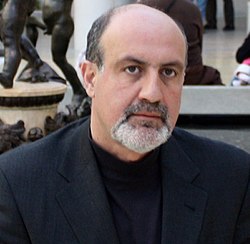
Image from Wikipedia

Taleb as a student

Genealogy map of topics treated by Nassim Taleb