My Lai massacre
A "search-and-destroy" mission was warped by intelligence failures and a culture of aggression.
A "search-and-destroy" mission was warped by intelligence failures and a culture of aggression.
Task Force Barker was deployed to Sơn Mỹ village to neutralize the Viet Cong’s 48th Local Force Battalion. Despite having no direct combat contact for months, the soldiers of Charlie Company were highly agitated, having suffered 28 casualties from mines and booby traps. On the eve of the attack, Captain Ernest Medina told his men that all civilians would be at the market by 7:00 AM; anyone remaining was to be considered a combatant or sympathizer.
The operational climate turned the village into a "free-fire zone," where the distinction between soldier and civilian was erased. Officers urged their troops to "wipe them out for good." Testimonies later revealed that many soldiers understood their orders as a mandate to kill everything "walking, crawling, or growling," including women, children, and livestock.
The slaughter was a systematic execution of unarmed villagers rather than a heat-of-battle crossfire.
The slaughter was a systematic execution of unarmed villagers rather than a heat-of-battle crossfire.
On the morning of March 16, 1968, U.S. troops landed in helicopters and entered the sub-hamlet of Xom Lang. Instead of the expected enemy battalion, they found families cooking breakfast. Without provocation or a single shot fired at them, the GIs began rounding up elderly men, women, and children. In one of the most infamous episodes, Lieutenant William Calley ordered a group of 70–80 villagers into an irrigation ditch and mowed them down with automatic weapons.
The violence was intimate and thorough. Soldiers used bayonets and grenades on people hiding in huts or praying near temples. To ensure the village could never support the enemy again, the troops burned every home and slaughtered the livestock. The only American casualty that day was a soldier who intentionally shot himself in the foot to avoid participating in the massacre.
Widespread sexual violence and mutilation underscored a total breakdown of military discipline.
Widespread sexual violence and mutilation underscored a total breakdown of military discipline.
Beyond the mass shootings, the Peers Commission later confirmed that at least 20 Vietnamese women and girls—some as young as ten—were raped or sexually tortured. These were not isolated incidents; they included gang rapes and occurred alongside the mutilation of bodies. In some instances, "C Company" was carved into the chests of victims.
This level of depravity suggests a collapse of the moral and legal framework that governs military conduct. While some soldiers refused to participate in the killings, they did not openly protest or report the crimes to their superiors at the time. This collective silence allowed the atrocities to continue throughout the morning across multiple hamlets, including My Lai 4 and My Khe 4.
A massive institutional cover-up left Lieutenant William Calley as the sole, lightly punished scapegoat.
A massive institutional cover-up left Lieutenant William Calley as the sole, lightly punished scapegoat.
The U.S. Army initially reported the event as a victorious battle against 128 Viet Cong. It took the persistence of veteran Ronald Ridenhour and investigative journalist Seymour Hersh to break the story to the American public in November 1969. The revelation prompted global outrage and significantly fueled domestic opposition to the Vietnam War, stripping away the military's moral high ground.
Legal accountability for the massacre was nearly non-existent. While 26 soldiers were eventually charged with criminal offenses, only Lieutenant William Calley Jr. was convicted. He was found guilty of murdering 22 villagers and sentenced to life in prison. However, after intervention by President Richard Nixon and a sentence commutation, he served only three-and-a-half years—all of it under house arrest.
Warrant Officer Hugh Thompson Jr. provided a rare instance of moral courage by threatening to fire on his own troops.
Warrant Officer Hugh Thompson Jr. provided a rare instance of moral courage by threatening to fire on his own troops.
Amidst the carnage, helicopter pilot Hugh Thompson Jr. and his two-man crew realized that U.S. ground forces were murdering civilians. In a stunning act of defiance against the chain of command, Thompson landed his helicopter between fleeing Vietnamese villagers and the advancing American soldiers. He ordered his door gunner to fire on his fellow GIs if they attempted to kill the civilians he was protecting.
Thompson successfully evacuated a small group of survivors and reported the massacre to his superiors, which eventually forced a "ceasefire" order that morning. For decades, Thompson was treated as a traitor by some in the military and the public; it was not until thirty years later that he was officially decorated for his bravery in stopping the massacre.
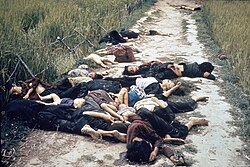
Image from Wikipedia

Sơn Mỹ operations, 16 March 1968

Photograph taken by Ronald L. Haeberle of South Vietnamese women and children in Mỹ Lai before being killed in the massacre. According to Haeberle, soldiers had attempted to rip the blouse off the woman in the back while her mother, in the front of the photo, tried to protect her.

An unidentified man and child who were killed on a road

Dead bodies outside a burning home

PFC Mauro, PFC Carter, and SP4 Widmer (Carter shot himself in the foot with a .45 pistol during the My Lai massacre.)

Visitors to the War Remnants Museum view enlarged photos of the massacre by Ronald Haeberle.

Monument of the My Lai Massacre in Sơn Mỹ, Vietnam

Image from Wikipedia