Mexican cuisine
Ancient Mesoamerican techniques like nixtamalization turned corn into a nutritional powerhouse that remains the foundation of the national diet.
Ancient Mesoamerican techniques like nixtamalization turned corn into a nutritional powerhouse that remains the foundation of the national diet.
Before the Spanish arrived, groups like the Olmec, Maya, and Aztec had already perfected the "three sisters" agricultural system of corn, beans, and squash. The most critical innovation was nixtamalization—soaking corn in an alkaline solution (like lime water). This process doesn't just make the corn easier to grind into masa; it unlocks essential B vitamins and minerals, preventing malnutrition and allowing complex civilizations to thrive.
Today, this ancient chemistry is still the heartbeat of the kitchen. While wheat and rice have been introduced, corn remains the primary grain, consumed mostly as tortillas but also as fermented drinks, tamales, and hominy soups. The biological synergy between corn and beans is also vital; together, they provide a complete protein source that has sustained the population for millennia.
The Spanish Conquest introduced livestock and frying, transforming indigenous ingredients into a global fusion of Mediterranean and Moorish flavors.
The Spanish Conquest introduced livestock and frying, transforming indigenous ingredients into a global fusion of Mediterranean and Moorish flavors.
Modern Mexican food is one of the world’s earliest "fusion" cuisines. The Spanish brought cows, pigs, goats, and sheep, along with dairy, rice, and sugar. Most importantly, they introduced the technique of frying in pork fat (lard), which radically changed the texture of indigenous dishes. This era also brought a hidden Muslim heritage via Spain: sweets like alfajores and churros have deep roots in Moorish culinary traditions.
This synthesis created distinct regional identities. In the north, Spanish-style ranching led to a culture of beef and wheat, while the south preserved more indigenous-heavy traditions. Influences didn't stop with Europe; the Manila-Acapulco Galleons and the Atlantic slave trade brought Asian and African flavors, further layering the complexity of what we now identify as "traditional" Mexican food.
Chile peppers are used for their vast spectrum of flavor and color rather than mere heat, defining the soul of the dish more than the protein itself.
Chile peppers are used for their vast spectrum of flavor and color rather than mere heat, defining the soul of the dish more than the protein itself.
In Mexican cooking, the sauce is the protagonist. Dishes like mole, adobo, and pipian are defined by their complex chile-based gravies; the meat or vegetable underneath is often secondary. Chiles are treated as a staple vegetable rather than a condiment. As the 16th-century friar Bartolomé de las Casas noted, the indigenous people did not feel they were eating a meal if it lacked chiles.
There is a sophisticated taxonomy of chiles—fresh, dried, smoked, and pickled—each providing a different profile. A pozole soup changes its entire identity from "white" to "green" or "red" based solely on the specific chile sauce used. This deep reliance on the pepper is a core pillar of national identity; most Mexicans believe their cultural essence would be lost without the specific "kick" and depth provided by their endemic varieties.
Traditional cooking is recognized as UNESCO heritage because it serves as a social glue, where "sazón" is considered a spiritual gift of commitment.
Traditional cooking is recognized as UNESCO heritage because it serves as a social glue, where "sazón" is considered a spiritual gift of commitment.
Mexican cuisine was the first to be inscribed on UNESCO’s Intangible Cultural Heritage list because it is inseparable from social structure. Cooking is rarely a solitary task; for major festivals like the Day of the Dead, teams of women may spend days preparing mole or tamales. This labor is viewed as an investment in community bonds.
The concept of sazón (seasoning) is more than just salt; it is a perceived "gift" of flavor that comes from experience and a sense of devotion to the diners. Even the dead are included in this social circle; traditional belief holds that during festivals, spirits return to consume the "essence" of the food left on altars. If the living eat the food afterward, it is said to have lost its flavor because the souls have already enjoyed it.
Street food offers a functional "utility" eating experience that strips away the elaborate social rituals of the home kitchen.
Street food offers a functional "utility" eating experience that strips away the elaborate social rituals of the home kitchen.
While home cooking is bound by tradition, gender roles, and four-meal-a-day schedules, Mexican street food (known as antojitos or "little cravings") is about immediate satisfaction. Tacos, the most famous export, originated from the pre-Hispanic habit of using tortillas as spoons. They are rarely eaten as a main meal at home; instead, they are the go-to fuel for the hours before midday or late at night.
Street food also solves a practical problem: many Mexican homes traditionally lacked ovens. Roasted chickens, barbacoa (meat cooked in pits), and carnitas are almost exclusively purchased from specialized vendors. This creates a unique ecosystem where the vendor-customer relationship becomes its own form of "fast-food" community, separate from the formal labor of the family table.

Chile en nogada, maize, tamales, pozole, mezcal, pan de muerto, and cóctel de camarón

Still-life with Fruit, Scorpion and Frog (1874) by Hermenegildo Bustos

Still-life, oil on canvas painting by José Agustín Arrieta (Mexican), c. 1870, San Diego Museum of Art

Ancient Mesoamerican engraving of maize, National Museum of Anthropology of México
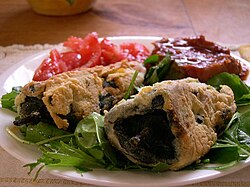
Chiles rellenos, stuffed chile peppers

A molcajete and tejolote, the traditional mortar and pestle of Mexico

Taco
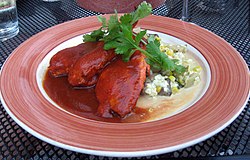
Pechuga adobada, chicken breast in adobo with a side of chayote, mushrooms, corn and poblano rajas. Adobo, including a key item, vinegar, arrived with the Spanish. A common characteristic of Mexican adobo is its incorporation of chile ancho.
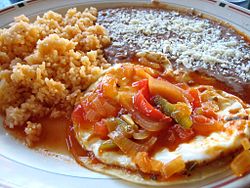
Huevos rancheros
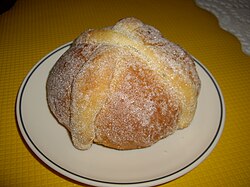
Pan de muerto is traditionally baked in Mexico during the weeks leading up to the Day of the Dead.

Chiles en nogada, due to the dish's incorporation of red, white and green, is popularly consumed during the celebrations of the Grito de Dolores. Tied to the independence of the country since it is said they were prepared for the first time to entertain the future emperor Agustín de Iturbide when he came to signing of the Treaty of Córdoba.

Barbacoa in Actopan, Hidalgo. The barbecue in a ground oven is a typical dish from the Mezquital Valley.

Fruit punch is popular around Christmas time during Las Posadas.
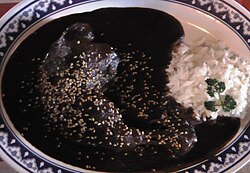
Mole sauce, with dozens of varieties across the Republic, is seen as a symbol of Mexicanidad and is considered Mexico's national dish.

Tamale