March on Washington
The march was a radical demand for economic parity, prioritizing "Jobs" as the prerequisite for "Freedom."
The march was a radical demand for economic parity, prioritizing "Jobs" as the prerequisite for "Freedom."
While remembered today primarily for its moral appeal, the event was officially the "March on Washington for Jobs and Freedom." Organizers A. Philip Randolph and Bayard Rustin argued that integration in schools and housing would remain hollow as long as fundamental economic inequality persisted. Their platform included remarkably modern-sounding demands: a national $2 minimum wage (roughly $21 today), a massive federal public works program to employ Black workers, and a Fair Labor Standards Act that eliminated racial discrimination in hiring.
This economic focus was the result of a deliberate expansion of goals. Initially conceived as a protest against joblessness, the agenda grew to encompass the broader civil rights movement to secure the backing of the NAACP and the Urban League. By linking the paycheck to the ballot box, the marchers framed poverty not as a personal failing, but as a systemic violation of civil rights.
A fragile "Big Ten" coalition bridged deep ideological divides to project a unified national front.
A fragile "Big Ten" coalition bridged deep ideological divides to project a unified national front.
The march was not the product of a monolithic movement but a high-stakes compromise between the "Big Six" civil rights leaders and four white allies from labor and religious sectors. This "Big Ten" group represented a volatile mix of philosophies: some leaders wanted aggressive civil disobedience to shut down the capital, while others, like Roy Wilkins of the NAACP, feared that radicalism would alienate the Kennedy administration and kill pending legislation.
To maintain unity, the more radical factions—the SNCC and CORE—agreed to drop plans for direct action in exchange for a seat at the table. Even the leadership structure was a compromise; Bayard Rustin, the movement's most brilliant strategist, was relegated to "deputy organizer" because his past as a former Communist and a gay man was considered a political liability. Despite these internal frictions, the group successfully synchronized over 200,000 participants into a single, peaceful voice.
Master strategist Bayard Rustin engineered a logistical miracle while navigating state-sponsored sabotage.
Master strategist Bayard Rustin engineered a logistical miracle while navigating state-sponsored sabotage.
Organizing a 250,000-person rally in 1963 was an analog feat of staggering complexity. Operating out of a Harlem headquarters, Rustin led a team of 200 volunteers who coordinated thousands of buses and special "Freedom Trains" from across the country. They managed everything from 4,000 volunteer marshals to the distribution of 42,000 promotional buttons. To prevent any excuse for police intervention, organizers even banned civil disobedience and discouraged participants from bringing signs that weren't officially approved.
This logistical precision occurred under intense pressure from the FBI. Director J. Edgar Hoover actively attempted to sabotage the march by "red-baiting" its leaders and warning celebrity backers that the organizers were Communist sympathizers. South Carolina Senator Strom Thurmond even launched a public attack on Rustin's character on the Senate floor. The fact that the event remained peaceful and orderly was a calculated victory against those who predicted—and perhaps hoped for—a riot.
The demonstration functioned as a high-stakes pressure tactic to force the federal government out of "tokenism."
The demonstration functioned as a high-stakes pressure tactic to force the federal government out of "tokenism."
In 1963, many civil rights leaders felt betrayed by the Kennedy administration, viewing the President’s race policy as "tokenism" rather than true reform. The march was timed to coincide with the 100th anniversary of the Emancipation Proclamation, highlighting the century-long delay in full citizenship. After a disastrous meeting between Attorney General Robert F. Kennedy and Black cultural leaders like James Baldwin, it became clear that Washington politicians lacked a visceral understanding of the racial crisis.
The march effectively forced the federal government's hand. Though President Kennedy initially warned against the "atmosphere of intimidation" a crowd might create, the sheer scale and discipline of the event shifted the national narrative. It provided the political capital necessary to push the Civil Rights Act of 1964 and the Voting Rights Act of 1965 through a resistant Congress, forever changing the relationship between the federal government and the Southern system of Jim Crow.

Image from Wikipedia
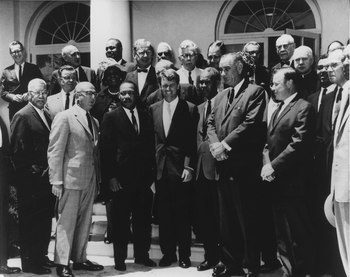
Leaders of the March on Washington meeting with Vice President Lyndon B. Johnson and Attorney General Robert F. Kennedy at the White House on June 22, 1963.

Leaders of the march in front of the statue of Abraham Lincoln: (sitting L-R) Whitney Young, Cleveland Robinson, A. Philip Randolph, Martin Luther King Jr., and Roy Wilkins; (standing L-R) Mathew Ahmann, Joachim Prinz, John Lewis, Eugene Carson Blake, Floyd McKissick, and Walter Reuther

Aerial view of Washington Monument showing marchers

Close up of some leaders of the March on Washington walking along Constitution Avenue.

Leaders arrived late and linked arms in front of marchers on Constitution Avenue.

Nearly 250,000 people marched, including 60,000 white participants

March on Washington for Jobs and Freedom program

John Lewis speaking in the Great Hall of the Library of Congress on the 50th anniversary, August 28, 2013

Martin Luther King Jr. waving his hand to the crowd after delivering his "I Have a Dream" speech

Actress/singer Lena Horne was present but excluded from speaking.
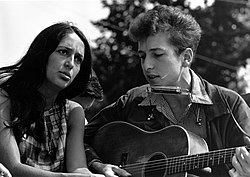
Joan Baez and Bob Dylan performing at the March on Washington

Kennedy meets with march leaders. Left to Right – Willard Wirtz, Matthew Ahmann, Martin Luther King Jr., John Lewis, Rabbi Joachin Prinz, Eugene Carson Blake, A. Philip Randolph, President John F. Kennedy, Vice President Lyndon Johnson, Walter Reuther, Whitney Young, Floyd McKissick, Roy Wilkins (not in order)

Leaders of the March on Washington speak to the news media after meeting with President Kennedy at the White House.

Leaders of the march leading marchers down the street