Mad Max: Fury Road
Fury Road survived a 27-year "development hell" defined by global crises and casting shifts.
Fury Road survived a 27-year "development hell" defined by global crises and casting shifts.
George Miller first conceived the film in 1987, but the project spent nearly three decades stalled by external forces. Early attempts to shoot in the 2000s were thwarted by the economic fallout of the September 11 attacks and the logistical restrictions of the Iraq War. These delays eventually aged out the original star, Mel Gibson, and allowed his personal controversies to further distance him from the role.
The production finally gained momentum in 2007, but even then, it faced environmental hurdles. Originally slated to shoot in the Australian outback, record-breaking rainfall turned the desert into a lush field of wildflowers, forcing the entire production to relocate to the starker landscapes of Namibia. By the time it reached theaters in 2015, the film had evolved from a potential 20th Century Fox project to a Warner Bros. blockbuster.
Director George Miller prioritized visual-first storytelling using 3,500 storyboards and center-framed cinematography.
Director George Miller prioritized visual-first storytelling using 3,500 storyboards and center-framed cinematography.
Before a traditional screenplay was ever finalized, Miller worked with storyboard artists to map out 3,500 panels—roughly the same number as the shots in the final edit. Miller’s goal was a "continuous chase" with minimal dialogue, designed so that even a non-English speaker could understand the plot through pure visual movement.
To maintain clarity during the film's frenetic editing, cinematographer John Seale used "center-framing." By keeping the primary point of interest in the middle of every frame, Seale ensured the audience didn't have to search the screen for the action, allowing for faster cuts without causing visual confusion. This was Seale’s first digital project, for which he came out of retirement, using a mix of high-end Arri Alexas and cheap consumer "crash cams" for the most dangerous stunts.
The production utilized 150 fully functional vehicles and 90% practical effects to achieve a visceral reality.
The production utilized 150 fully functional vehicles and 90% practical effects to achieve a visceral reality.
In an era of CGI-heavy blockbusters, Fury Road relied on physical stunts and practical engineering. Production designer Colin Gibson oversaw the creation of 150 custom vehicles, all of which were fully functional and designed to withstand the harsh Namibian desert. These included the "War Rig"—a 78-foot eighteen-wheeler fused with various car bodies—and the "Doof Wagon," which featured a wall of speakers and a flame-throwing guitar that actually worked.
The commitment to physical reality extended to the cast. Because Miller wanted to ground the film’s feminist themes in lived experience, he invited Eve Ensler (author of The Vagina Monologues) to advise the actors on the psychology of violence against women. This ensured that while the spectacle was high-octane, the character motivations—specifically the "wives" fleeing domestic enslavement—remained emotionally resonant.
The film redefined the "Mad Max" legacy, sweeping the Academy Awards and launching a new cinematic saga.
The film redefined the "Mad Max" legacy, sweeping the Academy Awards and launching a new cinematic saga.
Despite its troubled production, Fury Road became the highest-grossing film in the franchise, earning $380.4 million. It was a rare action film to achieve "prestige" status, receiving ten Academy Award nominations and winning six, primarily in technical categories like Film Editing and Production Design. Critics frequently cite it as one of the greatest action films ever made due to its pacing and world-building.
The success of the film revitalized the dormant franchise, leading to a prequel comic series and the 2024 prequel film, Furiosa: A Mad Max Saga. By shifting the focus from Max as a traditional protagonist to a "universal donor" supporting Furiosa’s mission, the film expanded the lore of the Wasteland beyond simple survival to a story about the reclamation of humanity.
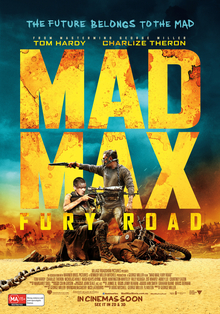
A man muzzled, standing and pointing a gun in one direction. A woman crouched beside him pointing her gun in the opposite direction. The title in large letters fills background.

Cast and crew attending the premiere of the film at the 2015 Cannes Film Festival

Director George Miller during the shooting of the film in 2012