Las Meninas
The painting captures a seemingly casual "snapshot" of the Spanish court that belies a rigid, highly choreographed hierarchy.
The painting captures a seemingly casual "snapshot" of the Spanish court that belies a rigid, highly choreographed hierarchy.
Set in the Royal Alcazar of Madrid, the work centers on the five-year-old Infanta Margaret Theresa. She is surrounded by a specialized entourage: two meninas (maids of honor), a chaperone, a bodyguard, two dwarfs, and a sleepy Spanish mastiff. While some figures interact, others—including the Infanta and the artist himself—stare directly out of the canvas, breaking the "fourth wall."
Art historian F. J. Sánchez Cantón suggests this is a specific room in the palace that served as Velázquez’s studio. The scene feels like a candid moment—perhaps the princess was brought in to relieve the boredom of her parents' portrait sitting—but every figure is placed with mathematical precision within a perspective grid, creating a complex "box" of space.
Velázquez uses the canvas to demand a shift in social status, transforming the painter from a craftsman into an intellectual aristocrat.
Velázquez uses the canvas to demand a shift in social status, transforming the painter from a craftsman into an intellectual aristocrat.
In 17th-century Spain, painting was legally classified as a manual craft, putting artists on the same social level as carpenters. Velázquez spent 33 years working his way up the court of Philip IV, eventually becoming the palace chamberlain. By depicting himself in the same room as the royal family, holding the tools of his trade, he was making a bold claim that painting was a noble, intellectual pursuit.
The red cross on his chest represents the Order of Santiago, a prestigious knighthood he didn't actually receive until three years after the painting was finished. Legend says that after Velázquez died, King Philip IV himself ordered the cross to be painted onto the figure as a final mark of respect for his friend and "theology of painting."
The central mirror creates a visual paradox that forces the viewer to occupy the same physical space as the King and Queen.
The central mirror creates a visual paradox that forces the viewer to occupy the same physical space as the King and Queen.
The most debated element of the work is the mirror on the back wall, which reflects the upper bodies of King Philip IV and Queen Mariana. If the mirror reflects the "real" people standing where the viewer is now, it means we are standing exactly where the King and Queen are standing. This creates an uncertain relationship between the viewer and the painted space.
Alternatively, some scholars believe the mirror is reflecting the large canvas Velázquez is seen working on within the painting. This "meta-painting" approach suggests that Velázquez is actually painting the very portrait of the King and Queen that we see in the reflection. This layers of illusion are why the work is often described as the "philosophy of art."
Hidden within the background are mythological warnings about the dangers of mortals challenging the gods of art.
Hidden within the background are mythological warnings about the dangers of mortals challenging the gods of art.
The dim back wall is hung with copies of paintings by Rubens depicting scenes from Ovid’s Metamorphoses. Specifically, they show Minerva Punishing Arachne and Apollo's Victory Over Marsyas. Both stories involve mortals who were foolish enough to challenge gods to contests of skill (weaving and music) and suffered terrible consequences.
These aren't just background fillers; they serve as a "theology of painting." They underscore the divine nature of artistic talent and perhaps serve as a humble nod from Velázquez to his king, suggesting that while the artist is great, he is still a subject to the "god-like" authority of the Spanish Monarchy.
A survivor of fire and "restoration riots," the canvas has evolved from a private royal family portrait into a protected national icon.
A survivor of fire and "restoration riots," the canvas has evolved from a private royal family portrait into a protected national icon.
For centuries, the painting was known simply as "The Family." It survived the 1734 fire that destroyed the Alcázar palace, though it had to be cut down on the sides and the Infanta’s left cheek was almost entirely repainted. It wasn't until 1843, after entering the Museo del Prado, that it received its current title, Las Meninas.
The painting is so central to Spanish identity that a 1984 cleaning by a British conservator sparked a "small riot" outside the museum. Critics argued that only a Spaniard could truly "comprehend" the work well enough to touch it. Today, the painting is considered too fragile and culturally significant to ever be lent to other museums, remaining a permanent anchor of the Prado.

Image from Wikipedia

The Infanta Margaret Theresa (1651–1673), in mourning dress for her father in 1666, by del Mazo. The background figures include her young brother Charles II and the dwarf Maria Bárbola, also in Las Meninas. She left Spain for her marriage in Vienna the same year.

Detail showing Philip IV's daughter, the Infanta Margaret Theresa. Most of her left cheek was repainted after being damaged in the fire of 1734.
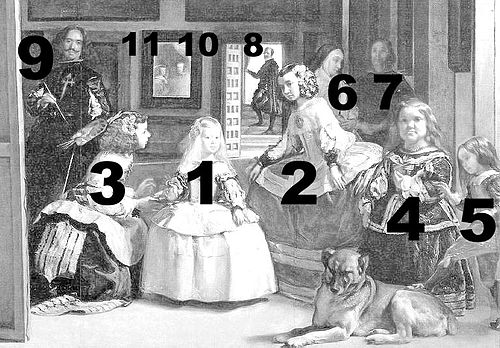
Key to the people represented: see text

Detail showing Don José Nieto Velázquez at the door in the background of the painting

Detail of the mirror hung on the back wall, showing the reflected images of Philip IV and his wife, Mariana of Austria

Detail of Doña María de Sotomayor, showing Velázquez's free brushwork on her dress

Detail of the mirror in van Eyck's Arnolfini Portrait. Van Eyck's painting shows the pictorial space from "behind", and two further figures in front of the picture space, like those in the reflection in the mirror in Las Meninas.

In the Arnolfini Portrait (1434), Jan van Eyck uses an image reflected in a mirror in a manner similar to Velázquez in Las Meninas.
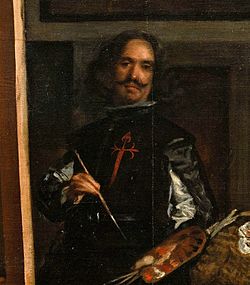
Detail showing the red cross of the Order of Santiago painted on the breast of Velázquez. Presumably this detail was added at a later date, as the painter was admitted to the order by the king's decree on 28 November 1659.

Velázquez's Christ in the House of Martha and Mary, 1618. The smaller image may be a view to another room, a picture on the wall, or a reflection in a mirror.
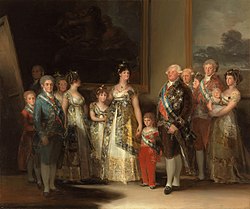
Francisco Goya's Charles IV of Spain and His Family references Las Meninas, but is less sympathetic towards its subjects.

John Singer Sargent, The Daughters of Edward Darley Boit, 1882, Boston Museum of Fine Arts

During 1957 Pablo Picasso painted 58 recreations of Las Meninas.